The Influence of Competence, Compensation, and Leadership Style on the Performance of Village Officials in North Candi Laras District
DOI:
https://doi.org/10.26618/4fqk8352Abstract
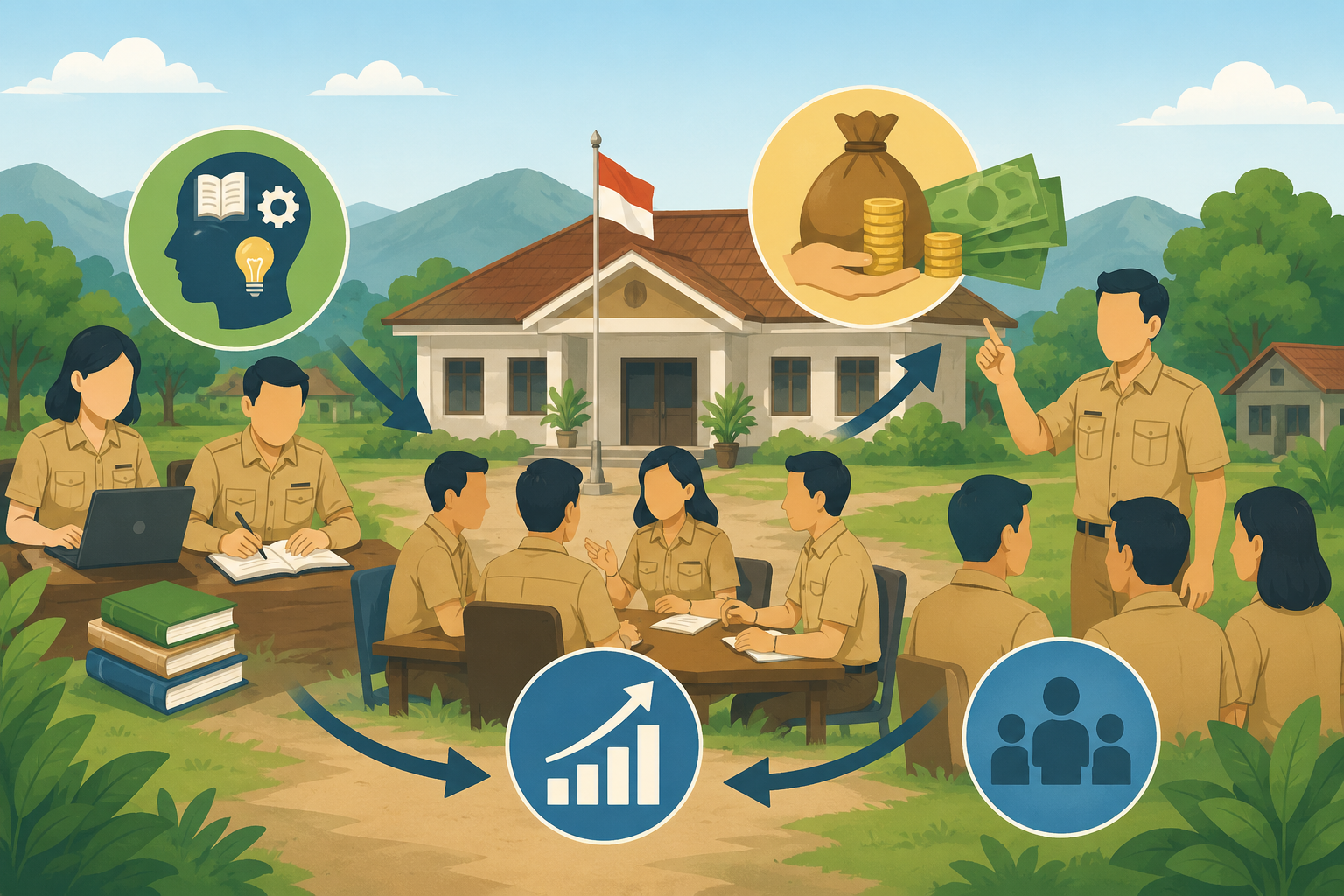
Village apparatus performance is a crucial factor in supporting the effectiveness of village governance and the quality of public services. However, several issues remain evident, including low attendance rates, delays in administrative reporting, and suboptimal public service performance among village officials in North Candi Laras District. This study aims to examine the effects of employee competence, compensation, and leadership style on village apparatus performance in North Candi Laras District, Tapin Regency. A quantitative approach with an explanatory research design was employed. The study involved 54 village apparatus members selected through a stratified random sampling technique. Data were collected using questionnaires and analyzed through multiple linear regression. The results reveal that employee competence, compensation, and leadership style each have a positive and significant effect on village apparatus performance. Simultaneously, these three variables also exert a significant influence on performance improvement. The findings indicate that enhancing employee competence, providing fair compensation, and implementing effective leadership practices are essential factors in improving village apparatus performance. This study contributes to the human resource management literature in the public sector, particularly in the context of village governance.
Downloads
Published
Issue
Section
License
In the event that the article is accepted by the Editorial Team of KIMAP: Scientific Review of Public Administration, with registration number ISSN 2746-0460 (online) and there is a decision to publish the article, the copyright of the article passes to KIMAP: Scientific Review of Public Administration, with registration number ISSN 2746-0460 (online).
The Department of Public Administration, Faculty of Social and Political Sciences, Universitas Muhammadiyah Makassar in collaboration with the Indonesian Association for Public Administration (IAPA) as the publisher of the Scientific Review of Public Administration, with registration number ISSN 2746-0460 (online) holds the copyright to all articles published in this journal.
The Department of Public Administration, Faculty of Social and Political Sciences, University of Muhammadiyah Makassar in collaboration with the Indonesian Association for Public Administration (IAPA) has the right to reproduce and distribute this article and the author is not allowed to republish the same article that has been published in this journal.
Manuscript Authenticity and Copyright Statement can be downloaded: Click Here
After filling out the statement, please send it via email: kimap@unismuh.ac.id