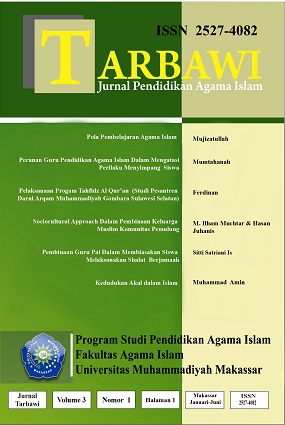
Kedudukan Akal dalam Islam
DOI: https://doi.org/10.26618/jtw.v3i01.1382
Abstract
Abstrak
Allah swt., menganugerahkan akal kepada seluruh manusia yang merupakan kelebihan manusia dibanding dengan makhluk-makhluk-Nya yang lain. Dengan menggunakan akalnya manusia dapat membuat hal-hal yang dapat mempermudah urusan mereka di dunia. Tetapi segala yang dimiliki manusia sudah tentu ada keterbatasan-keterbatasan sehingga ada batas-batas yang tidak boleh dilewati. Meskipun Islam sangat memperhatikan dan memuliakan akal, tetapi tidak menyerahkan segala sesuatu kepada akal, bahkan Islam membatasi ruang lingkup akal sesuai dengan kemampuannya, karena akal terbatas jangkauannya, tidak akan mungkin bisa menjangkau hakekat segala sesuatu. Maka Islam menundukkan akal terhadap Wahyu dan Sunnah Nabi saw., artinya di dalam segala hal wahyu dan sunnah harus di dahulukan.
Kata kunci: Kedudukan Akal, Islam
Abstract
Allah swt., Conferring reason to all human beings who are superior human beings compared to His other creatures. By using the wisdom of man can make things that can ease their affairs in the world. But everything that man has is of course there are limitations so there are boundaries that should not be passed. Although Islam is very concerned and glorifies the intellect, it does not surrender everything to the intellect, even Islam limits the scope of reason according to its ability, because the reason is limited in its reach, it will not be possible to reach the essence of all things. So Islam subjects reason to the Revelation and the Sunnah of the Prophet , meaning in all things the revelation and the sunnah should be first.
Keywords: The position of Intellect , Islam
References
DAFTAR PUSTAKA
Al-Maraghi, Ahmad Mustafa. Tafsir Al-Maraghi. 1993. Semarang: PT. Karya Toha Putra.
Al-Wahidiy al-Naisabury, Abi al-Hasan Ali bin Ahmad. 1991. Asbab al-Nuzul. Beirut: Dar al-Fikr.
Departemen Agama. 1996. Al-Qur’an dan Terjemahannya. Semarang: Toha Putera.
Goleman, Daniel. 2001. Kecerdasan emosional. Bandung:Prima.
Katsir al Quraisy al-Dimasyqi, Abi al-Fida’ Ismail. 1986. Tafsir Ibnu Katsir, Jilid 1. Makkah al-Mukarramah: al-Maktabah al-Tijariyah.
Khalaf, Abd al-Wahab. 1987. Ilmu Ushul Fiqh. Mesir: Dar al Ma’arif.
Khaldun, Ibnu. 1999. Muqaddimah Jilid III. t.tp.
Khalil, Munawwar. 1975. Salafiyah. Jakarta: Bulan Bintang.
Nasution, Harun. 1986. Akal dan
Wahyu Dalam Islam. Jakarta: UI Pres.
-------------.1994. Asas-asas Kurikulum. Jakarta: Bumi Aksara.
Shihab, M. Quraish. 2000. Logika Agama. Bandung: Lentera Hati.
Zabadiy, al-Fayruz. 1952. Al-Qamus Al-Muhith, cetakan II. Mesir: Al-Halabiy
Downloads
Published
Issue
Section
License
In the event that an article is accepted by the Editorial Team of TARBAWI: Jurnal Pendidikan Agama Islam, registered under ISSN 2527-4082 (Print) and ISSN 2622-920X (Online), and a decision is made to publish the article, the copyright of the article remains with the author(s).
The Islamic Religious Education Study Program, Faculty of Islamic Studies, Universitas Muhammadiyah Makassar, as the publisher of TARBAWI: Jurnal Pendidikan Agama Islam, holds the publication rights for all articles published in this journal.
The Islamic Religious Education Study Program, Faculty of Islamic Studies, Universitas Muhammadiyah Makassar, as the publisher of TARBAWI: Jurnal Pendidikan Agama Islam, registered under ISSN 2527-4082 (Print) and ISSN 2622-920X (Online), has the right to reproduce and distribute the articles, and the author(s) are not permitted to publish the same article elsewhere once it has been published in this journal.
The Statement of Originality and Copyright Form can be downloaded
: here
After completing the statement form, please send it via email to: jurnaltarbawipai@gmail.com