
Efficiency effectiveness of PPh 21 reporting via taxation digitalization in state institutions using value for money
Article Sidebar
Main Article Content
Abstract
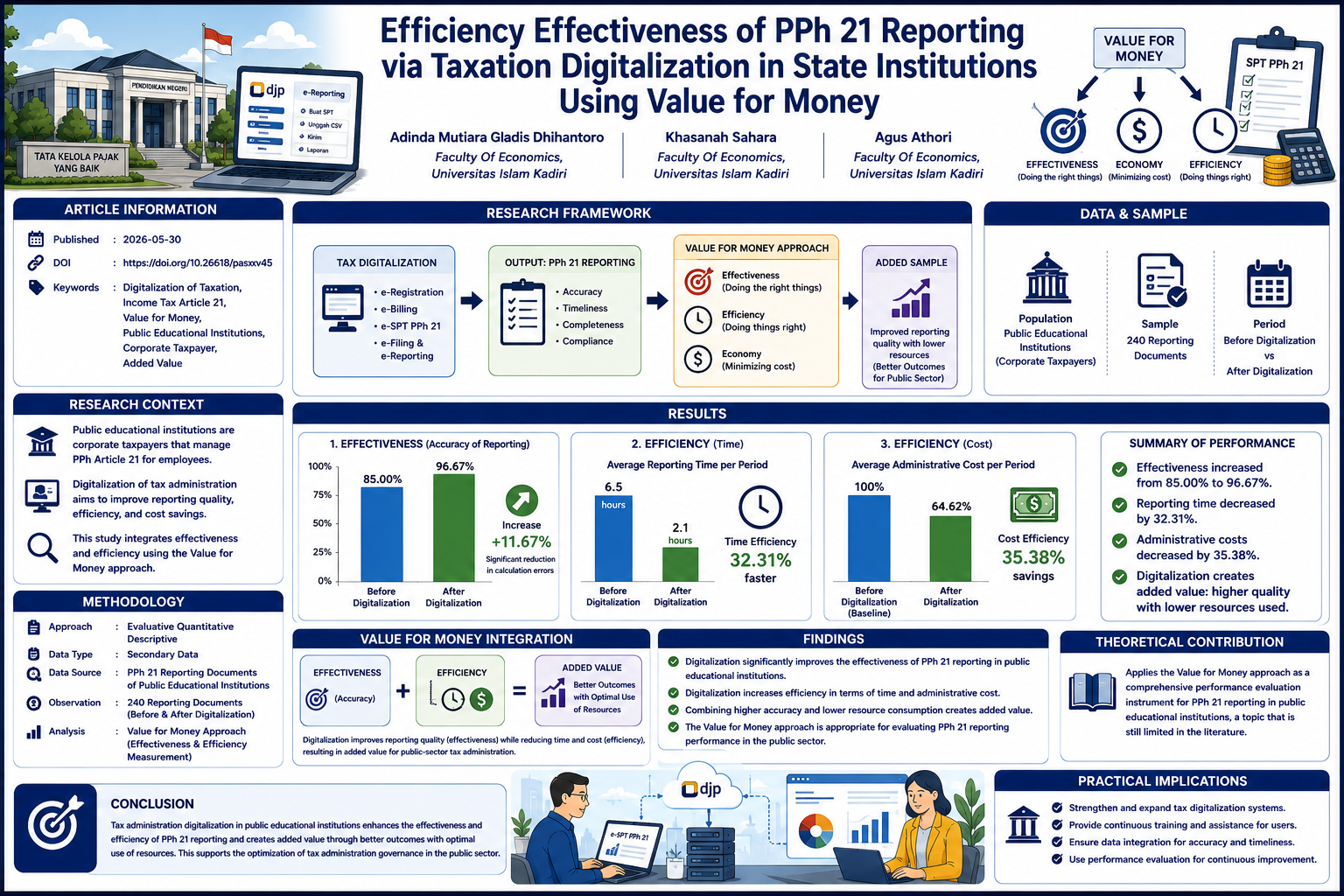
The digitalization of tax administration has become a strategic reform to improve the quality of public-sector tax governance through greater efficiency and effectiveness. This study examines the effectiveness and efficiency of Income Tax Article 21 (PPh 21) reporting after the implementation of tax digitalization in public educational institutions using the Value for Money framework. Unlike previous studies that primarily focus on individual taxpayers or private organizations, this research evaluates public educational institutions as public-sector corporate taxpayers by integrating effectiveness and efficiency into a unified performance assessment. A quantitative descriptive evaluative approach was employed using 240 secondary administrative documents, comprising 120 reporting records before and 120 after digitalization. Data were analyzed using effectiveness and efficiency ratios, followed by an interpretation based on the Value for Money concept. The findings reveal that digitalization significantly improved reporting effectiveness from 85.00% to 96.67%, indicating a substantial decline in tax calculation errors and greater compliance with reporting standards. Moreover, the average reporting time decreased from 6.5 hours to 2.1 hours per reporting cycle, producing a time efficiency ratio of 32.31%, while administrative costs declined by 35.38%. These improvements demonstrate that digital tax administration enhances reporting accuracy while simultaneously optimizing the utilization of institutional resources. The study concludes that the implementation of digital taxation fulfills the Value for Money principles by generating higher-quality tax reporting with lower resource consumption. This research contributes to the literature by extending the application of the Value for Money framework to evaluate digital tax administration performance in public educational institutions and provides practical evidence to support the optimization of digital taxation policies and public-sector financial governance.
Downloads
Article Details
Section

This work is licensed under a Creative Commons Attribution-NonCommercial-NoDerivatives 4.0 International License.
References
Abdixhiku, L., & Krasniqi, B. A. (2023). Digital transformation and tax administration efficiency in developing economies. Journal of Public Budgeting, Accounting & Financial Management, 35(4), 512–531.
Alm, J., & Malézieux, A. (2021). Forty years of tax compliance research: A review and assessment. Public Finance Review, 49(5), 635–670.
Bastian, I. (2021). Akuntansi sektor publik. Erlangga.
Bird, R. M., & Zolt, E. M. (2021). Technology and tax administration in developing countries. ICTD Working Paper Series.
Bovens, M., Goodin, R. E., & Schillemans, T. (2023). The Oxford handbook of public accountability (2nd ed.). Oxford University Press.
Direktorat Jenderal Pajak. (2016). Peraturan Direktur Jenderal Pajak Nomor PER-16/PJ/2016 tentang Tata Cara Pemotongan, Penyetoran, dan Pelaporan Pajak Penghasilan Pasal 21. Direktorat Jenderal Pajak.
Direktorat Jenderal Pajak. (2022). Modernisasi sistem administrasi perpajakan. Kementerian Keuangan Republik Indonesia.
Direktorat Jenderal Pajak. (2024). Core Tax Administration System (Coretax). Kementerian Keuangan Republik Indonesia.
Direktorat Jenderal Pajak. (2024). Modernisasi administrasi perpajakan. Kementerian Keuangan Republik Indonesia.
Ghozali, I. (2018). Aplikasi analisis multivariate dengan program IBM SPSS. Badan Penerbit Universitas Diponegoro.
Hai, D. T., Nguyen, T. H., & Tran, P. H. (2024). Digital transformation and public sector performance: Evidence from tax administration. Government Information Quarterly, 41(2), 101932.
Halim, A., & Kusufi, M. S. (2014). Akuntansi sektor publik. Salemba Empat.
Hesami, S., Mardani, A., Streimikiene, D., & Zavadskas, E. K. (2024). Digital government transformation and public sector performance: A systematic literature review. Government Information Quarterly, 41(1), 101889.
Kementerian Keuangan Republik Indonesia. (2007). Undang-Undang Nomor 28 Tahun 2007 tentang Ketentuan Umum dan Tata Cara Perpajakan.
Kementerian Keuangan Republik Indonesia. (2023). Laporan kinerja Direktorat Jenderal Pajak Tahun 2023.
Lestari, N., & Dewi, P. (2022). Digitalisasi layanan perpajakan dan kepatuhan wajib pajak. Jurnal Riset Akuntansi.
Mahmudi. (2019). Manajemen kinerja sektor publik (3rd ed.). UPP STIM YKPN.
Mardiasmo. (2019). Perpajakan. Andi.
Nugraha, T. (2023). Digitalisasi pajak dan efisiensi administrasi sektor publik. Jurnal Perpajakan Indonesia.
Nurhayati, E., & Hidayat, A. (2020). Pengaruh penerapan sistem administrasi perpajakan modern terhadap kepatuhan wajib pajak. Jurnal Akuntansi dan Keuangan Publik, 7(2), 85–96.
Nuryanah, S., Siregar, S. V., & Harahap, S. N. (2023). Public financial accountability and digital governance in Indonesia. Journal of Asian Public Policy, 16(3), 401–420.
OECD. (2021). Supporting the digitalisation of developing country tax administrations. OECD Publishing.
OECD. (2023). Digital transformation in tax administration. OECD Publishing.
OECD. (2024). Tax administration digitalisation and digital transformation initiatives. OECD Publishing.
Pratama, Y. (2024). Implementasi Coretax dalam administrasi perpajakan Indonesia. Jurnal Perpajakan Modern, 5(1), 21–38.
Putri, R. A., & Pratama, A. (2021). Efektivitas dan efisiensi pelaporan pajak berbasis elektronik pada sektor publik. Jurnal Akuntansi Pemerintahan, 5(1), 45–58.
Rahmawati, L. (2022). Analisis efisiensi administrasi perpajakan berbasis digital. Jurnal Administrasi Negara, 28(2), 189–205.
Republik Indonesia. (2008). Undang-Undang Nomor 36 Tahun 2008 tentang Pajak Penghasilan.
Resmi, S. (2023). Perpajakan: Teori dan kasus (13th ed.). Salemba Empat.
Siregar, B. (2017). Akuntansi sektor publik. UPP STIM YKPN.
Sugiyono. (2019). Metode penelitian kuantitatif, kualitatif, dan R&D. Alfabeta.
United Nations. (2022). E-Government Survey 2022: The future of digital government. United Nations.
Waluyo. (2022). Perpajakan Indonesia (14th ed.). Salemba Empat.
World Bank. (2022). Digital government and tax reform. World Bank.
World Bank. (2023). GovTech Maturity Index 2023: Digital transformation in public administration. World Bank.
Zhang, Y., Chen, X., & Li, J. (2023). Digital governance and public sector performance: Evidence from emerging economies. Public Administration Review, 83(5), 1124–1140.