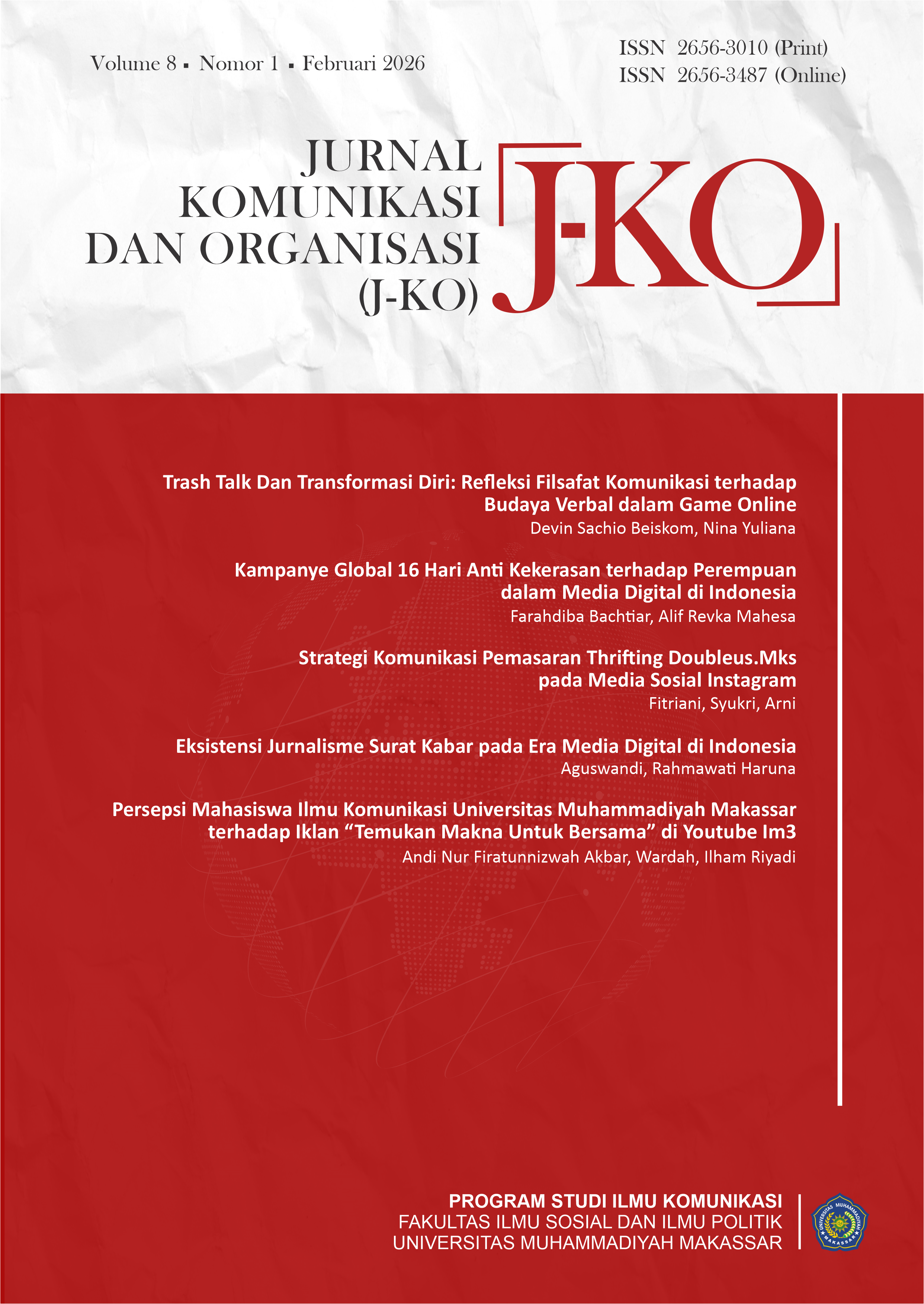
Trash Talk Dan Transformasi Diri: Refleksi Filsafat Komunikasi Terhadap Budaya Verbal Dalam Game Online
DOI:
https://doi.org/10.26618/sz1vae91Keywords:
trash talk, communication philosophy, verbal culture, self-transformation, online gamesAbstract
Trash talk has become an integral element of communication among online gamers and is often perceived as a spontaneous expression triggered by competitive tension. However, its influence extends far beyond momentary emotional reactions, shaping how players communicate, construct their identities, and negotiate social meaning within virtual and real-life interactions. This study aims to examine the verbal culture of trash talk through the lens of communication philosophy by exploring its ontological, epistemological, and axiological dimensions, while also integrating perspectives from symbolic interactionism, speech act theory, and constructivism. Using a literature review method, this article analyzes various studies that address verbal behavior in online games, digital communication ethics, and the linguistic impact of gaming on players’ character and social interactions. The findings indicate that trash talk is not merely an emotional outburst, but a symbolic communicative practice that emerges through repeated interactions within gamer communities. The use of harsh language and specific expressions contributes to the formation of shared meanings and group identity, functioning as markers of social positioning in digital competition. Conversely, this phenomenon reveals shifts in values and ethical challenges, as the normalization of verbal aggression risks influencing players’ attitudes, emotional responses, and interpersonal behavior. This study highlights the importance of a philosophical perspective to understand trash talk more comprehensively, particularly regarding how it constructs meaning, shapes social relations, and contributes to players’ self-transformation within the increasingly dominant culture of online gaming.
References
Adnan Anugrah, I., Arianto, A., & Karnay, S. (2024). Perilaku Komunikasi Toxic Pengguna Game Online “Arena of Valor.” Jurnal Penelitian Inovatif, 4(3), 997–1002. https://doi.org/10.54082/jupin.467
Ambarwati, M., Rahman, A., Sebelas, U., & Surakarta, M. (2022). Trash-Talking Pemain Mobile Legends : Bang Bang Mahasiswa FKIP UNS. Jurnal Ilmu Sosial Dan Humaniora, 5, 243–255.
Anhar, Hasanah, R., & Aprilia, R. P. (2024). Pengaruh Interaksi Virtual Terhadap Pembentukan Bahasa Slang Di Komunitas Gamer Indonesia : Perspektif Sosiolinguistik. Jurnal Intelek Insan Cendekia, 3821–3829.
Bustomi, Sukardi, I., & Astuti, M. (2024). Pemikiran Konstruktivisme Dalam Teori Pendidikan Kognitif Jean Piaget Dan Lev Vygotsky. Jurnal Review Pendidikan Dan Pengajaran, 7, 16376–16383.
Fitrianugroho, D., Sopianti, J., Razanah, Faza, M., Fauziah, N., & Sudrajat, R. (2023). Krisis Perkembangan Bahasa Sebab Hadirnya Game Online. Jurnal Sosial Dan Sains, 3, 638–643.
Hamama, S. (2024). Etika Komunikasi dalam Media Sosial: Tantangan dan Solusinya. Selasar KPI : Referensi Media Komunikasi Dan Dakwah, 4(2), 182–197.
Kartini, Aqil Ramadhan, I., Bas Praptama, R., Salsabila, K., Atsni Sudarmansyah, H. M., Ul Jannah, L., Arifin Nasution, M. S., Fajar, K., & Tadzkiya Aulia. (2024). Filsafat Komunikasi, Sistematika Berfikir dan Fenomena Komunikasi. Da’watuna: Journal of Communication and Islamic Broadcasting, 4(3), 1414–1425. https://doi.org/10.47467/dawatuna.v4i3.1197
Octavina, Tri, M., Harianto, S., & Jacky, M. (2024). Ketimpangan Pendidikan dan Peluang Kerja : Perspektif Teori Interaksionisme Simbolik. Jurnal Penelitian Ilmu-Ilmu Sosial Dan KeIslaman, 10(1).
Pratama, C. A., & Pribadi, M. A. (2024). Interaksi Simbolik pada Perencanaan Komunikasi : Studi Kasus Distributor Beras. 160–168.
Putri, F., Trixie Sonia Hakim, Carenin Coshilia Firmanda, Irsanti Joenitasari Bercha Akbar, Devita Srihandayani, & Eppy Setiyowati. (2023). Dampak Toxic Game Terhadap Trash Talking Remaja. Jurnal Pendidikan Modern, 8(2), 70–75. https://doi.org/10.37471/jpm.v8i2.686
Ramadhan, R. F., Dalimunthe, R. Z., & Conia, P. D. D. (2023). Hubungan kecanduan game online mobile legends terhadap perilaku trash talking. Diversity Guidance and Counseling Journal, 1(2), 1–11.
Rimadona, F., Wulandari, C., & Yulistio, D. (2025). Tindak Tutur pada Interaksi Guru dan Siswa dalam Pembelajaran Bahasa Indonesia Kelas VIII di SMPN 5 Bengkulu Tengah. Jurnal Ilmiah Korpus, 9(1), 197–211.
Safitri, R. D., Mulyani, M., & Farikah. (2021). Teori tindak tutur dalam studi pragmatik. 1(1), 59–67.
Sari, A. F. (2020). Etika Komunikasi: Menanamkan Pemahaman Etika Komunikasi kepada Mahasiswa. TANJAK: Journal of Education and Teaching, 1(2), 127–135.
Setiawan, Y. L., Nasir, J., & Putra, R. H. (2024). Komunikasi Virtual melalui Perilaku Trash-Talking Antar Pemain Game Online Mobile Legends. … Jurnal Penelitian Dan …, 05, 133–141.
Solihin, S. (2024). Analisis Perilaku Trash-Talk Dalam Komunikasi Virtual Pada Game Online Mobile Legends. Jurnal.Ittc.Web.IdS SolihinJurnal Ilmu Komunikasi Dan Sosial Politik, 2024•jurnal.Ittc.Web.Id, 02(02), 146–160.
Syafitri, E., Armanto, D., & Rahmadani, E. (2021). Aksiologi Kemampuan Berpikir Kritis. Journal of Science and Social Research, 4(3), 320.
Tohari, B., & Rahman, A. (2024). Konstruktivisme Lev Semonovich Vygotsky dan Jerome Bruner : Model Pembelajaran Aktif dalam Pengembangan Kemampuan Kognitif Anak. Nusantara: Jurnal Pendidikan Indonesia, 4(1).
Unwakoly, S. (2022). Berpikir Kritis Dalam Filsafat Ilmu: Kajian Dalam Ontologi, Epistemologi dan Aksiologi. Jurnal Filsafat Indonesia, 5(2), 95–102. https://doi.org/10.23887/jfi.v5i2.42561
Zaad, M., & Arni, A. (2025). Perilaku Komunikasi Toxic Remaja yang Bermain Game Online Mobile Legends Pulau Barrang Lompo Kecamatan Kepulauan Sangkarrang Kota Makassar. Jurnal Komunikasi Dan Organisasi (J-KO), 7(1), 15–20. https://doi.org/10.26618/jko.v7i1.1758
Downloads
Published
Issue
Section
License

This work is licensed under a Creative Commons Attribution-NonCommercial-ShareAlike 4.0 International License.
Authors who submit manuscripts to the Jurnal Komunikasi dan Organisasi (J-KO) fully understand and agree that, upon acceptance for publication, the copyright of the article shall be transferred to the Jurnal Komunikasi dan Organisasi (J-KO) and the Faculty of Social and Political Sciences, Universitas Muhammadiyah Makassar, as the journal's publisher. Authors are required to submit a signed Copyright Transfer Agreement as part of the publication process. It can be downloaded: Click Here




 2656-3010