
Tax Compliance of MSMEs in Makassar: Digitalization and Tax Literacy with Trust as a Moderating Variable
Article Sidebar
Main Article Content
Abstract
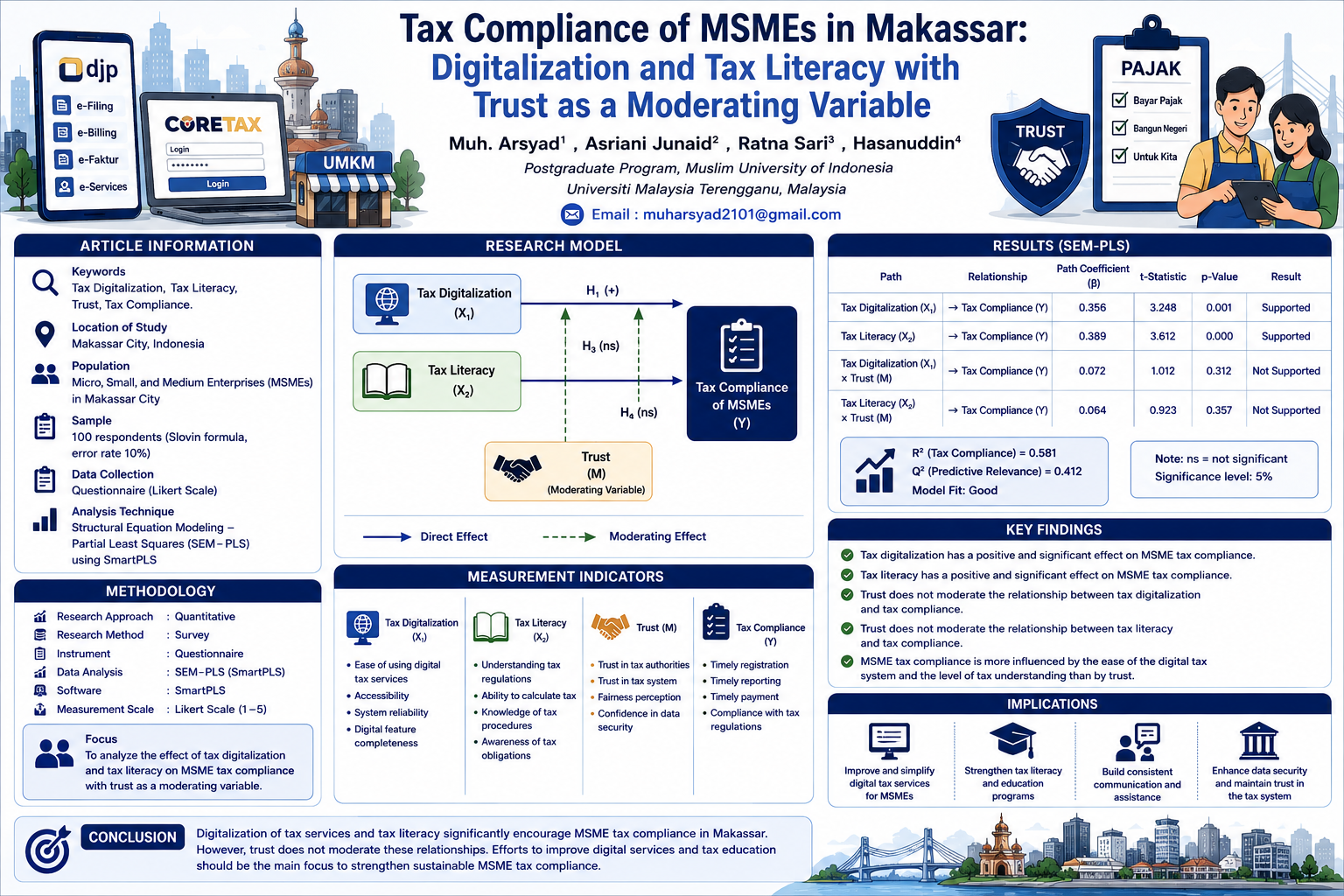
Tax compliance is a crucial factor in optimizing state revenue, particularly from the Micro, Small, and Medium Enterprises (MSMEs) sector, which significantly contributes to the national economy. In the digital era, the government continues to promote tax administration transformation through various technology-based services to improve the ease and effectiveness of fulfilling tax obligations. However, MSMEs still face various challenges related to tax understanding and trust in tax authorities. This study aims to analyze the impact of tax digitalization and tax literacy on MSME tax compliance in Makassar City and examine the role of trust as a moderating variable. The study employed a quantitative approach with a survey method. The study population comprised small businesses (MSMEs) in Makassar City. A sample of 100 respondents was determined using the Slovin formula with a 10% error rate. Data were collected through questionnaires and analyzed using Structural Equation Modeling–Partial Least Squares (SEM-PLS) with the help of the SmartPLS application. The results of the study indicate that tax digitalization has a positive and significant impact on MSME tax compliance. Tax literacy was also shown to have a positive and significant impact on tax compliance. However, trust did not moderate the relationship between tax digitalization and tax compliance, nor did it moderate the relationship between tax literacy and tax compliance. These findings suggest that MSME tax compliance is more influenced by the ease of the digital tax system and the level of tax understanding than by trust. This study provides implications for tax authorities to continuously improve the quality of digital services and tax education programs to strengthen MSME tax compliance sustainably.
Downloads
Article Details
Section

This work is licensed under a Creative Commons Attribution-NonCommercial-NoDerivatives 4.0 International License.
References
Abdullah, UZF, & Anggoro, RW (2025). The Influence of Mental Accounting, Tax Literacy, Tax Digitalization, and Social Media on Individual Tax Compliance. Journal of Accounting and Management , 36 (1), 15–29. https://doi.org/10.53916/jam.v36i1.157
Afrinia, A., Analisa, A., Novianty, N., & Yusri, Y. (2024). The Effect of Taxpayer Trust Level and Environment on Tax Compliance with Intention as a Moderating Variable. Journal of Business Economics, Management and Accounting (JEBMA) , 4 (3), 2072–2079. https://doi.org/10.47709/jebma.v4i3.4474
Agusetiawati, WD, Askandar, NS, & Nandiroh, U. (2024). The Influence of Tax Education, Digital Literacy, and the E-Filling System on Individual Taxpayer Compliance. Scientific Journal of Accounting Vol. , 13 (01), 680–691.
Aini, AN, Suhatmi, EC, & Meikhati, E. (2025). The Influence of Trust in Government, Tax Literacy, and Tax Digitalization on Taxpayer Compliance. Journal of Accounting and Taxation , 26 (01), 1–10.
Amanda, O., Ananda Viarna, F., Sari, IK, Riski, M., Saputra, A., & Fionasari, D. (2024). The Influence of Tax Literacy, Tax Morale, and Tax Sanctions on MSME Taxpayer Compliance in Pekanbaru. AKTIVA Accounting Journal , 5 (1), 86–95. www.riau.gp.id
Amelia, R., & Budi Yanti, H. (2025). The Influence of Digitalization, Literacy, and Sanctions on Taxpayer Compliance with Moderation Awareness. Trisakti Journal of Economics , 5 (2), 961–972. https://doi.org/10.25105/v5i2.23726
Annisa, I., & Wijaya, S. (2024). Moral Obligation, Tax Fairness, and Government Trust in Taxpayer Compliance. Journal of Accounting, Finance, and Management (JAKMAN) , 5 (4), 341–355.
Barlan, AR, Laekkeng, M., & Sari, R. (2021). The Effect of Tax Sanctions, Income Level, and Tax Knowledge on Motor Vehicle Taxpayer Compliance at the Samsat Office of Polewali Mandar Regency. Journal of Islamic Economics and Business , 4 (2), 1–6.
Ciptawan, Parerungan, SD, & Hantono. (2025). The Impact of Digital Taxation Policy on MSME Tax Reporting in the Platform Economy Era . 6 (2), 456–465.
Davis, F.D. (1989). Perceived usefulness, perceived ease of use, and user acceptance of information technology. MIS Quarterly , 13(3) (319–340).
Elfriska, Armel, RS, & Samsiah, S. (2025). The Effect of Tax Literacy, Tax Morale, and Tax Socialization on Taxpayer Compliance with Tax Digitalization as a Moderator. Al-Khitmah Journal of Economics , 5 (02), 84–98. https://doi.org/10.47701/bismak.v5i01.5386
Gunardi, Eri Febriani, SK, & Framesthi, DB (2025). Digitalization of Tax Administration and Its Impact on MSME Compliance in Bandung City. Journal of Office Administration and Secretariat , 3 (2).
Hindayani, N., & Arum, M. (2025). The Influence of Tax Literacy and Taxpayer Awareness on Tax Compliance of MSMEs in North Jakarta. JAB , 4 (6), 8764–8774.
Imanda, AN, Alrasyid, H., & Sari, AFK (2025). The Influence of Tax Literacy, Digitalization, and Tax Service Quality on Taxpayer Compliance in Sidoarjo Regency. e_Journal of Accounting Research , 14 (01), 639–649.
Ismawati, I., Indriana, I., Rosidi, R., & Rusydi, MK (2023). Determining Factors of COVID-19 Budget Fraud in Makassar City. Asia Pacific Fraud Journal , 8 (2), 351. https://doi.org/10.21532/apfjournal.v8i2.300
Karina, M., Wirawan, EG, & Yulik, R. (2024). Tax Digitalization in the Technology Era. Taxation.Binus.Ac.Id.
Kusumadewi, Rahmawati, D., & Dyarini, D. (2022). The Influence of Tax Literacy, Modernization of the Administrative System, Tax Incentives, and Tax Morale on MSME Taxpayer Compliance. Journal of Accounting and Finance , 10 (2), 171. https://doi.org/10.29103/jak.v10i2.7182
Lasahido, A. (2024). Tax digitalization. Kompas.id. https://www.kompas.id/baca/opini/2024/02/26/20240226las%0Adigitalisasi-pajak
Latuheru, JB (2023). The effect of tax literacy on taxpayer compliance of MSMEs in Ambon City moderated by tax sanctions. Management and Entrepreneurship Studies , 6 (2), 81–99.
Lolita Siregar, Sarwani, S., & Rahma Yuliani. (2025). The Influence of Perceived Tax Service Quality, Tax Sanctions, Tax Compliance Costs, E-Filing Implementation, Tax Understanding, and Trust on Taxpayer Compliance. Edunomics Journal , 6 (1), 18–37. https://doi.org/10.37304/ej.v6i1.18836
Mardhatilla, DP, Marundha, A., & Eprianto, I. (2023). The Influence of Tax Literacy, Tax Administration System, and Sanctions on MSME Taxpayer Compliance. Jurnal Economina , Vol.2 No.2 , 1–12.
Mufarrokhah, S., Mawardi, MC, & Nandiroh, U. (2024). The Impact of Tax Planning, Digitalization of Tax Services, and Religiosity on Taxpayer Compliance (Saidatul). e_Jurnal Ilmiah Riset Akuntansi , 13 (01), 107–115. http://jim.unisma.ac.id/index.php/jra
Nasution, WK, & Purnamasari, DI (2023). The Influence of Tax Knowledge and Taxpayer Awareness on Village-Owned Enterprises' Tax Compliance . 5 (2), 180–189.
Nichita, A., Batrancea, L., Pop, C.M., Batrancea, I., Morar, D., Masca, E., Roux-Cesar, A.M., Forte, D., Aderito, A., Morar, I.D., Masca, E., Roux-Cesar, A.M., Forte, D., Formigoni, H., & Roux-Cesar, A.M. (2021). We learn not for school but for life: Empirical evidence of the impact of tax literacy on tax compliance. Eastern European Economics , 57 (2).
Nurfadillah, Bakri, AA, Basalamah, MSA, & Junaid, A. (2024). The Influence of Tax Knowledge, Tax Rates, and Trust in the Government on Tax Compliance of MSMEs in Kolaka City. Journal of Economics Center Students , 6 (4), 2621 – 8186.
Putri Mardhatilla, D., Marundha, A., & Eprianto, I. (2023). The Influence of Tax Literacy, Tax Administration System, and Sanctions on MSME Taxpayer Compliance. Jurnal Economina , Vol.2 No.2 , 1–12.
Rachmawati, T., & Shelvi. (2025). Does Public Trust Drive Voluntary Tax Compliance? A Study of Indonesian Taxpayers. Jia , 22 (1), 31–48.
Rizal, M., Permana, N., & Qalbia, F. (2024). Tax System Transformation in the Digital Era: Challenges, Innovations, and Adaptive Policies. CITIZEN: Indonesian Multidisciplinary Scientific Journal , 4 (4), 340–348. https://doi.org/10.53866/jimi.v4i4.648
Rizalti, SM, & Iskandar, D. (2025). The Influence of Taxpayer Awareness, Level of Trust in the Government, and Tax Sanctions on MSME Tax Compliance. Gorontalo Accounting Journal , 8 (1), 165. https://doi.org/10.32662/gaj.v8i1.3546
Rosyid, MA, Pangesti, I., Hasanah, N., & Siti Mastutik. (2024). The Influence of Digitalization on Compliance and Implementation of Tax Laws in Indonesia. Journal of Administrative Law , 5 , 265–280.
Simongkir, RTMC (2023). A Study of Taxpayers at the Pondok Aren Primary Tax Service Office. Dewantara Journal of Management & Business Research , 6 (2), 57–74. https://ejournal.stiedewantara.ac.id/index.php/JMD/article/view/1207
Syadat, F., & Irwansyah. (2024). The influence of digitalization and taxpayer behavior on individual taxpayer compliance of employees of PT. BNI (Persero) Tbk Retail Collection and Recovery Division in Jakarta in 2023. Public Administration Study Program, Faculty of Administrative Sciences, Institute , 4(3), 283–292.
Tambun, S., & Pratiwi, A. (2022). The Effect of Accounting Information Systems and Internal Control on Employee Performance Effectiveness Moderated by Accounting Software Implementation. AFRE Accounting and Financial Review , 5 (2), 117–123. https://jurnal.unmer.ac.id/index.php/afr
Tihatena, AA, & Loupatty, LG (2024). The Effect of Income Tax Incentive Policy on Taxpayer Compliance: Tax Digitalization as a Moderating Variable (Empirical Study on Medium-Scale MSMEs in Sirimau District, Ambon City). HUMANITIS: Journal of Humanities, Social and Business , 2 (11), 1651–1672. https://humanisa.my.id/index.php/hms/article/view/275
Triansyah, I., & Rahmat, PR (2025). The Effect of Tax Literacy on Taxpayer Compliance with Digital Literacy as a Moderator. EKOMA: Journal of Economics, Management, and Accounting , 4 (4), 6784–6797. https://doi.org/10.56799/ekoma.v4i4.8256
Zahro, AF, & Machdar, NM (2025). Determinants of Taxpayer Compliance: Digitalization, Awareness, and Tax Knowledge. Journal of Economics and Accounting Research , 3 (1), 41–51.