
Evaluating the Effectiveness of Surface Water Tax Collection Mechanisms: A Case Study of the Samsat Office in Gowa Regency
DOI:
https://doi.org/10.26618/qpq5n390Keywords:
Surface Water Tax, Tax Collection Mechanism, Regional Revenue, Public Financial Administration, Tax ComplianceAbstract
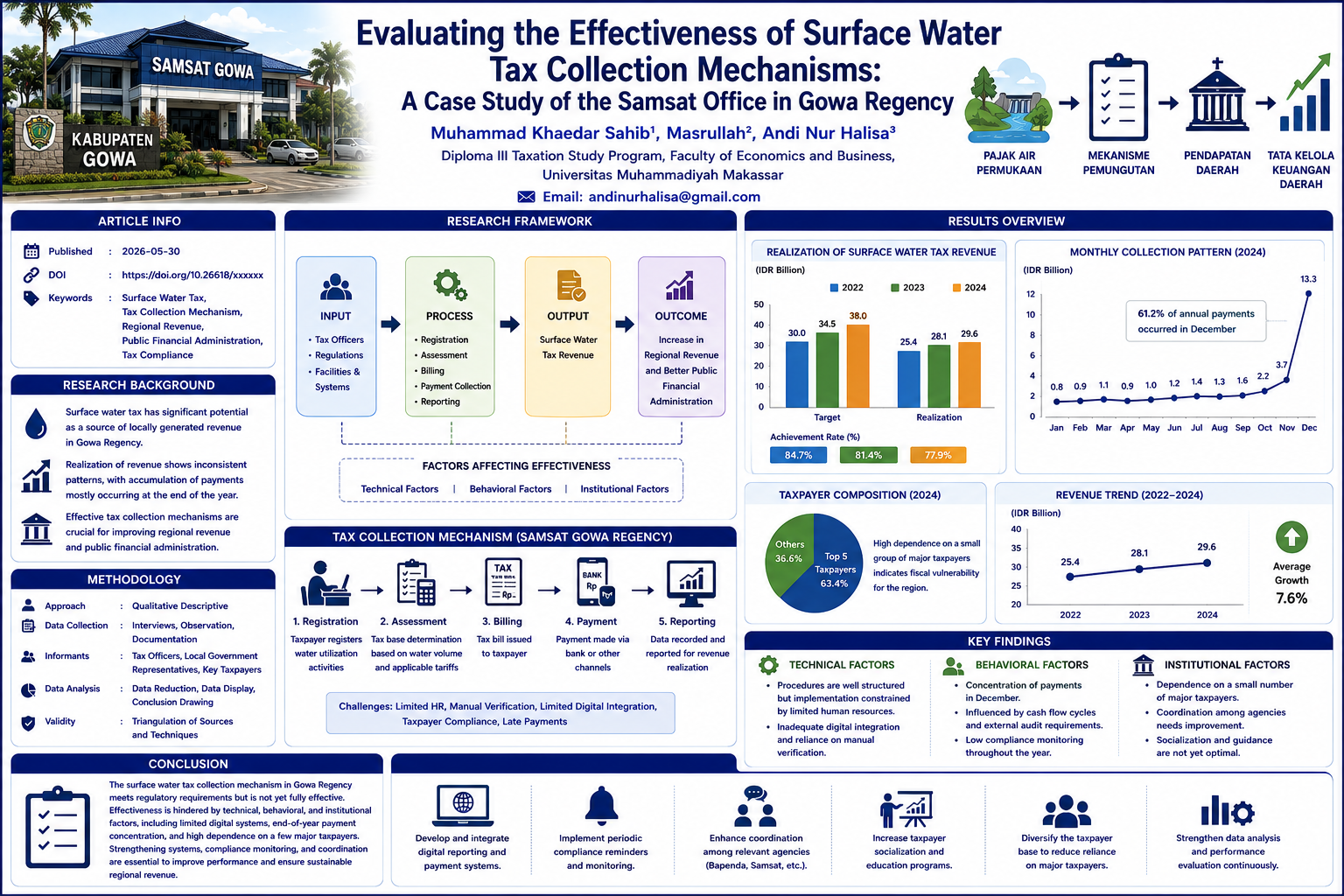
This study examines the effectiveness of surface water tax collection mechanisms implemented by the Samsat Office of Gowa Regency, Indonesia, in the context of increasing regional revenue demands and the need for efficient public financial administration. Despite the significant potential of surface water taxation as a source of locally generated revenue, its realization has shown inconsistent patterns, particularly the recurring accumulation of payments near the end of the fiscal year. Using a qualitative descriptive approach, data were collected through interviews, observation, and documentation involving tax officers, local government representatives, and key taxpayers. The analysis reveals several key findings. First, administrative procedures for tax assessment and billing are generally well structured; however, operational implementation remains constrained by limited human resources, inadequate digital integration, and dependence on manual verification. Second, the concentration of payments in December is influenced by taxpayer behavior, corporate cash flow cycles, and external audit requirements, indicating structural weaknesses in periodic monitoring. Third, the tax revenue structure is highly dependent on a small group of major taxpayers, posing fiscal vulnerability for the region. Overall, while the tax collection mechanism meets regulatory requirements, its effectiveness is hindered by technical, behavioral, and institutional factors. The study recommends strengthening digital reporting systems, implementing periodic compliance reminders, enhancing inter-agency coordination, and diversifying the taxpayer base to ensure sustainable regional revenue.
Downloads
References
Ajzen, I. (1991). The theory of planned behavior. Organizational Behavior and Human Decision Processes, 50(2), 179–211. https://doi.org/10.1016/0749-5978(91)90020-T
Arsyad, Muh., Junaid, A., Sari, R., & Hasanuddin. (2026). Tax Compliance of MSMEs in Makassar: Digitalization and Tax Literacy with Trust as a Moderating Variable. Journal Amnesty, 9(1), 77–97. https://doi.org/10.26618/3A35AV90
Astriana, S., Astriana, S., & Khoirunurrofik, K. (2024). Desentralisasi Fiskal dan Kinerja Tata Kelola Pemerintahan: Bukti Empiris dari Tingkat Kabupaten Kota di Indonesia: BPK, IPB University. Jurnal Ekonomi Dan Kebijakan Pembangunan, 13(1), 15–29. https://doi.org/10.29244/jekp.13.1.2024.15-29
Braun, V., & Clarke, V. (2006). Using thematic analysis in psychology. Qualitative Research in Psychology, 3(2), 77–101. https://doi.org/10.1191/1478088706QP063OA
Creswell, J. W., & Creswell, J. D. (2018). Qualitative, Quantitative, and Mixed Methods Approaches. SAGE Publications.
Doan, N. (2026). The Effect of Fiscal Decentralization on Tax Compliance Time: Evidence From the World Bank Doing Business Project. Public Budgeting and Finance, 46(1), 40–57. https://doi.org/10.1111/PBAF.12404;ISSUE:ISSUE:DOI
Fauziah, H., Fitriana, & Agus Santoso, R. (2025). Transformasi Digital Administrasi Perpajakan: Literature Review Berdasarkan Artikel yang Terindeks Scopus. Journal of Economic, Bussines and Accounting (COSTING), 8(6), 3956–3970. https://doi.org/10.31539/AVQKQC54
Jonathan, G. M., Perjons, E., & Rusu, L. (2024). Digital Transformation-driven Decentralisation of Public Governance. Procedia Computer Science, 239, 1220–1229. https://doi.org/10.1016/J.PROCS.2024.06.290
Judijanto, L., & Al-Amin. (2026). Tranformasi Digital dalam Administrasi Pajak Daerah: Analisis Efisiensi Pelayanan dan Kepatuhan Wajib Pajak. Jurnal Administrasi Negara, 4.
Kristanto, S. B., Wardhani, R., Siswantoro, D., & Ekananda, M. (2026). Fiscal decentralization, governance, and corruption: evidence from Indonesian local governments (2010–2021). Cogent Business & Management, 13(1). https://doi.org/10.1080/23311975.2026.2652136
Lekettey, E., Gaffar, V., Juliana, J., & Nugraha, N. (2025). Fiscal Decentralization and Local Financial Autonomy: A Bibliometric Review of Global Research Trends. JASF: Journal of Accounting and Strategic Finance, 8(2), 235–255. https://doi.org/10.33005/JASF.V8I2.598
Li, M., & Gu, Y. (2025). From fiscal decentralization to high-quality economic development: role of tax administration intensity. Finance Research Letters, 77, 107047. https://doi.org/10.1016/J.FRL.2025.107047
Lincoln, Y. G. E. G. (1985). Naturalistic Inquiry (Empat kriteria keabsahan data: credibility, transferability, dependability, dan confirmability). Sage Publications, Inc., 289–331. https://uk.sagepub.com/en-gb/asi/naturalistic-inquiry/book842
Maulana, C., Hamid, M., & Suyuthi, N. F. (2026). Digital Transformation in Local Tax Administration: A Study on Increasing Revenue through Online Payment in Nunukan Regency. Journal Amnesty, 9(1), 179–190. https://doi.org/10.26618/WA3NVP08
Noveliza, Z., Safitri, N., Amirotul, D., Afif, A., Sa’diyah Yuni, H., Yohanes, S., & Mau, B. (2026). Digital Tax Administration Systems and Taxpayer Compliance: A Qualitative Literature Review. AKUMULASI: Indonesian Journal of Applied Accounting and Finance, 5(1), 1–9. https://doi.org/10.20961/AKUMULASI.V5I1.3569
Oktavianti, O., Tibrani, T., & Salesti, J. (2025). Exploring behavioral drivers of tax compliance: The mediating role of attitude and moral value. Jurnal Akuntansi Dan Auditing Indonesia, 29(2), 298–308. https://doi.org/10.20885/JAAI.VOL29.ISS2.ART9
Putra, A. F., Syahid, I., & Riantika, R. L. (2024). Optimizing regional tax revenue with taxpayer compliance as a moderating variable in Yogyakarta. Journal of Contemporary Accounting, 6(3), 151–171. https://doi.org/10.20885/JCA.VOL6.ISS3.ART2
Saptono, P. B., Mahmud, G., Khozen, I., Saragih, A. H., Sari, W. K., Hendrawan, A., & Setyowati, M. S. (2026). Tax Professionals’ Perceptions, Compliance Costs, and Compliance Intentions Under Indonesia’s Core Tax Administration System. Informatics, 13(4), 52. https://doi.org/10.3390/INFORMATICS13040052
Serly Audia, P., Tjaraka, H., Gde, A. A., & Utama, S. (2026). Digital Tax Compliance: The Role of Literacy, Ease, and Trust. Advances in Taxation Research, 4(2), 144–158. https://doi.org/10.60079/ATR.V4I2.850
Wijaya, E., & Luthfiana Ulfa, L. (2026). Tax Digitalization and Taxpayer Compliance: A Systematic Literature Review of Impacts, Determinants, and Barriers. NADI in Economic and Policy, 1(1).
Wijaya, G. C., Corneliatisa, N. P. K., Primajana, D. J., & T, D. P. (2025). Determinants of Land and Building Taxpayer Compliance in a Decentralized Tax System: Evidence from Denpasar City. Jurnal Ilmiah Akuntansi Dan Bisnis, 10(2), 179–187. https://doi.org/10.38043/JIAB.V10I2.7352
Zamhur, Z., & Marantika, A. (2026). Digital Tax Governance in Optimizing Local Own-Source Revenue: Evidence from Kampar Regency, Indonesia. Dinasti International Journal of Economics, Finance & Accounting, 7(1), 585–592. https://doi.org/10.38035/DIJEFA.V7I1.6581
Downloads
Published
Issue
Section
License

This work is licensed under a Creative Commons Attribution-NonCommercial-NoDerivatives 4.0 International License.