
Digital Transformation in Local Tax Administration: A Study on Increasing Revenue through Online Payment in Nunukan Regency
DOI:
https://doi.org/10.26618/wa3nvp08Keywords:
Regional Tax, Online Payment, Nunukan RegencyAbstract
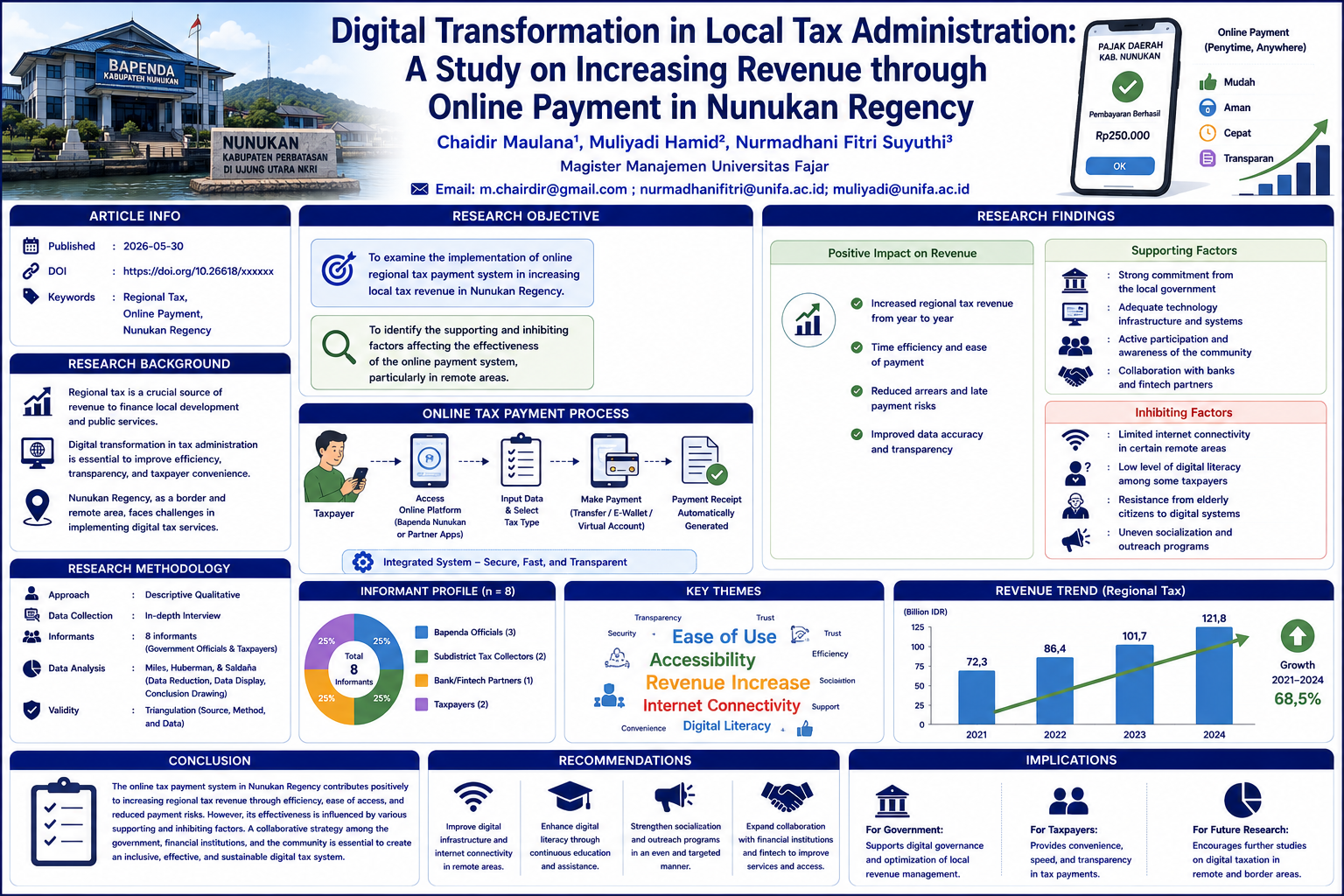
This study aims to examine the implementation of an online regional tax payment system in efforts to increase regional tax revenue at the Regional Revenue Agency (Bapenda) of Nunukan Regency, as well as to identify the supporting and inhibiting factors affecting the effectiveness of the system, particularly in remote areas. This research employs a descriptive qualitative approach, with data collected through in-depth interviews involving eight informants consisting of relevant government officials and taxpayers. The results indicate that the online payment system contributes positively to the increase in regional tax revenue, particularly in terms of time efficiency, ease of access, and the reduction of late payment risks. However, several technical challenges remain, such as limited internet connectivity in certain areas and the low level of digital literacy among some members of the community.Supporting factors for the effectiveness of this system include the commitment of the local government, technological support, and active community participation. Meanwhile, inhibiting factors consist of limited digital infrastructure, resistance among elderly citizens, and the lack of evenly distributed socialization. This study emphasizes the importance of a collaborative strategy among the government, financial institutions, and the community in optimizing an inclusive and sustainable online tax system.
Downloads
References
Abrori, M., Setiawan, A., & Kurniawati, R. (2024). Digital tax transformation and regional revenue optimization in local government administration. Jurnal Bina Praja, 16(1), 45–58. https://doi.org/10.21787/jbp.16.2024.45-58
Agung, R., & Sari, D. (2021). Analisis penerapan sistem pembayaran pajak online. Jurnal Ekonomi dan Kebijakan Publik.
Akitoby, B., Honda, J., & Primus, K. (2020). Tax administration modernization and public revenue performance in developing countries. International Monetary Fund Working Paper, 20(112), 1–35. https://doi.org/10.5089/9781513546842.001
Bapenda Nunukan. (2022). Laporan tahunan penerimaan pajak daerah.
Davis, F. D. (1989). Perceived usefulness, perceived ease of use, and user acceptance of information technology. MIS Quarterly, 13(3), 319–340. https://doi.org/10.2307/249008
Dong, Y., Zhang, X., & Liu, H. (2025). Digital divide and public service accessibility in remote governance systems. Government Information Quarterly, 42(1), 101902. https://doi.org/10.1016/j.giq.2024.101902
Fitriyani, D., & Hendri, H. (2021). Analisis kontribusi pajak daerah. Jurnal Akuntansi dan Keuangan Daerah.
Haryono, S. (2022). Sosialisasi pembayaran pajak online. Jurnal Administrasi Publik.
Hidayat, R., Prasetyo, D., & Nugroho, A. (2025). E-tax service innovation and administrative efficiency in Indonesian local taxation. International Journal of Public Administration, 48(2), 211–225. https://doi.org/10.1080/01900692.2024.2311457
Khasanah, N., & Aldiyanto, A. (2023). Efektivitas pajak daerah.
Khasanah, U., & Aldiyanto, R. (2023). Analysis of digital tax application utilization and taxpayer compliance in regional tax administration. Jurnal Administrasi Publik Indonesia, 9(2), 98–112. https://doi.org/10.31506/japi.v9i2.18341
Leliya, L., & Afiyah, F. (2023). Efektivitas pembayaran pajak online. Al-Mustashfa.
Leliya, N., & Afiyah, N. N. (2023). Online payment systems and regional tax revenue enhancement: Evidence from Indonesian local governments. Journal of Public Sector Innovation, 8(1), 55–70. https://doi.org/10.26740/jpsi.v8n1.p55-70
Mandasari, P., Sari, M., & Putri, D. A. (2024). The implementation of electronic tax payment systems and taxpayer acceptance in public service transformation. International Journal of Economics and Public Administration, 6(1), 77–92. https://doi.org/10.35808/ijepa.624
Mergel, I., Edelmann, N., & Haug, N. (2019). Defining digital transformation: Results from expert interviews. Government Information Quarterly, 36(4), 101385. https://doi.org/10.1016/J.GIQ.2019.06.002
Mulatsih, S. (2023). Adoption of digital public services in taxation: Determinants of taxpayer behavioral intention. Journal of Asian Public Policy, 16(3), 410–425. https://doi.org/10.1080/17516234.2022.2098764
Ningsih, R., & Prasetyo, A. (2021). Adopsi teknologi pajak. Jurnal Teknologi dan Inovasi.
Putra, M. (2020). Aksesibilitas pembayaran pajak. Jurnal Geografi.
Santoso, B. (2021). Analisis penerimaan pajak. Jurnal Studi Ekonomi.
Sari, I., & Rahman, A. (2021). Kepatuhan wajib pajak. Jurnal Ilmu Ekonomi.
Setiawan, A. (2021). Digitalisasi pajak daerah. Jurnal Ilmu Administrasi.
Setiawan, Y. (2022). Strategi sosialisasi pajak online. Jurnal Komunikasi.
Sherenita, I. (2022). Efektivitas pajak non tunai. Jurnal Administrasi Bisnis.
Sukasih, N., Firmansyah, A., & Harto, P. (2025). Institutional trust and digital transformation in tax administration reform. Public Organization Review, 25(1), 134–151. https://doi.org/10.1007/s11115-024-00712-8
Susilowati, E., Pramono, H., & Yusuf, A. (2023). Regional digital taxation and local revenue sustainability in decentralized governance. Public Administration Quarterly, 47(4), 623–645.
Vial, G. (2019). Understanding digital transformation: A review and a research agenda. The Journal of Strategic Information Systems, 28(2), 118–144. https://doi.org/10.1016/J.JSIS.2019.01.003
Widiastuti, L. (2022). Edukasi teknologi pajak. Jurnal Pendidikan dan Teknologi.
Yusuf, M., & Anwar, H. (2021). Kepercayaan sistem pajak. Jurnal Perpajakan dan Keuangan.
Downloads
Published
Issue
Section
License

This work is licensed under a Creative Commons Attribution-NonCommercial-NoDerivatives 4.0 International License.