
What Drives Corporate Tax Avoidance in Indonesia’s Basic Materials Sector?
DOI:
https://doi.org/10.26618/6ksn5x83Kata Kunci:
Tax avoidance; Profitability; Capital structure; Firm size; Panel data regression.Abstrak
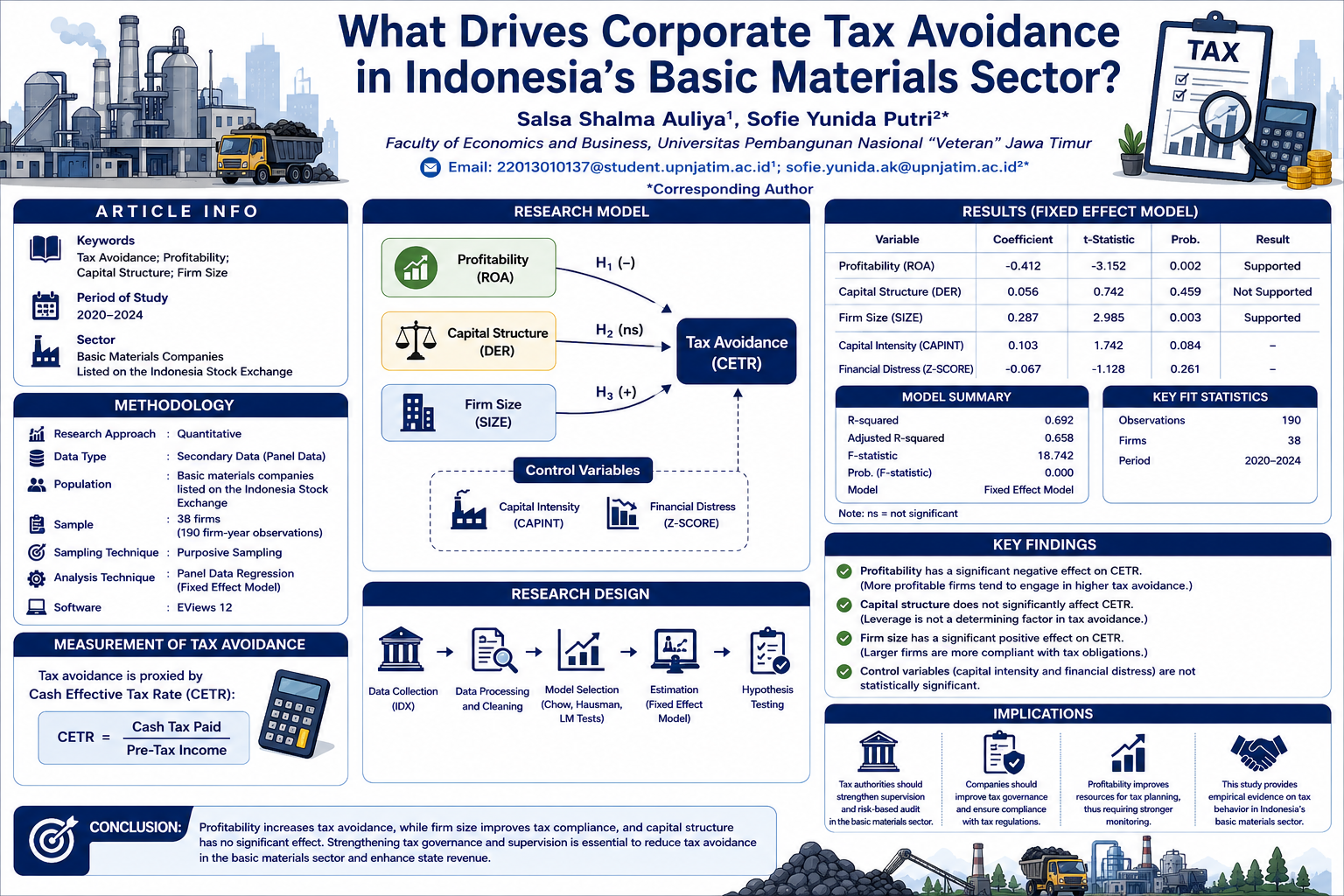
Tax avoidance remains a persistent challenge in emerging economies, particularly in Indonesia, where corporate tax compliance varies across industries despite continuous regulatory reforms. Empirical evidence on the effects of profitability, capital structure, and firm size on tax avoidance has produced inconsistent findings, indicating the need for further investigation. This study examines the influence of profitability, capital structure, and firm size on corporate tax avoidance among basic materials companies listed on the Indonesia Stock Exchange during 2020–2024. Tax avoidance is proxied by the Cash Effective Tax Rate (CETR), while capital intensity and financial distress are incorporated as control variables to improve model robustness. A quantitative research design was employed using balanced panel data from 38 firms, resulting in 190 firm-year observations selected through purposive sampling. Panel data regression analysis was conducted using EViews 13, with the Fixed Effect Model (FEM) identified as the most appropriate specification based on Chow and Hausman tests. The findings reveal that profitability has a significant negative effect on CETR, indicating that more profitable firms are more likely to engage in tax avoidance. Capital structure has no statistically significant influence on CETR, suggesting that leverage is not a primary determinant of corporate tax avoidance. Conversely, firm size has a significant positive effect on CETR, implying that larger firms exhibit lower tax avoidance and greater tax compliance. These findings extend agency theory by demonstrating how firm-specific characteristics shape corporate tax behavior and provide practical implications for policymakers in strengthening tax governance, regulatory oversight, and corporate compliance strategies in Indonesia's basic materials sector.
Unduhan
Referensi
Adiguna, S., & Ritonga, F. (2024). The effect of transfer pricing and profitability on tax avoidance: Empirical study in industrial sector companies. Jurnal Ilmiah Akuntansi Kesatuan, 12(3), 421–430. https://doi.org/10.37641/jiakes.v12i3.2718
Arianti, B. F., & Soesila, B. (2025). Analysis of capital structure, leverage, and sales growth in term of tax avoidance. Journal of Accounting and Business Education, 9(4), 19–31. https://doi.org/10.17977/jabe.v9i4.62218
Asqolani, Adhitama, S., & Johantri, B. (2024). Era baru program relawan pajak: Pemanfaatan media sosial dalam penyuluhan pajak. Jurnal Keuangan Umum dan Akuntansi Terapan (KUAT), 6(2), 100.
Cuevas-Vargas, H., Cortés-Palacios, H. A., & Lozano-García, J. J. (2021). Impact of capital structure and innovation on firm performance: Direct and indirect effects of capital structure. Procedia Computer Science, 199, 1082–1089. https://doi.org/10.1016/j.procs.2022.01.137
Darma, S. S., & Amelia, K. Z. (2025). Pengaruh struktur modal, beban pajak tangguhan dan pertumbuhan penjualan terhadap penghindaran pajak. Scientific Journal of Reflection: Economic, Accounting, Management and Business, 8(4), 1496–1505.
Dewi, N. P. S. S., & Putri, I. G. A. M. A. D. (2021). Corporate social responsibility dan free cash flow pada tax avoidance. E-Jurnal Akuntansi, 31(5). https://doi.org/10.24843/EJA.2021.V31.I05.P01
Efendi, M., & Winingrum, S. P. (2025). Pengaruh struktur modal, capital intensity, dan ukuran perusahaan terhadap tax avoidance. Jurnal Ekonomika dan Bisnis (JEBS), 5(1), 269–280. https://doi.org/10.47233/jebs.v5i1.2496
Gumelar, A., Susanto, H., & Sukayat, H. (2024). Effect of profitability, leverage, and firm size on tax avoidance: Case study on banking companies listed on the IDX 2023 period. Jurnal Ilmiah Akuntansi Kesatuan, 12(3), 341–350. https://doi.org/10.37641/jiakes.v12i2.1435
Hardana, A., & Hasibuan, A. N. (2023). The impact of profitability, transfer pricing, and capital intensity on tax avoidance in listed property and real estate companies on the Indonesia Stock Exchange. International Journal of Islamic Economics, 5(1). https://doi.org/10.32332/ijie.v5i01.6991
Haztania, S., & Lestari, T. U. (2023). Pengaruh transfer pricing, karakter eksekutif, dan koneksi politik terhadap tax avoidance. Cakrawala Repositori IMWI, 6(1). https://doi.org/10.52851/cakrawala.v6i1.112
Hossain, M. S., Ali, M. S., Islam, M. Z., Ling, C. C., & Fung, C. Y. (2024). Nexus between profitability, firm size and leverage and tax avoidance: Evidence from an emerging economy. Asian Review of Accounting, 32(5). https://doi.org/10.1108/ARA-08-2023-0238
Jensen, M. C., & Meckling, W. H. (1976). Theory of the firm: Managerial behavior, agency costs and ownership structure. Journal of Financial Economics, 3(4), 305–360. https://doi.org/10.1016/0304-405X(76)90026-X
Kalbuana, N., Taqi, M., Uzliawati, L., & Ramdhani, D. (2023). CEO narcissism, corporate governance, financial distress, and company size on corporate tax avoidance. Cogent Business & Management, 10(1). https://doi.org/10.1080/23311975.2023.2167550
Keryn, T., Lubis, S., & Mikroskil, U. (2025). Analysis of factors that influence tax avoidance with company size as an intervening variable in consumer companies on the Indonesian Stock Exchange period 2021–2023. Management Studies and Entrepreneurship Journal, 6(4), 5721–5744. http://journal.yrpipku.com/index.php/msej
Ma'sum, M. A., Jaeni, & Badjuri, A. (2023). Tax avoidance dalam perspektif agency theory (Studi empiris pada karakteristik teks laporan tahunan). Jurnal Ilmiah MEA (Manajemen, Ekonomi, dan Akuntansi), 7(2), 1873–1884. https://doi.org/10.31955/mea.v7i2.3349
Ministry of Finance. (2024). APBN KiTa Desember 2024. https://www.kemenkeu.go.id/apbnkita
Ningrum, N. A., Herawati, R., Isthika, W., & Setyowati, L. (2025). Determinan financial distress, thin capitalization, karakteristik eksekutif dan multinationality terhadap praktik tax avoidance. Jurnal Ilmiah MEA (Manajemen, Ekonomi, dan Akuntansi), 9(1), 1439–1456.
Nyman, R. C. S., Kaidun, I. P., & Lingga, I. S. (2022). Pengaruh firm size, return on equity, dan current ratio terhadap tax avoidance pada perusahaan LQ45 yang terdaftar di Bursa Efek Indonesia. Jurnal Akuntansi, 14(1). https://doi.org/10.28932/jam.v14i1.4375
Prajitno, V. J., Widianingsih, L. P., Jaby, A. C., Hallen, S. I. I., & Pangestu, G. A. (2025). CSR disclosure and financial distress as determinants of tax avoidance: Empirical evidence from mining companies in Indonesia. Ecopreneur.12, 8(2), 148–155. https://doi.org/10.51804/econ12.v8i2.148-155
Rahmawati, D., & Nani, D. A. (2021). Pengaruh profitabilitas, ukuran perusahaan, dan tingkat hutang terhadap tax avoidance. Jurnal Akuntansi dan Keuangan, 26(1), 1–11. https://doi.org/10.23960/jak.v26i1.246
Rahmayani, M. W., Hernita, N., & Riyadi, W. (2023). Company size and profitability against tax avoidance in coal sector mining companies listed on the IDX in 2018–2021. International Journal of Professional Business Review, 8(8). https://doi.org/10.26668/businessreview/2023.v8i8.3262
Rosmanidar, E., Putriana, M., & Nasution, M. A. P. (2024). Pengaruh biaya lingkungan dan kinerja lingkungan terhadap kinerja keuangan. E-Bisnis: Jurnal Ilmiah Ekonomi dan Bisnis, 17(1), 111–125. https://doi.org/10.51903/e-bisnis.v17i1.1770
Sari, P. I. P., & Ramli, A. (2023). The effect of leverage, company size, and company risk on tax avoidance in 2020–2022. Jurnal Ilmiah Akuntansi Kesatuan, 11(3). https://doi.org/10.37641/jiakes.v11i3.2074
Septriani, D., & Arianti, B. F. (2025). Pengaruh struktur modal, risiko perusahaan dan pertumbuhan penjualan terhadap penghindaran pajak. Jurnal Akuntansi Barelang, 9(2), 12.
Situmorang, Y. D., Hamzani, U., & Dosinta, N. F. (2025). Determinants of tax avoidance on basic materials companies. Jurnal Ilmiah Akuntansi Kesatuan, 13(4), 1063–1074. https://doi.org/10.37641/jiakes.v13i4.3659
Sumartono, S., & Puspasari, I. W. T. (2021). Determinan tax avoidance: Bukti empiris pada perusahaan publik di Indonesia. Jurnal Ilmiah Akuntansi, 6(1). https://doi.org/10.23887/jia.v6i1.29281
Susilowati, E., Fadilah, A. K. W., Putri, S. Y., Andayani, S., & Kirana, N. W. I. (2024). Maximizing firm value: Analyzing profitability and leverage with tax avoidance interventions. Journal of Accounting and Strategic Finance, 7(1). https://doi.org/10.33005/jasf.v7i1.450
Tempo.co. (2024, June 4). PT Antam diduga pernah hindari pajak impor emas yang didatangkan dari Hong Kong melalui Singapura, begini modusnya. https://www.tempo.co/hukum/pt-antam-diduga-pernah-hindari-pajak-impor-emas-yang-didatangkan-dari-hong-kong-melalui-singapura-begini-modusnya-52735
Wibowo, R. Y. K., Asyik, N. F., & Bambang, S. (2021). Pengaruh struktur kepemilikan, arus kas bebas, ukuran perusahaan terhadap nilai perusahaan melalui struktur modal. EKUITAS (Jurnal Ekonomi dan Keuangan), 5(3). https://doi.org/10.24034/j25485024.y2021.v5.i3.4799
Yohanes, & Sherly, F. (2022). Pengaruh profitability, leverage, audit quality, dan faktor lainnya terhadap tax avoidance. E-Jurnal Akuntansi TSM, 2(2).
Yulianty, R., & Sumanti, E. (2025). Pengaruh financial distress terhadap penghindaran pajak pada perusahaan transportasi yang terdaftar di Bursa Efek Indonesia selama pandemi COVID-19. Journal of Accounting and Finance Management, 6(2). https://doi.org/10.38035/jafm.v6i2.1899
Unduhan
Diterbitkan
Terbitan
Bagian
Lisensi

Artikel ini berlisensi Creative Commons Attribution-NonCommercial-NoDerivatives 4.0 International License.