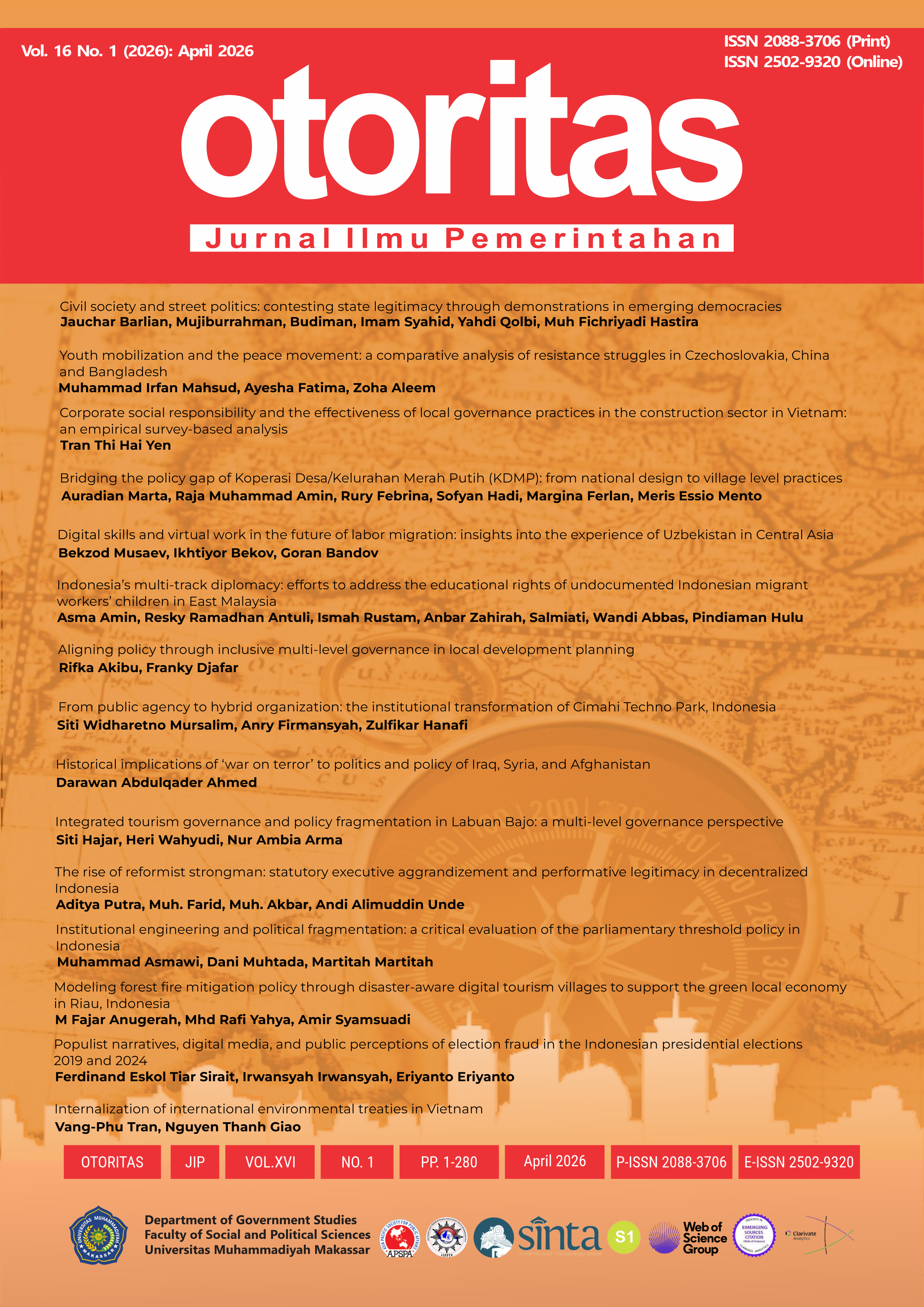
Populist narratives, digital media, and public perceptions of election fraud in the Indonesian presidential elections 2019 and 2024
DOI:
https://doi.org/10.26618/ojip.v16i1.21189Keywords:
populist narratives, digital media, public perceptions, election fraud, presidential electionsAbstract
Persistent allegations of electoral fraud after Indonesia’s 2019 and 2024 elections show that legitimacy is shaped not only by legal validation but also by competing public narratives. Although both elections were certified, post-election discourse remained marked by polarization, distrust, and manipulation claims. Existing studies have examined fraud perceptions, populism, misinformation, and digital politics separately, yet research on how fraud narratives evolved across consecutive Indonesian elections remains limited. This study addresses this gap by analyzing how populist fraud narratives were produced and circulated in both elections, and how survey institutions contributed to electoral legitimacy. Using qualitative descriptive content analysis based on library and document-based research, this study synthesizes academic literature, official documents, media reports, and survey publications. The findings reveal a transformation in fraud narratives. In 2019, they were explicit, personalized, and elite-centered, articulated by senior political and religious actors, and linked to offline mobilization. In 2024, they became decentralized, implicit, and digitally networked, circulating through short-form content, partisan online communities, and buzzer-like amplification. Across both elections, survey institutions functioned as epistemic actors by measuring public perceptions and countering claims of widespread illegitimacy, while exposing partisan asymmetries and winner’s bias. This article contributes to debates on digital populism, electoral integrity, and democratic legitimacy by showing how election legitimacy is contested across legal-institutional, moral-populist, and empirical-survey arenas.
References
Arifianto, A. (2021). Nahdlatul Ulama and Its Commitment Towards Moderate Political Norms: a Comparison Between the Abdurrahman Wahid and Jokowi Era. Journal Of Global Strategic Studies, 1(1), 77–114. https://doi.org/10.36859/jgss.v1i1.573
Arifianto, A. R. (2019). What the 2019 Election Says about Indonesian Democracy. Asia Policy, 14(4), 46–53. https://doi.org/10.1353/asp.2019.0045
Arum, I. M., Santosa, R., & Sumarlam, N. (2020). Pelanggaran Kesantunan Berbahasa Politisi dalam Kontroversi Ancaman People Power Pascapilpres. Madah, 11(2), 141–152. https://doi.org/10.31503/madah.v11i2.201
Aspinall, E., & Mietzner, M. (2019). Indonesia’s Democratic Paradox: Competitive Elections amidst Rising Illiberalism. Bulletin of Indonesian Economic Studies, 55(3), 295–317. https://doi.org/10.1080/00074918.2019.1690412
Assyaukanie, L. (2019). Religion as a Political Tool: Secular and Islamist Roles in Indonesian Elections. Journal of Indonesian Islam, 13(2), 454–479. https://doi.org/10.15642/JIIS.2019.13.2.454-479
Beaulieu, E. (2013). Political Parties and Perceptions of Election Fraud in the U.S. SSRN Electronic Journal, 1–32. https://doi.org/10.2139/ssrn.2264806
Bowler, S., & Donovan, T. (1994). Information and Opinion Change on Ballot Propositions. Political Behavior, 16(4), 411–435. https://doi.org/10.1007/BF01498825
Burhani, A. N. (2022). Lessons from Madura Nahdlatul Ulama Conservatism and the Presidential Election. In The Jokowi-Prabowo Elections (Vol. 2). Chapter, ISEAS–Yusof Ishak Institute.
Castells, M. (2009a). Communicaton Power (first edit). Oxford University Press.
Castells, M. (2009b). The Rise of the Network Society. In The Rise of the Network Society: Vol. I. https://doi.org/10.1002/9781444319514
Daxecker, U., Di Salvatore, J., & Ruggeri, A. (2019). Fraud Is What People Make of It: Election Fraud, Perceived Fraud, and Protesting in Nigeria. Journal of Conflict Resolution, 63(9), 2098–2127. https://doi.org/10.1177/0022002718824636
Duile, T. (2021). Challenging Hegemony: Nurhadi-Aldo and the 2019 Election in Indonesia. Journal of Contemporary Asia, 51(4), 537–563. https://doi.org/10.1080/00472336.2020.1748896
Fjelde, H., & Höglund, K. (2016). Electoral Institutions and Electoral Violence in Sub-Saharan Africa. British Journal of Political Science, 46(2), 297–320. https://doi.org/10.1017/S0007123414000179
Hanan, D. (2020). Identity Politics in The 2019 Indonesian General Elections: Its Significance and Limitation. Jurnal Wacana Politik, 5(1), 15–25. https://doi.org/10.24198/jwp.v5i1.27710
Hasyim, S. (2020). Aliran politics, political jihad, and disappointment: Notes for Muslim Javanese in the pre-and post-2019 general election in Central Java. In The 2018 and 2019 Indonesian Elections (pp. 75–89). Routledge.
Hyde, S. D., & Marinov, N. (2014). Information and self-enforcing democracy: The role of international election observation. International Organization, 68(2), 329–359. https://doi.org/10.1017/S0020818313000465
Indikator Politik Indonesia. (2024). Evaluasi Publik atas Pelaksanaan Pemilu 2024 dan Isu-Isu Malpraktek Elektoral.
Lestari, Y. S. (2018). Politik Identitas di Indonesia: Antara Nasionalisme dan Agama. Journal of Politics and Policy, 1(1), 19–30. https://doi.org/10.21776/ub.jppol.2018.001.01.2
Linde, J., & Ekman, J. (2003). Satisfaction with democracy: A note on a frequently used indicator in comparative politics. European Journal of Political Research, 42(3), 391–408. https://doi.org/10.1111/1475-6765.00089
Miles, M. B., Huberman, A. M., & Saldaña, J. (2014). Qualitative Data Analysis (Edition 3). Arizona State University.
Moffitt, B. (2016). The Global Rise of Populism: Performance, Political Style, and Representation. Stanford University Press. https://doi.org/doi.org/10.2307/j.ctvqsdsd8
Mudde, C., & Kaltwasser, C. R. (2012). Populism in Europe and the Americas: Threat or Corrective for Democracy? Cambridge University Press. https://doi.org/doi.org/10.1017/CBO9781139152365
Mudde, C., & Kaltwasser, C. R. (2017). Populism: A Very Short Introduction. Oxford University Press. https://doi.org/doi.org/10.1093/actrade/9780190234874.001.0001
Norris, P. (2014). Why Electoral Integrity Matters. Cambridge University Press. https://doi.org/doi.org/10.1017/CBO9781107280861
Norris, P., Inglehart, R., & Becker, J. (2019). Cultural backlash: Trump, Brexit, and authoritarian populism. In International Affairs (Vol. 95, Issue 5). Cambridge University Press. https://doi.org/doi.org/10.1017/9781108595841
Nurita, D. (2019). Kubu Jokowi Buka 4 Kejanggalan Data Kecurangan Versi Kubu Prabowo. Tempo.Co. https://www.tempo.co/politik/kubu-jokowi-buka-4-kejanggalan-data-kecurangan-versi-kubu-prabowo-744263
Reuter, O. J., & Szakonyi, D. (2013). Online social media and political awareness in authoritarian regimes. British Journal of Political Science, 45(1), 29–51. https://doi.org/10.1017/S0007123413000203
Reuter, O. J., Szakonyi, D., Reuter, O. R. A. J., & Szakonyi, D. (2014). Online Social Media and Political Awareness in Authoritarian Regimes. British Journal of Political Science, 45(1), 29–51. https://doi.org/10.1017/S0007123413000203
Robertson, G., & Greene, S. (2017). The Kremlin Emboldened: How Putin Wins Support. Journal of Democracy, 28(4), 86–100. https://doi.org/10.1353/jod.2017.0069
Siddiq, T. (2019). Lagi, Amien Rais Ancam People Power Jika Pilpres 2019 Curang. Tempo.Co. https://www.tempo.co/politik/lagi-amien-rais-ancam-people-power-jika-pilpres-2019-curang-756961
Sirait, F. E. T. (2020). Ujaran Kebencian, Hoax dan Perilaku Memilih (Studi Kasus pada Pemilihan Presiden 2019 di Indonesia). Jurnal Penelitian Politik, 16(2), 179. https://doi.org/10.14203/jpp.v16i2.806
Stepan, A. C., & Künkler, M. (2007). An Interview with Amien Rais. Journal of International Affairs, 205–216. https://www.jstor.org/stable/24358087
Tang, G., & Lee, F. L. F. (2018). Social media campaigns, electoral momentum, and vote shares: evidence from the 2016 Hong Kong Legislative Council election. Asian Journal of Communication, 28(6), 579–597. https://doi.org/10.1080/01292986.2018.1476564
Tucker, J. A. (2007). Enough! electoral fraud, collective action problems, and post-communist colored revolutions. Perspectives on Politics, 5(3), 535–551. https://doi.org/10.1017/S1537592707071538
Uscinski, J. E., Klofstad, C., & Atkinson, M. D. (2016). What Drives Conspiratorial Beliefs ? The Role of Informational Cues and Predispositions. Political Research Quarterly, 69(1), 57–71. https://doi.org/10.1177/1065912915621621
Widjayanto, F., Naim, S., & Mokodenseho, S. (2022). Maruf Amin’s Political Communication Strategy in the 2019 Election Campaign: A Lesson for Anti-Hoax Politics. Jurnal Wacana Politik, 7(2), 108–119. https://doi.org/10.24198/jwp.v7i2.40869
Downloads
Published
Issue
Section
License
Copyright (c) 2026 Otoritas : Jurnal Ilmu Pemerintahan

This work is licensed under a Creative Commons Attribution-ShareAlike 4.0 International License.
The Editorial Team of Otoritas: Jurnal Ilmu Pemerintahan reserves the right to transfer the copyright of the article once it has been accepted and a decision has been made to publish it.
Department of Government Studies, Faculty of Social and Political Sciences, Universitas Muhammadiyah Makassar in collaboration with Muhammadiyah’s College Association of Government Studies (AIPPTM) and Asia Pacific Society for Public Affairs (APSPA) as the publisher of Otoritas: Jurnal Ilmu Pemerintahan holds the copyright of all articles published in this journal.
The Publisher holds the right to reproduce and distribute the article and author is not allowed to publish the same article published in this journal.
Statement of Authenticity and Manuscript Copyright can be downloaded: here
After filling in the statement letter, please send via e-mail: otoritas@unismuh.ac.id