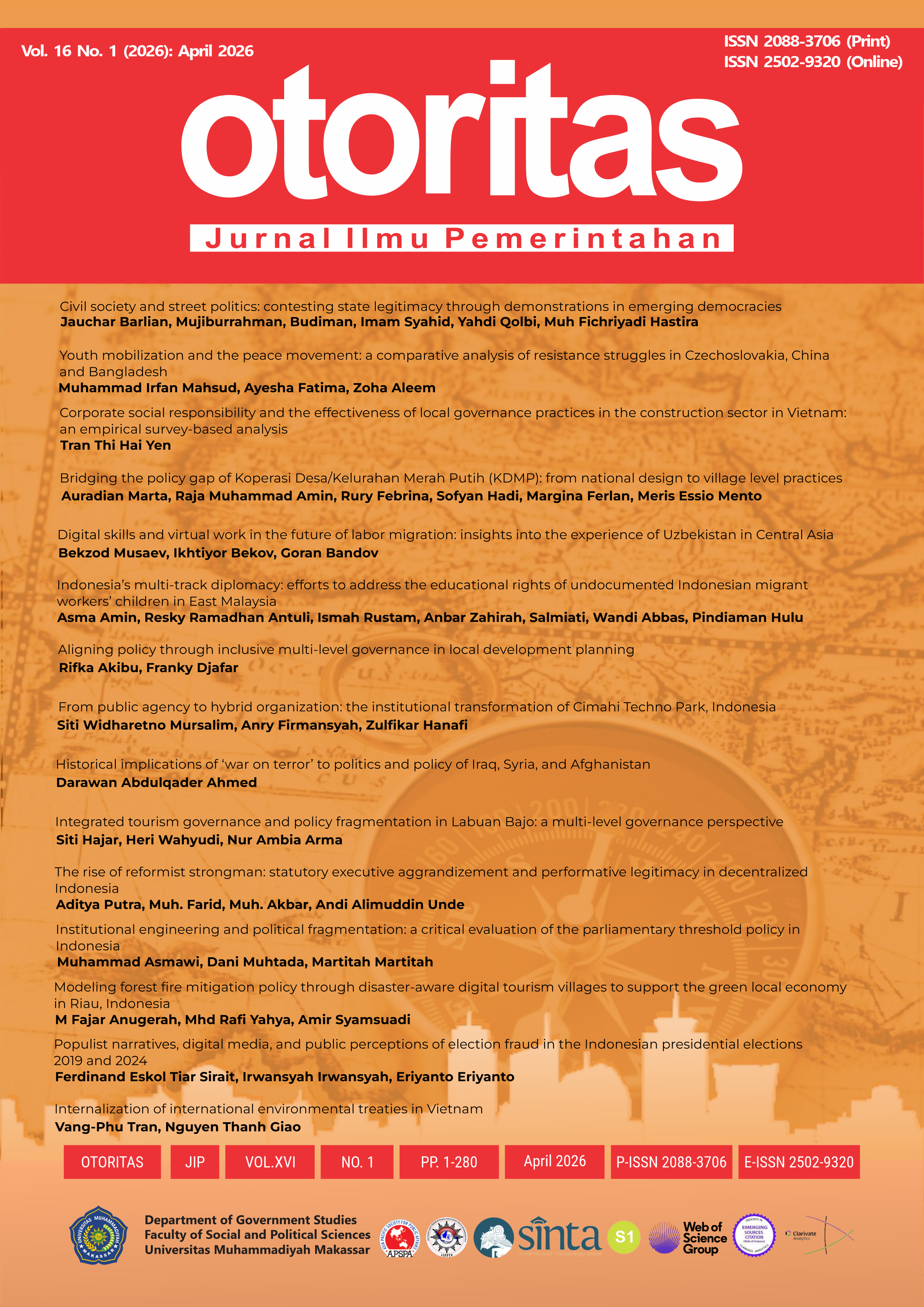
From public agency to hybrid organization: the institutional transformation of Cimahi Techno Park, Indonesia
DOI:
https://doi.org/10.26618/ojip.v16i1.21107Keywords:
hybrid organization, government transformation, science techno park, governance innovationAbstract
This study analyzes the institutional dynamics of Cimahi Techno Park (CTP), a local government-owned Science and Technology Park (STP) currently undergoing a transformation toward a hybrid organizational model. The study aims to identify these gaps by analyzing institutional dynamics, characteristics of hybridity, and barriers to CTP’s transformation. The research method employed is based on a qualitative case study, in which data were collected through interviews, observations, and document analysis to examine competing public-private logics, collaborative governance practices, and institutional barriers. The findings showed that although the CTP has developed early forms of hybridity through collaborative networks involving the government, academics, industry, and the creative community, its operational autonomy remains constrained by structural rigidity, limited financial autonomy, and gaps in human resource capacity. This study demonstrates that transforming the CTP from a public agency into STP a hybrid organization requires more than just administrative reforms; it necessitates broader institutional changes in governance, capacity, and policy alignment. The research has formulated a transformation model toward a Regional Public Service Agency that emphasizes human resource development, financial autonomy, and the institutionalization of collaborative governance mechanisms. This study contributes to the development of the concept of hybrid organizations as a public sector innovation in developing countries.
References
Albahari, A., Barge-Gil, A., Pérez-Canto, S., & Modrego, A. (2018). The influence of Science and Technology Park characteristics on firms’ innovation results. Papers in Regional Science, 97(2), 253–279. https://doi.org/10.1111/pirs.12253
Annosi, M. C., & Brunetta, F. (2017). New Organizational Forms, Controls, and Institutions. Springer International Publishing. https://doi.org/10.1007/978-3-319-54750-3
Annosi, M. C., Foss, N., Brunetta, F., & Magnusson, M. (2017). The Interaction of Control Systems and Stakeholder Networks in Shaping the Identities of Self-Managed Teams. Organization Studies, 38(5), 619–645. https://doi.org/10.1177/0170840616679454
Anton-Tejon, M. (2024). Enhancing green innovation: the role of science and technology parks. Applied Economics Letters. https://doi.org/10.1080/13504851.2024.2409951
Ávila, L., & Amorim, M. (2018). Operational Challenges in Hybrid Organizations. In Operations and Service Management (pp. 955–973). IGI Global. https://doi.org/10.4018/978-1-5225-3909-4.ch044
Battilana, J., & Lee, M. (2014). Advancing Research on Hybrid Organizing - Insights from the Study of Social Enterprises. Academy of Management Annals, 8(1), 397–441. https://doi.org/10.1080/19416520.2014.893615
Baudot, L., Dillard, J., & Pencle, N. (2022). Hybrid organizations and an ethic of accountability: the role of accountability systems in constructing responsible hybridity. Accounting, Auditing & Accountability Journal, 35(3), 598–626. https://doi.org/10.1108/AAAJ-11-2019-4287
Benish, A. (2020). The Logics of Hybrid Accountability: When the State, the Market, and Professionalism Interact. The ANNALS of the American Academy of Political and Social Science, 691(1), 295–310. https://doi.org/10.1177/0002716220965905
Benish, A., & Mattei, P. (2020). Accountability and hybridity in welfare governance. Public Administration, 98(2), 281–290. https://doi.org/10.1111/padm.12640
Boccardelli, P., Annosi, M. C., Brunetta, F., & Magnusson, M. (2017). Learning and innovation in hybrid organizations: Strategic and organizational insights. In Learning and Innovation in Hybrid Organizations: Strategic and Organizational Insights. Springer International Publishing. https://doi.org/10.1007/978-3-319-62467-9
Bonacina Roldan, L., Hansen, P. B., & Garcia-Perez-de-Lema, D. (2018). The relationship between favorable conditions for innovation in technology parks, the innovation produced, and companies’ performance: A framework for an analysis model. Innovation and Management Review, 15(3), 286–302. https://doi.org/10.1108/INMR-05-2018-0027
Brandsen, T., & Karré, P. M. (2021). Hybridization and Hybridity. In International Encyclopedia of Civil Society (pp. 1–6). Springer International Publishing. https://doi.org/10.1007/978-3-319-99675-2_34-1
Cadorin, E., Johansson, S. G., & Klofsten, M. (2017). Future developments for science parks. Industry and Higher Education, 31(3), 156–167. https://doi.org/10.1177/0950422217700995
Cinar, E., Trott, P., & Simms, C. (2019). A systematic review of barriers to public sector innovation process. Public Management Review, 21(2), 264–290. https://doi.org/10.1080/14719037.2018.1473477
De Waele, L., Polzer, T., van Witteloostuijn, A., & Berghman, L. (2021). “A little bit of everything?” Conceptualising performance measurement in hybrid public sector organisations through a literature review. Journal of Public Budgeting, Accounting & Financial Management, 33(3), 343–363. https://doi.org/10.1108/JPBAFM-05-2020-0075
Denis, J. L., Ferlie, E., & Van Gestel, N. (2015). Understanding hybridity in public organizations. Public Administration, 93(2), 273–289. https://doi.org/10.1111/padm.12175
Denzin, N. K., & Lincoln, Y. S. (2018). The SAGE handbook of qualitative research (5th ed.). Sage Publications.
Díez-Vial, I., & Montoro-Sánchez, Á. (2016). How knowledge links with universities may foster innovation: The case of a science park. Technovation, 50–51, 41–52. https://doi.org/10.1016/j.technovation.2015.09.001
Emerson, K., Nabatchi, T., & Balogh, S. (2012). An Integrative Framework for Collaborative Governance. Journal of Public Administration Research and Theory, 22(1), 1–29. https://doi.org/10.1093/jopart/mur011
Entringer, T. C., & Da Silva, L. L. (2020). Critical success factors in science and technology parks: a bibliographic review and analysis. Independent Journal of Management & Production, 11(2), 343–359. https://doi.org/10.14807/ijmp.v11i2.1050
Etzkowitz, H., & Leydesdorff, L. (2000). The dynamics of innovation: from National Systems and “Mode 2” to a Triple Helix of university–industry–government relations. Research Policy, 29(2), 109–123. https://doi.org/10.1016/S0048-7333(99)00055-4
Fulgencio, H. (2017). Social value of an innovation ecosystem: the case of Leiden Bioscience Park, The Netherlands. International Journal of Innovation Science, 9(4), 355–373. https://doi.org/10.1108/IJIS-09-2017-0098
Fuglsang, L., & Møller, J. K. (2020). Bridging public and private innovation patterns. In Handbook on Hybrid Organisations. Edward Elgar Publishing. https://doi.org/10.4337/9781785366116.00017
Gestel, N. van, Denis, J.-L., & Ferlie, E. (2020). Hybridity in public organisations. In Handbook on Hybrid Organisations. Edward Elgar Publishing. https://doi.org/10.4337/9781785366116.00011
Granstrand, O., & Holgersson, M. (2020). Innovation ecosystems: A conceptual review and a new definition. In Technovation (Vols. 90–91). Elsevier Ltd. https://doi.org/10.1016/j.technovation.2019.102098
Grossi, G., Vakkuri, J., & Sargiacomo, M. (2022). Accounting, performance and accountability challenges in hybrid organisations: a value creation perspective. Accounting, Auditing and Accountability Journal, 35(3), 577–597. https://doi.org/10.1108/AAAJ-10-2021-5503
Hahn, T., Pinkse, J., Preuss, L., & Figge, F. (2015). Tensions in Corporate Sustainability: Towards an Integrative Framework. Journal of Business Ethics, 127(2), 297–316. https://doi.org/10.1007/s10551-014-2047-5
Kattel, R., & Mazzucato, M. (2018). Mission-oriented innovation policy and dynamic capabilities in the public sector. Industrial and Corporate Change, 27(5), 787–801. https://doi.org/10.1093/icc/dty032
Khoirunisa, R., Mushfiroh, A., & Gamal, A. (2023). The Identification of Challenges in Innovation Ecosystem of West Java, Indonesia Using a Systematic Literature Review. International Journal of Technology, 14(7), 1408–1418. https://doi.org/10.14716/ijtech.v14i7.6662
ml, J. G. S. (2003). The Politics of Quasi-Government. Cambridge University Press. https://doi.org/10.1017/CBO9780511490989
Li, W., & Abiad, V. (2009). Institutions, Institutional Change, and Economic Performance. SSRN Electronic Journal. https://doi.org/10.2139/ssrn.1416542
Löfsten, H., & Klofsten, M. (2024). Exploring dyadic relationships between Science Parks and universities: bridging theory and practice. Journal of Technology Transfer, 49(5), 1914–1934. https://doi.org/10.1007/s10961-024-10064-y
Maine, J., Uman, T., & Florin-Samuelsson, E. (2024). Actors constructing accountability in hybrid organisations: The case of a Swedish municipal corporation. The British Accounting Review, 56(5), 101207. https://doi.org/10.1016/j.bar.2023.101207
Merriam, S. B., & Tisdell, E. J. (2016). Qualitative research A guide to design and implementation. Jossey-Bass.
Mian, S., Lamine, W., & Fayolle, A. (2016). Technology Business Incubation: An overview of the state of knowledge. Technovation, 50–51, 1–12. https://doi.org/10.1016/j.technovation.2016.02.005
Miles, M. B., Huberman, A. Michael., & Saldaña, Johnny. (2014). Qualitative Data Analysis A Methods Sourcebook. SAGE Publications.
Mursalim, S. W., & Anwar, S. (n.d.). Institutional Model Of Science Techno Park: Overview Of Government-Owned Stp Management In West Java. Retrieved http://ojs.unm.ac.id/iap
Ng, W. K. B., Junker, R., Appel-Meulenbroek, R., Cloodt, M., & Arentze, T. (2020). Perceived benefits of science park attributes among park tenants in the Netherlands. Journal of Technology Transfer, 45(4), 1196–1227. https://doi.org/10.1007/s10961-019-09744-x
Nicola Bellini, Jukka Teräs, & Håkan Ylinenpää. (2013). Science and Technology Parks in the Age of Open Innovation. The Finnish Case. Symphonya. Emerging Issues in Management, (1). https://doi.org/10.4468/2012.1.03bellini.teras.ylinenpaa
O’Reilly, C. A., III, & Tushman, M. L. (2013). Organizational Ambidexterity: Past, Present and Future Academy of Management Perspectives (in press).
Park, S. (Ethan). (2020). Beyond patient-centred care: a conceptual framework of co-production mechanisms with vulnerable groups in health and social service settings. Public Management Review, 22(3), 452–474. https://doi.org/10.1080/14719037.2019.1601241
Perobelli, E., Cappellaro, G., & Saporito, R. (2025). Public–private hybrid organisations in the public sector: Evidence and future directions from a systematic literature review. Public Management Review, 27(11), 2615–2642. https://doi.org/10.1080/14719037.2024.2365244
Phua, S. Hui. (2018). One-north : fostering research, innovation, and entrepreneurship. Centre for Liveable Cities.
Reddick, C. G., Demir, T., & Perlman, B. (2020). Horizontal, Vertical, and Hybrid: An Empirical Look at the Forms of Accountability. Administration & Society, 52(9), 1410–1438. https://doi.org/10.1177/0095399720912553
Rokhmat, D. F., Suwaryo, U., & Mulyawan, R. (2023). Perbandingan Kolaborasi Penta Helix Dalam Pengembangan Potensi Unit Pelaksana Teknis Menjadi Badan Layanan Umum (Studi Di Uptd Cimahi Techno Park Dan Uptd Solo Techno Park Tahun 2021). Jurnal Academia Praja, 6(1), 39–58. https://doi.org/10.36859/jap.v6i1.1080
Rosarie Harni Triastuti, M., Myrna, R., Rusli, B., & Ningrum, S. (2023). Governing Cimahi Techno Park Develop Creative Industry Ecosystem through Collaboration and Regulatory Framing. KnE Social Sciences. https://doi.org/10.18502/kss.v8i17.14143
Sætre, H. S. (2023). How Hybrid Organizations Respond to Institutional Complexity: The Case of Norway. Voluntas, 34(5), 990–1001. https://doi.org/10.1007/s11266-022-00514-2
Sandoval Hamón, L. A., Ruiz Peñalver, S. M., Thomas, E., & Fitjar, R. D. (2024). From high-tech clusters to open innovation ecosystems: a systematic literature review of the relationship between science and technology parks and universities. The Journal of Technology Transfer, 49(2), 689–714. https://doi.org/10.1007/s10961-022-09990-6
Schmitz, B. (2015). Beyond Structural Governance. International Studies of Management & Organization, 45(3), 241–258. https://doi.org/10.1080/00208825.2015.1006029
Siegel, D. S., Westhead, P., & Wright, M. (2003). Science Parks and the Performance of New Technology-Based Firms: A Review of Recent U.K. Evidence and an Agenda for Future Research. Small Business Economics, 20(2), 177–184. https://doi.org/10.1023/A:1022268100133
Skelcher, C., & Smith, S. R. (2015). Theorizing hybridity: Institutional logics, complex organizations, and actor identities: The case of nonprofits. Public Administration, 93(2), 433–448. https://doi.org/10.1111/padm.12105
Soenarso, W. S., Nugraha, D., & Listyaningrum, E. (2013). Development of Science and Technology Park (STP) in Indonesia to Support Innovation-Based Regional Economy: Concept and Early Stage Development. World Technopolis Review, 2(1), 32–42. https://doi.org/10.7165/wtr2013.2.1.32
Stake, R. E. (1995). The Art of Case Study Research (In R. M. J). SAGE Publications, Inc.
Steffen, M. O., Oliveira, M., & Balle, A. R. (2017). Knowledge sharing among companies in a science and technology park. Business Information Review, 34(2), 101–108. https://doi.org/10.1177/0266382117711331
Sun, S. L., Zhang, Y., Cao, Y., Dong, J., & Cantwell, J. (2019). Enriching innovation ecosystems: The role of government in a university science park. Global Transitions, 1, 104–119. https://doi.org/10.1016/j.glt.2019.05.002
Theeranattapong, T., Pickernell, D., & Simms, C. (2021). Systematic literature review paper: the regional innovation system-university-science park nexus. Journal of Technology Transfer, 46(6), 2017–2050. https://doi.org/10.1007/s10961-020-09837-y
Ubeda, F., Ortiz-de-Urbina-Criado, M., & Mora-Valentín, E.-M. (2019). Do firms located in science and technology parks enhance innovation performance? The effect of absorptive capacity. The Journal of Technology Transfer, 44(1), 21–48. https://doi.org/10.1007/s10961-018-9686-0
Vakkuri, J., Johanson, J.-E., Feng, N. C., & Giordano, F. (2021). Governance and accountability in hybrid organizations – past, present and future. Journal of Public Budgeting, Accounting & Financial Management, 33(3), 245–260. https://doi.org/10.1108/JPBAFM-02-2021-0033
Weinert, A. (2016). The Effectiveness of Hybrid Organisations: A Purposive Approach (pp. 315–326). https://doi.org/10.1007/978-3-319-21139-8_19
Xiao, L., & North, D. (2018). The role of Technological Business Incubators in supporting business innovation in China: a case of regional adaptability? Entrepreneurship and Regional Development, 30(1–2), 29–57. https://doi.org/10.1080/08985626.2017.1364789
Yan, M.-R., Chien, K.-M., Hong, L.-Y., & Yang, T.-N. (2018). Evaluating the Collaborative Ecosystem for an Innovation-Driven Economy: A Systems Analysis and Case Study of Science Parks. Sustainability, 10(3), 887. https://doi.org/10.3390/su10030887
Yin, R. K. (2018). Case study research and applications: Design and methods (6th ed.). SAGE Publications.
Zhu, Y., Tang, R. W., & Xing, K. (2023). Effective coordination and innovation-facilitating role of science parks: The place-based approach with paradoxical outcomes. Australian Journal of Management, 48(1), 171–195. https://doi.org/10.1177/03128962221098134
Zollo, L., Pellegrini, M. M., Faldetta, G., & Rialti, R. (2023). How to combine multiple identities and gaining stakeholders legitimacy in hybrid organizations? An organizational design response. Journal of Management and Governance, 27(4), 1189–1222. https://doi.org/10.1007/s10997-022-09644-7
Downloads
Published
Issue
Section
License
Copyright (c) 2026 Otoritas : Jurnal Ilmu Pemerintahan

This work is licensed under a Creative Commons Attribution-ShareAlike 4.0 International License.
The Editorial Team of Otoritas: Jurnal Ilmu Pemerintahan reserves the right to transfer the copyright of the article once it has been accepted and a decision has been made to publish it.
Department of Government Studies, Faculty of Social and Political Sciences, Universitas Muhammadiyah Makassar in collaboration with Muhammadiyah’s College Association of Government Studies (AIPPTM) and Asia Pacific Society for Public Affairs (APSPA) as the publisher of Otoritas: Jurnal Ilmu Pemerintahan holds the copyright of all articles published in this journal.
The Publisher holds the right to reproduce and distribute the article and author is not allowed to publish the same article published in this journal.
Statement of Authenticity and Manuscript Copyright can be downloaded: here
After filling in the statement letter, please send via e-mail: otoritas@unismuh.ac.id