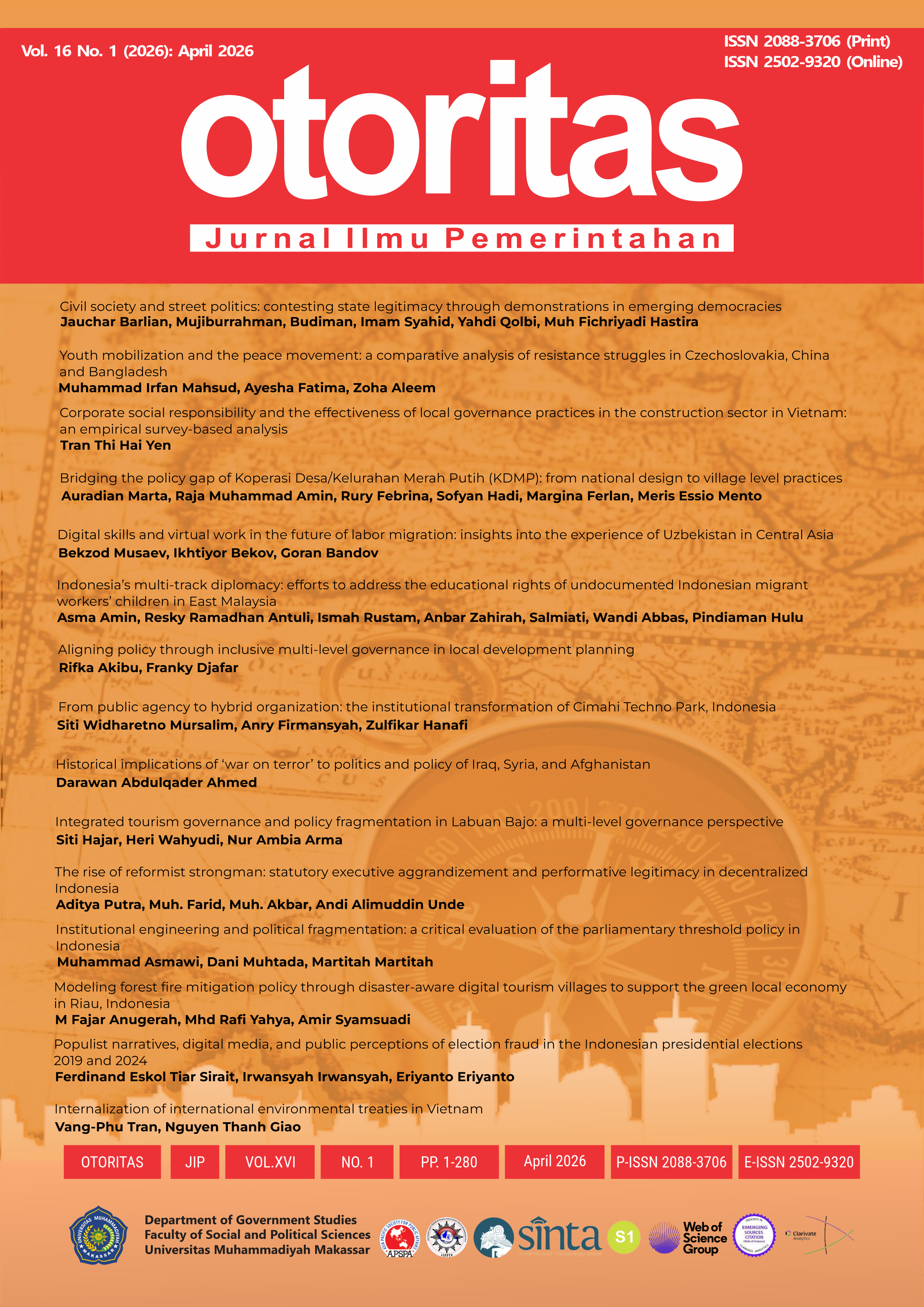
Indonesia’s multi-track diplomacy: efforts to address the educational rights of undocumented Indonesian migrant workers’ children in East Malaysia
DOI:
https://doi.org/10.26618/ojip.v16i1.21033Keywords:
multi-track diplomacy, right to education, undocumented, Indonesian migrant workers, East MalaysiaAbstract
The right to education for undocumented children of Indonesian migrant workers (IMWs) in East Malaysia remains inadequately protected due to administrative exclusion, legal uncertainty, geographic remoteness, and fragmented cross-border governance. This study analyzes how Indonesia’s multi-track diplomacy operates to protect the right to education for undocumented children of IMWs in East Malaysia. This research employs a qualitative explanatory design based on semi-structured interviews supported by document analysis. Data were analyzed through thematic coding using NVivo, with the application of triangulation and participant verification to enhance credibility. Findings indicate that educational protection functions through coordination across four main Tracks. Tracks One provides policy authority, diplomatic legitimacy, schools, documentation facilitation, and scholarships. Tracks Two translates formal commitments into operational support, particularly regarding student repatriation and placement. Tracks Four maintains access in remote plantation areas through mentor teachers who fill teaching vacancies. Tracks Five strengthens the system through temporary teaching, training, and the production of policy-relevant knowledge. This study makes a theoretical contribution by expanding multi-track diplomacy beyond conflict resolution and demonstrating its value as an analytical lens for cross-border social governance. It further demonstrates that effective coordination depends on functional complementarity, negotiated interdependence, and adaptive responses to structural constraints.
References
Agustina, N., & Azizah, N. (2024). Strategies of the Indonesian Embassy in Kuala Lumpur in Resolving Education Problems for Undocumented Children of Indonesian Migrant Workers in Malaysia. Edunesia : Jurnal Ilmiah Pendidikan, 5(2), 652–668. https://doi.org/10.51276/edu.v5i2.874
Anita, Darwis, & Baharuddin, A. (2021). Kerjasama Indonesia - Malaysia dalam Peningkatan Taraf Pendidikan Anak TKI di Negeri Sabah. Hasanuddin Journal of International Affairs, 1(2), 193–216. https://doi.org/https://doi.org/10.31947/hjirs.v1i2.17737
Asma Amin; Danar Hafidz Adi Wardhana; Riady Ibnu Khaldun. (2023). Multi Track diplomacy. Penerbit Lakeisha.
Aura, J. (2022). Kemlu: Jumlah TKI Ilegal yang Berangkat ke Malaysia Melonjak 146 Persen. Kumparan.Com.
Belarbi, A. K., Refae, G. A. El, & Aissani, R. A. (2023). Internationalization of Education and the BrainDrain Paradox:Case of the Mena Region. Journal of Higher Education Theory and Practice, 23(3), 136–145.
Christie, D. A. (2016). Upaya Indonesia dalam Menangani Pendidikan Anak Tenaga Kerja Indonesia di Sabah Malaysia. EJournal Ilmu Hubungan Internasional, 4(4).
Damayanti, C., Dewi, U. N. M., & Permatasari, D. G. (2023). Diplomasi Pendidikan Sabah Bridge Dalam Memenuhi Hak Pendidikan Bagi Anak Pekerja Migran Indonesia Di Sabah, Malaysia. Indonesian Journal of International Relations, 7(2). https://doi.org/10.32787/ijir.v7i2.440
Dewi, U. N. M. (2018). Kebijakan KJRI Johor Bahru Dalam Mengatasi Permasalahan Pelayanan Pendidikan Bagi Anak-Anak Pekerja Migran Indonesia. Prosiding Konferensi Nasional Ke- 7 Asosiasi Program Pascasarjana Perguruan Tinggi Muhammadiyah „Aisyiyah (APPPTMA), 209–220.
kemendikdasmen. (2025). Program Gema Cita: Rajut Asa Pendidikan Berkelanjutan Anak Pekerja Migran Indonesia. Https://Www.Kemendikdasmen.Go.Id/.
KJRI Kota Kinabalu. (2022). 265 Anak PMI Penerima Beasiswa Repatriasi Pendidikan Diberangkatkan ke Indonesia. Konsulat Jenderal Republik Indonesia Di Kota Kinabalu, Malaysia.
Lendong, L. G. N. (2021). Migran Indonesia di Malaysia, 50% Diantaranya Ilegal. Tribunnews.Com.
Maksum, A. (2025). Indonesian migrant workers’ multi-track diplomacy for education rights in Penang, Malaysia. Diaspora, Indigenous, and Minority Education, 1–13. https://doi.org/10.1080/15595692.2025.2492549
Mukhtar-Landgren, D., & Smith, G. (2019). Perceived action spaces for public actors in the development of Mobility as a Service. European Transport Research Review, 11(1), 32. https://doi.org/10.1186/s12544-019-0363-7
Muslihudin, M., Hussin, R., Retno Wulan, T., & Santoso, J. (2023). The Role of Non-Government Organizations in the Education of Migrant Workers’ Children in Sabah Malaysia. KnE Social Sciences. https://doi.org/10.18502/kss.v8i3.12841
Mustaffa, A., Noura, C., Haque, M. M., & Nawang, N. I. (2022). Rights Of Undocumented Migrant Children To Education Under The Malaysian Legal Framework: Towards A Human Right Approach. IIUM Law Journal, 30(IS), 229–252. https://doi.org/https://doi.org/10.31436/iiumlj.v30iS1.705
Muyamin, M. (2019). Peran Aktif NGO Humana dalam Memfasilitasi Pendidikan Anak-Anak Tenaga Kerja Indonesia (TKI) di Sabah Malaysia. Indonesian Perspective, 4(2). https://doi.org/10.14710/ip.v4i2.26703
Neale, B. (2021). Fluid Enquiry, Complex Causality, Policy Processes: Making a Difference with Qualitative Longitudinal Research. Social Policy & Society, 20(4), 653–669. https://doi.org/10.1017/S1474746421000142
Prianto, A. L., Amri, A. R., & Ajis, M. N. (2023). Governance and Protection of Indonesian Migrant Workers in Malaysia. Journal of Southeast Asian Human Rights, 7(2), 214. https://doi.org/10.19184/jseahr.v7i2.44185
Saefuddin, A., Jumintono, & Rejokirono. (2023). National Identity Transnational Life: The Case of Dual Education of Indonesian Migrant Children in Sabah, East Malaysia. Kajian Malaysia, 42(1), 117–138. https://doi.org/https://doi.org/10.21315/km2024.42.1.6
Solidar Suisse. (2019). Exploited and illegalised: The lives of Palm Oil Migrant Workers in Sabah.
Suarno, D. T., Suryonom, Y., & Zamroni. (2021). Equalizzation Access to Education as an Effort to Foster the Nastinalism of Indonesian Migrant Workers’ Children in Border Areas. European Journal of Educational Research, 10(4), 1825–1837. https://doi.org/https://doi.org/10.12973/eu-jer.10.4.1825
Sucipto, Wiyono, B. B., Rasyad, A., Dayati, U., & Purwito, L. (2021). The Contribution of Individual Characteristics of Managers to the Success of Equivalency Education Programs of the Community Learning Center in Indonesia. Sustainability, 13(19), 11001. https://doi.org/10.3390/su131911001
Susilo, S. (2016). Remittance in phenomenology perspective: A study of Indonesian Migran Worker (TKI) in Tulungagung, Indonesia. The Social Sciences, 11(19), 4730–4733. https://doi.org/1010.3923/sscience.2016.4730.4733
Thamrin. (2019). A study of legal and Illegal Indonesian Migrant Workers in Malaysia and their problems: Finding a solution from the violence and protecting their rights. International Journal of Innovation, Creativity and Change, 6(11), 133–149.
Udhwalalita, A. A., & Hakim, M. F. (2023). Pemenuhan Pendidikan Anak-Anak PMI Di Malaysia Oleh Pusat Pendidikan Warga Negera Indonesia. SIYAR: Social Issues by Academic Researchers, 3(1), 31–42. https://doi.org/https://doi.org/10.15642/siyar.2023.3.1.31-42
Widiawati, S., Mahardhani, A. J., Cahyono, H., Sulton, S., & Nasution, I. F. (2023). Collaborative Governance in Fulfilling the Right to Education for Children of Non-Document Migrant Workers in Malaysia. Journal of Governance, 8(2). https://doi.org/10.31506/jog.v8i2.19207
Witteveen, L., Fliervoet, J., Roosmini, D., van Eijk, P., & Lairing, N. (2023). Reflecting on four Living Labs in the Netherlands and Indonesia: a perspective on performance, public engagement and participation. Journal of Science Communication, 22(03). https://doi.org/10.22323/2.22030201
Wulan, T. R., Muslihudin, M., & Wijayanti, S. (2024). The Difficulty of Education for the Children of Indonesian Migrant Workers in Sabah Malaysia. Migration Letter, 21(2), 115–126. https://doi.org/https://doi.org/10.59670/ml.v21i2.5855
Yulianto, M. I., Mahardhani, A. J., Sulton, S., & Majid, I. A. (2023). The Role of the Government of Indonesia in Fighting for Recognition and the Right to Education for Children of Indonesia Migrant Workers in Malaysia. Jurnal Public Policy, 9(3). https://doi.org/10.35308/jpp.v9i3.7059
Yun, S.-H. (2012). Relational Public Diplomacy: The Perspective of Sociological Globalism. International Journal of Communication, 6, 2199–2219.
Yuvanti, D. A. (2021). Indonesian Government’s Efforts to Cooperate with Malaysia’s Government in Protecting Educational Rights of Indonesian Migrant Workers Children (Case Study: Children of Indonesian Migrant Workers in Sabah). Journal of ASEAN Dynamics and Beyond, 2(2). https://doi.org/10.20961/aseandynamics.v2i2.52149
Downloads
Published
Issue
Section
License
Copyright (c) 2026 Otoritas : Jurnal Ilmu Pemerintahan

This work is licensed under a Creative Commons Attribution-ShareAlike 4.0 International License.
The Editorial Team of Otoritas: Jurnal Ilmu Pemerintahan reserves the right to transfer the copyright of the article once it has been accepted and a decision has been made to publish it.
Department of Government Studies, Faculty of Social and Political Sciences, Universitas Muhammadiyah Makassar in collaboration with Muhammadiyah’s College Association of Government Studies (AIPPTM) and Asia Pacific Society for Public Affairs (APSPA) as the publisher of Otoritas: Jurnal Ilmu Pemerintahan holds the copyright of all articles published in this journal.
The Publisher holds the right to reproduce and distribute the article and author is not allowed to publish the same article published in this journal.
Statement of Authenticity and Manuscript Copyright can be downloaded: here
After filling in the statement letter, please send via e-mail: otoritas@unismuh.ac.id