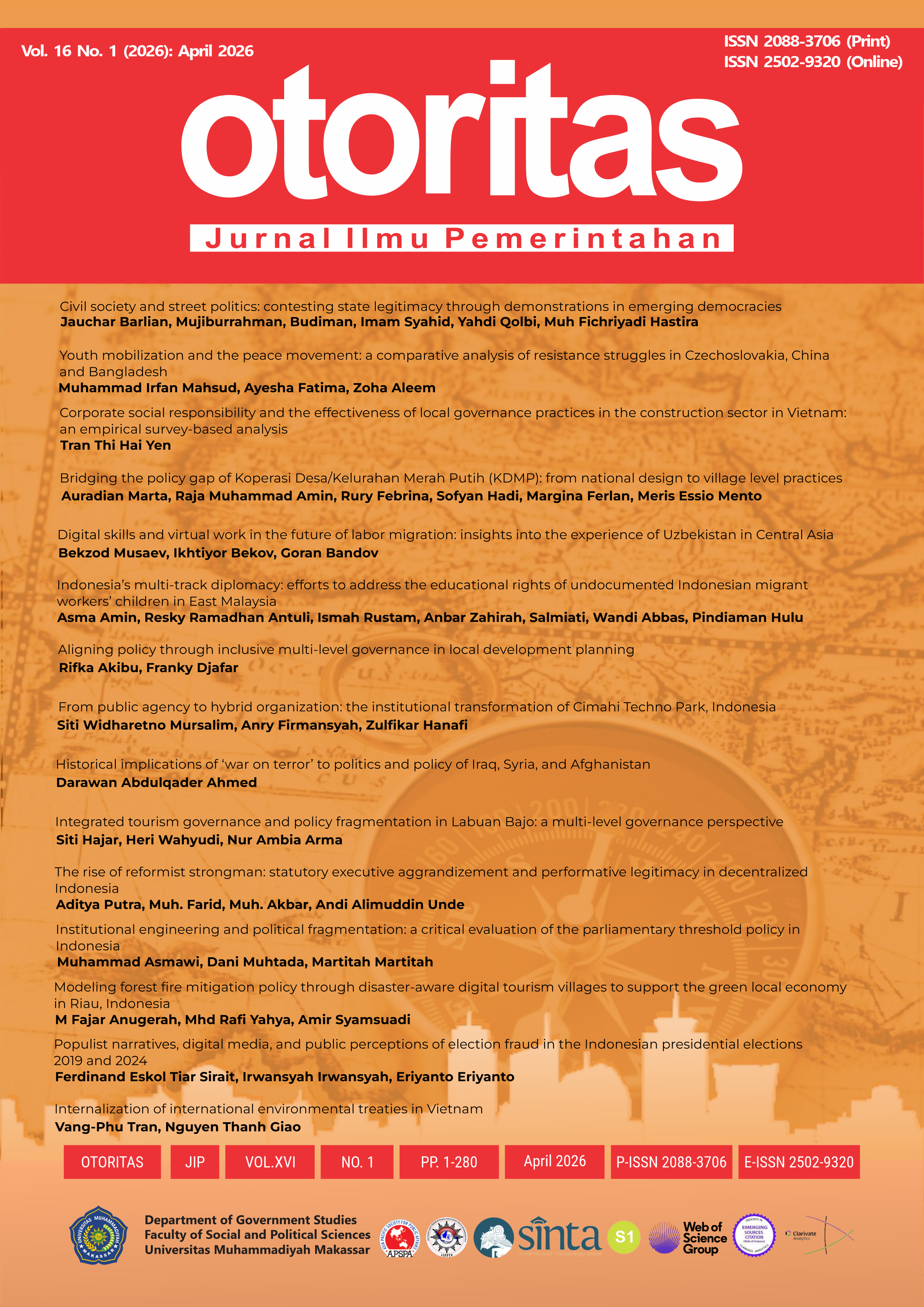
Digital skills and virtual work in the future of labor migration: insights into the experience of Uzbekistan in Central Asia
DOI:
https://doi.org/10.26618/ojip.v16i1.20919Keywords:
digital skills, virtual work, labor migration, online platforms, global labor marketAbstract
This article examines how digital skills and virtual employment are reshaping labor migration patterns, with a focus on Uzbekistan’s evolving experience within Central Asia. Drawing on comparative legal analysis and secondary statistical sources, the study traces the shift from predominantly physical mobility toward digitally mediated cross-border work facilitated by online labor platforms. Evidence from the Online Labour Index shows that demand for virtual labor is concentrated in high-income economies, while supply is generated largely by developing countries, reflecting an emerging digital division of labor. The article analyzes the implications of artificial intelligence, automation, and telework for migrant workers and assesses Uzbekistan’s policy responses, including vocational upskilling, WorldSkills standards, and pre-migration preparation. The findings suggest that targeted digital skills development, streamlined recognition of qualifications, and alignment of training with global standards can enhance the competitiveness of Uzbek workers in remote labor markets. The article contribute for recognizing “virtual labor migration” within international legal frameworks and integrating remote-work preparation into national workforce strategies to promote inclusive growth and social resilience.
References
Abuseridze, G., Agapova, O., Paliani-Dittrich, I., Grasis, J., & Kavelidze, E. (2023). Migration from Georgia and Ukraine in the context of Russian aggression. In Handbook of Research on the Regulation of the Modern Global Migration and Economic Crisis (pp. 107–121). IGI Global Scientific Publishing. https://doi.org/10.4018/978-1-6684-6334-5.ch007
Alfano, V., Mariotti, I., Nappo, N., & Vecchione, G. (2024). Work-life balance during the COVID-19 pandemic. A European perspective. Journal of Industrial and Business Economics, 51(4), 1041–1065. https://doi.org/10.1007/s40812-024-00316-1
Anastasiadou, A., Kim, J., Sanlitürk, E., de Valk, H. A. G., & Zagheni, E. (2024). Gender Differences in the Migration Process: A Narrative Literature Review. Population and Development Review, 50(4), 961–996. https://doi.org/10.1111/padr.12677
Axelsson, L. (2022). Border timespaces: understanding the regulation of international mobility and migration. Geografiska Annaler, Series B: Human Geography, 104(1), 59–74. https://doi.org/10.1080/04353684.2022.2027260
Batista, C., Han, D., Haushofer, J., Khanna, G., McKenzie, D., Mobarak, A. M., Theoharides, C., & Yang, D. (2025). Brain drain or brain gain? Effects of high-skilled international emigration on origin countries. Science, 388(6749), eadr8861. https://doi.org/10.1126/science.adr8861
Fan, W., & Moen, P. (2025). The Future(s) of Work? Disparities Around Changing Job Conditions When Remote/Hybrid or Returning to Working at Work. Work and Occupations, 52(1), 91–129. https://doi.org/10.1177/07308884231203668
Giguashvili, G. (2023). Challenges of international migration in Georgia. InterConf, 37(171), 33–43. https://doi.org/10.51582/interconf.19-20.09.2023.004
He, W., Zhang, B., & Zhang, J. (2024). The Impact of Technology on the Labor Market: An Analysis of the Changing Landscape. 9th International Conference on Financial Innovation and Economic Development (ICFIED 2024), 498–504. https://doi.org/10.2991/978-94-6463-408-2_56
Helsper, E. (2022). The Digital Disconnect: The Social Causes and Consequences of Digital Inequalities. The Digital Disconnect: The Social Causes and Consequences of Digital Inequalities. https://doi.org/10.4135/9781526492982
İçduygu, A., & Diker, E. (2017). Labor Market Integration of Syrian Refugees in Turkey: From Refugees to Settlers. The Journal of Migration Studies, 3(1), 12–35.
Kässi, O., & Lehdonvirta, V. (2018). Online labour index: Measuring the online gig economy for policy and research. Technological Forecasting and Social Change, 137, 241–248. https://doi.org/10.1016/j.techfore.2018.07.056
Kaur, R., & Kaur, K. (2024). Adapting to Global Work Dynamics: Navigating Change and Cultivating Sustainable Employment Strategies. Journal of Social Welfare and Management, 16(3).
Klaus Schwab. (2019). Davos Manifesto 2020: The Universal Purpose of a Company in the Fourth Industrial Revolution | World Economic Forum. World Economic Forum, 2, 1–2.
Kramer, A., & Kramer, K. Z. (2020). The potential impact of the Covid-19 pandemic on occupational status, work from home, and occupational mobility. In Journal of Vocational Behavior (Vol. 119, p. 103442). Elsevier. https://doi.org/10.1016/j.jvb.2020.103442
Kumpikaite-Valiuniene, V., Duobiene, J., Pinnington, A. H., & Lahrech, A. (2022). Migrants’ motivations and intentions to work virtually for their country of origin. International Journal of Emerging Markets, 17(2), 386–412. https://doi.org/10.1108/IJOEM-06-2019-0475
Lupak, R., Mizyuk, B., Zaychenko, V., Kunytska-Iliash, M., & Vasyltsiv, T. (2022). Migration Processes and Socio-Economic Development: Interactions and Regulatory Policy. Agricultural and Resource Economics, 8(1), 70–88. https://doi.org/10.51599/are.2022.08.01.04
Maury, O., Hakala, O., & Näre, L. (2024). Migrant workers within the platform assemblage: entwined temporalities of gig work and the border regime. Journal of Ethnic and Migration Studies, 50(15), 3768–3785. https://doi.org/10.1080/1369183X.2024.2379645
McKendrick, G., & Graziane, N. M. (2020). Drug-Induced Conditioned Place Preference and Its Practical Use in Substance Use Disorder Research. Frontiers in Behavioral Neuroscience, 14, 582147. https://doi.org/10.3389/fnbeh.2020.582147
Okruashvili, N., & Bakhtadze, L. (2019). International Migration Processes and Its Impact on the Georgian Labor Market. Proceedings of International Academic Conferences, 9111470. https://doi.org/10.20472/iac.2019.046.012
Panfilova, L., Drogovoz, S. M., Sadovnyk, O. V., Kalko, K. O., Borysiuk, I. Y., Glushchenko, A. V., Liulchak, S. Y., & Hainiuk, M. B. (2021). Rights and Obligations of Regulators, Drug Manufacturers, Doctors, Pharmacists, Patients, and Insurance Companies in the Case of Off Label Use of Medicinal Products. Pharmacologyonline, 3, 1532–1543.
Pastorek, Š., & Tomšej, J. (2025). The Balance Between National Sovereignty and Economic Migration: Are Quota Systems Discriminatory and Do Foreigners Have a Right to Work Permits? Adam Mickiewicz University Law Review, 17, 151–172. https://doi.org/10.14746/ppuam.2025.17.06
Sabattini, N. (2022). International Labor Migration and Care: The Case of Southeast Asian Workers in Japan.
Sava, Z., & Sava, Z. (2025). The Global Shift Towards Remote Work and its Legal Implications. Interdisciplinary Journal of Research and Development, 12(1 S1), 279. https://doi.org/10.56345/ijrdv12n1s137
Shaikh, N. (2025). HYBRID WORK IN HIGH-TECH COMPANIES Why do employees need to be back at the office again?
Shkoler, O., & Tziner, A. (2022). Freelancers in organizations: A novel perspective. In Engineering the World of Work (pp. 21–38). Edward Elgar Publishing. https://doi.org/10.4337/9781839105562.00011
Trajano, J. C. (2021). A Rights-Based Approach to Governing Online Freelance Labour: Towards Decent Work in Digital Labour Platforms. In NTS Insight (Issue August). JSTOR.
Trebilcock, A. (2018). The International Labour Organization. Conceptual and Contextual Perspectives on the Modern Law of Treaties, 15(2), 848–880. https://doi.org/10.1017/9781316179031.028
Tsapenko, I. P., & Grishin, I. V. (2022). Virtualization of Cross-Border Labor Migration. Herald of the Russian Academy of Sciences, 92(5), 580–589. https://doi.org/10.1134/S1019331622050069
van Doorn, N., Ferrari, F., & Graham, M. (2023). Migration and Migrant Labour in the Gig Economy: An Intervention. Work, Employment and Society, 37(4), 1099–1111. https://doi.org/10.1177/09500170221096581
Vyas, L. (2022). “New normal” at work in a post-COVID world: work–life balance and labor markets. Policy and Society, 41(1), 155–167. https://doi.org/10.1093/polsoc/puab011
Wood, A. J., & Lehdonvirta, V. (2021). Antagonism beyond employment: How the ‘subordinated agency’ of labour platforms generates conflict in the remote gig economy. Socio-Economic Review, 19(4), 1369–1396. https://doi.org/10.1093/ser/mwab016
Zakharov, D. K. (2022). Organization of Remote Work of Employees in Modern Conditions. Lecture Notes in Networks and Systems, 398 LNNS, 26–32. https://doi.org/10.1007/978-3-030-94870-2_4
Downloads
Published
Issue
Section
License
Copyright (c) 2026 Otoritas : Jurnal Ilmu Pemerintahan

This work is licensed under a Creative Commons Attribution-ShareAlike 4.0 International License.
The Editorial Team of Otoritas: Jurnal Ilmu Pemerintahan reserves the right to transfer the copyright of the article once it has been accepted and a decision has been made to publish it.
Department of Government Studies, Faculty of Social and Political Sciences, Universitas Muhammadiyah Makassar in collaboration with Muhammadiyah’s College Association of Government Studies (AIPPTM) and Asia Pacific Society for Public Affairs (APSPA) as the publisher of Otoritas: Jurnal Ilmu Pemerintahan holds the copyright of all articles published in this journal.
The Publisher holds the right to reproduce and distribute the article and author is not allowed to publish the same article published in this journal.
Statement of Authenticity and Manuscript Copyright can be downloaded: here
After filling in the statement letter, please send via e-mail: otoritas@unismuh.ac.id