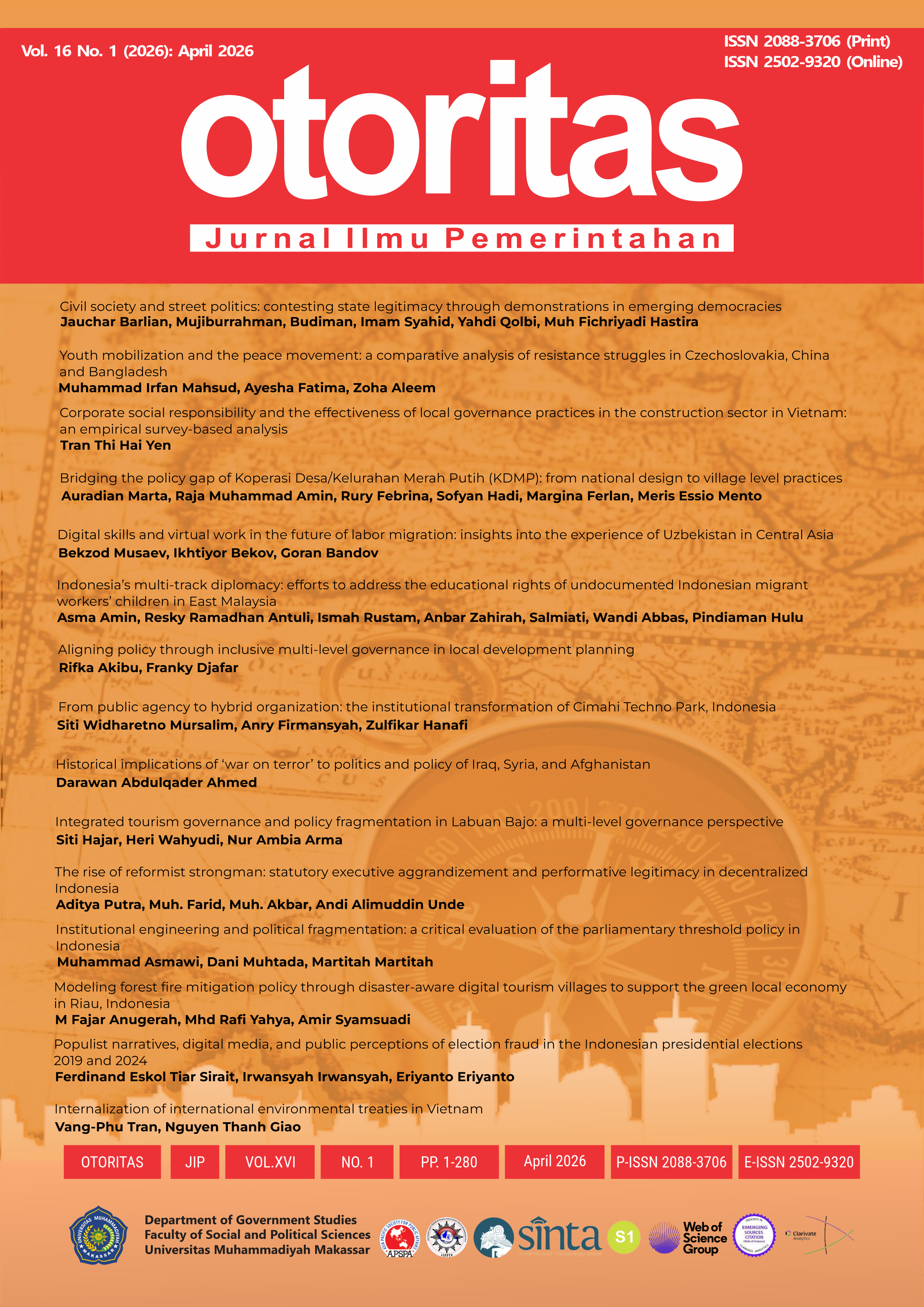
Internalization of international environmental treaties in Vietnam
DOI:
https://doi.org/10.26618/ojip.v16i1.20686Keywords:
international environmental law, internalization, climate change, sustainable development.Abstract
Global integration and the expansion of new-generation free trade agreements have intensified pressure on transitional economies to harmonize domestic legislation with international environmental law. This study examines how Vietnam’s 2020–2025 legislative reforms internalize core obligations derived from the Paris Agreement, Montreal Protocol, Basel Convention, and UNCLOS. Using a functional comparative law approach, it evaluates substantive compatibility, understood as the alignment between domestic statutory provisions, treaty obligations, and operational enforcement mechanisms. The novelty of this research lies in integrating legal transplantation theory with empirical policy analysis to assess not only formal legal convergence but also the institutional capacity required for effective compliance. The findings show that Vietnam has shifted from passive treaty ratification toward proactive regulatory integration, particularly through carbon pricing and Extended Producer Responsibility. However, the study also identifies patterns of isomorphic mimicry, whereby global legal forms are adopted without sufficient implementation capacity, resulting in persistent de facto enforcement gaps. Inter-sectoral tensions, especially between development-oriented land governance and biodiversity protection, further weaken regulatory coherence. This research contributes a conceptual evaluation model for environmental governance and offers practical insights for Global South transitional economies facing similar harmonization challenges.
References
Åhman, M., Nilsson, L. J., & Johansson, B. (2017). Global climate policy and deep decarbonization of energy-intensive industries. Climate Policy, 17(5), 634–649. https://doi.org/10.1080/14693062.2016.1167009
Anh, T. T. K., Mai, N. C., & Linh, T. M. (2024). Traditional Knowledge and Benefit Sharing. Vietnam Journal of Biotechnology, 22(1), 1–33. https://doi.org/10.15625/vjbt-20230
Bakhiyi, B., Gravel, S., Ceballos, D., Flynn, M. A., & Zayed, J. (2018). Has the question of e-waste opened a Pandora’s box? An overview of unpredictable issues and challenges. Environment International, 110, 173–192. https://doi.org/10.1016/j.envint.2017.10.021
Bibi, C., Tabassum, S., & Roussel, Y. (2024). International environmental law: Challenges and opportunities for biodiversity conservation. Journal of Energy and Environmental Policy Options, 7(2), 28–35.
Do, T. H., Vu, T. P., Nguyen, V. T., & Catacutan, D. (2018). Payment for forest environmental services in Vietnam: An analysis of buyers’ perspectives and willingness. Ecosystem Services, 32, 134–143. https://doi.org/10.1016/j.ecoser.2018.07.005
Ebeler, L., Balke, T., Laurie, E., Le, H., Nguyen, T., & Renaud, F. G. (2025). Local-scale impacts of mangrove restoration and conservation on coastal communities in two Vietnamese deltas: Socio-economic and institutional dynamics. Ocean and Coastal Management, 269, 107812. https://doi.org/10.1016/j.ocecoaman.2025.107812
Faure, M. G., & Partain, R. A. (2019). Environmental law and economics: Theory and practice. In Environmental Law and Economics: Theory and Practice. Cambridge University Press. https://doi.org/10.1017/9781108554916
Gallemore, C., Pham, T. T., Hamilton, M., & Munroe, D. K. (2024). Vietnam’s Payments for Forest Ecosystem Services scheme’s puzzling role in protecting longstanding forests as deforestation rates rise. Ecological Economics, 217, 108078. https://doi.org/10.1016/j.ecolecon.2023.108078
Ghosh, S. K., Parlikar, U. V., & Karstensen, K. H. (2021). Sustainable Management of Wastes Through Co-processing. Sustainable Management of Wastes Through Co-Processing, 1–374. https://doi.org/10.1007/978-981-16-6073-3
Hunter, D. (2018). International environmental law: international treaties and principles protect the environment and guard against climate change. Insights on L. & Soc’y, 19, 2. https://doi.org/10.4324/9781003451327-19
Leclerc, S. H., & Badami, M. G. (2020). Extended producer responsibility for E-waste management: Policy drivers and challenges. Journal of Cleaner Production, 251, 119657. https://doi.org/10.1016/j.jclepro.2019.119657
Legrand, P. (1997). The impossibility of ‘legal transplants.’ Maastricht Journal of European and Comparative Law, 4(2), 111–124.
Liu, K., Tan, Q., Yu, J., & Wang, M. (2023). A global perspective on e-waste recycling. Circular Economy, 2(1), 100028. https://doi.org/doi.org/10.1016/j.cec.2023.100028
Meckling, J., Sterner, T., & Wagner, G. (2017). Policy sequencing toward decarbonization. Nature Energy, 2(12), 918–922. https://doi.org/10.1038/s41560-017-0025-8
Mihai, F.-C., Gnoni, M. G., Meidiana, C., Schneider, P., Ezeah, C., & Elia, V. (2022). A Global Outlook on the Implementation of the Basel Convention and the Transboundary Movement of E-waste. In Paradigm Shift in E-waste Management (pp. 49–75). CRC Press. https://doi.org/10.1201/9781003095972-4
Mohapatra, P., Nøklebye, E., Arora, T., & Basu, A. R. (2023). International Regulatory Frameworks and Best Practices in Management of POPs. In Managing persistent organic pollutants in India: Case studies on Vapi and Surat, Gujarat (pp. 127–151). Springer. https://doi.org/10.1007/978-3-031-31311-0_7
Nguyen, Q. H., Tran, D. D., Dang, K. K., Korbee, D., Pham, L. D. M. H., Vu, L. T., Luu, T. T., Ho, L. H., Nguyen, P. T., Trang, T. T., Nguyen, D. T. K., Wyatt, A., van Aalst, M., Tran, T. A., & Sea, W. B. (2020). Land-use dynamics in the Mekong delta: From national policy to livelihood sustainability. Sustainable Development, 28(3), 448–467. https://doi.org/10.1002/sd.2036
Novemyanto, A. D. (2025). Legal and Economic Harmonization of Extended Producer Responsibility ( EPR ) as a Strategy for Sustainable Plastic Waste Management in Southeast Asia. Jurnal Penelitian Ilmu-Ilmu Sosial, 3(4), 357–364.
Pritchett, L., Woolcock, M., & Andrews, M. (2013). Looking Like a State: Techniques of Persistent Failure in State Capability for Implementation. Journal of Development Studies, 49(1), 1–18. https://doi.org/10.1080/00220388.2012.709614
Stockdale, N. L. (2016). United Nations Framework Convention on Climate Change. Water Planet: The Culture, Politics, Economics, and Sustainability of Water on Earth, 19(8), 400–401. https://doi.org/10.35935/edr/31.2513
Tortajada, C., & Biswas, A. K. (2016). Integrated water resources management. Routledge Taylor & Francis Group.
Tran, T. Y. A., Nguyen, T., Herat, S., Kaparaju, P., & Le, D. L. (2025). Monitoring and Assessing EPR Compliance of Producers and Importers To Prevent Free Riders in Developing Countries: the Case of Vietnam. Circular Economy and Sustainability, 5(7), 6171–6198. https://doi.org/10.1007/s43615-025-00703-3
Tung, D. Q., Bravo, F., Sierra-de-Grado, R., & Sam, H. Van. (2022). Global biodiversity-related conventions on facilitating biodiversity conservation in Vietnam. Forest and Society, 6(2), 489–502.
Van Phuong, T., & Pomeroy, R. S. (2022). Combating Illegal, Unreported and Unregulated (IUU) Fishing and Removing Yellow Card From European Commission (EC): Vietnam’s Determined Actions. Asian Fisheries Science, 35(1), 13–25. https://doi.org/10.33997/j.afs.2022.35.1.002
Vu, N.-K., & Minh Hoang, H.-T. (2025). Environmental Provisions Within New-Generation FTAs: Motivations, Implications, and Challenges. In Vietnam on the Road to Sustainable Economic, Social and Business Development (pp. 119–138). Springer. https://doi.org/10.1007/978-981-96-4371-4_6
Watson, A. (1975). Legal Transplants: An Approach to Comparative Law. In Stanford Law Review (Vol. 27, Issue 4). University of Georgia Press. https://doi.org/10.2307/1228215
World Bank. (2022). Vietnam Country Climate and Development Report. Elgar Encyclopedia of Human Rights, 600–605. https://doi.org/10.4337/9781789903621.world.bank.group
Downloads
Published
Issue
Section
License
Copyright (c) 2026 Otoritas : Jurnal Ilmu Pemerintahan

This work is licensed under a Creative Commons Attribution-ShareAlike 4.0 International License.
The Editorial Team of Otoritas: Jurnal Ilmu Pemerintahan reserves the right to transfer the copyright of the article once it has been accepted and a decision has been made to publish it.
Department of Government Studies, Faculty of Social and Political Sciences, Universitas Muhammadiyah Makassar in collaboration with Muhammadiyah’s College Association of Government Studies (AIPPTM) and Asia Pacific Society for Public Affairs (APSPA) as the publisher of Otoritas: Jurnal Ilmu Pemerintahan holds the copyright of all articles published in this journal.
The Publisher holds the right to reproduce and distribute the article and author is not allowed to publish the same article published in this journal.
Statement of Authenticity and Manuscript Copyright can be downloaded: here
After filling in the statement letter, please send via e-mail: otoritas@unismuh.ac.id