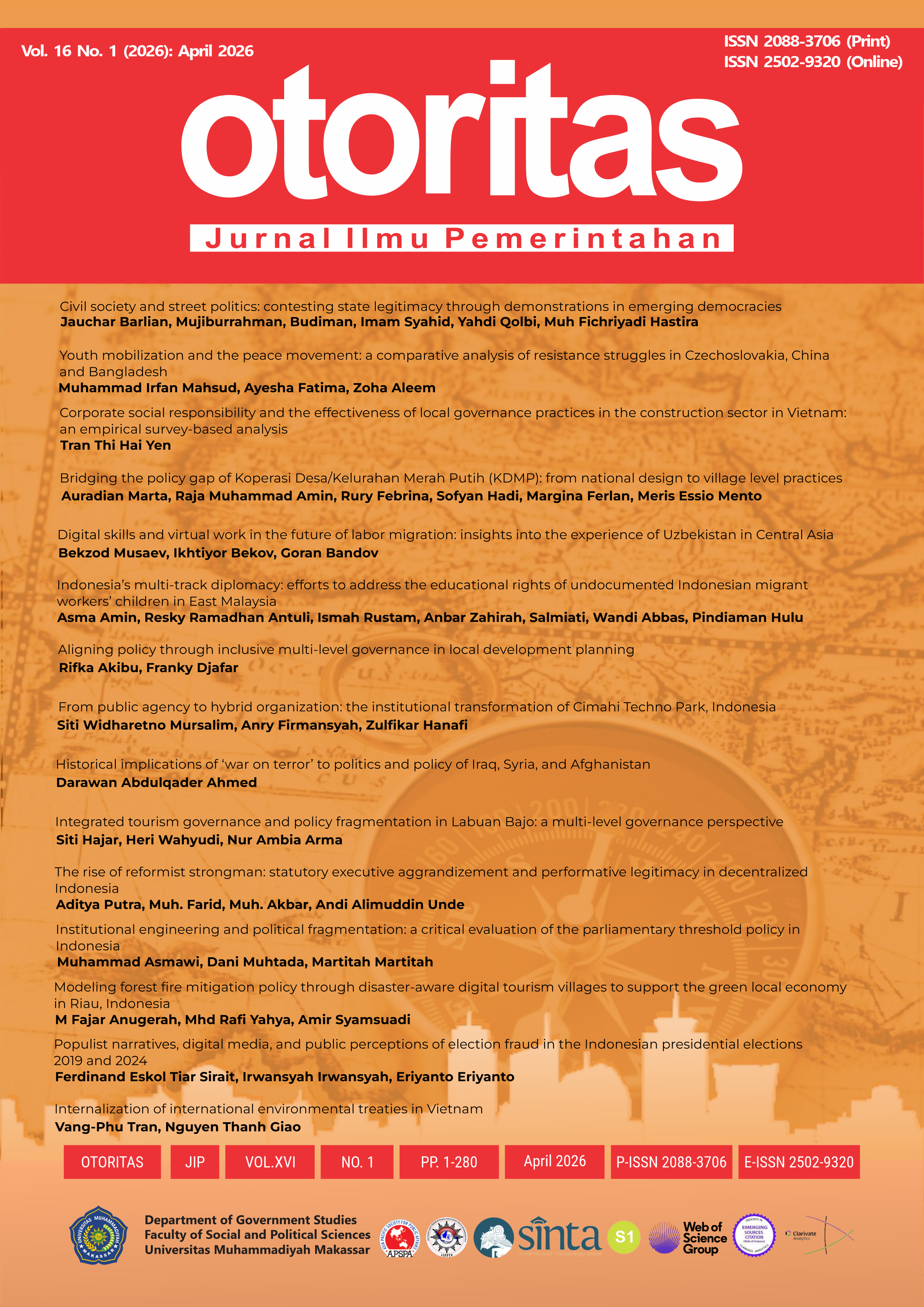
Historical implications of ‘war on terror’ to politics and policy of Iraq, Syria, and Afghanistan
DOI:
https://doi.org/10.26618/ojip.v16i1.20644Keywords:
Middle East, regional security complex theory, conflict, terrorism, war on terrorAbstract
Over the past few decades, the Middle East has been plagued by a series of conflicts linked to terrorism, which have disrupted the stability of several countries in the region. Since the war on terrorism was declared, terrorism has influenced politics and policy in the Middle East. Furthermore, terrorism has also hindered economic prosperity, development, and social welfare in countries caught up in conflict. This article aims to examine terrorism and its impact on the political and policy spheres in the Middle East, specifically in the selected countries: Syria, Iraq, and Afghanistan. This article uses a case study method to examine this topic in detail for each country. This article utilizes several global indices, including the Global Terrorism Index 2017–2024, the Global Peace Index, the Conflict Index, the Fragile States Index, and the Failed States Index. The findings indicate that regime change, clashes over ethnic and religious differences, and regional power politics are the underlying causes of the ongoing conflicts in the Middle East. Based on the findings of this study, it can be concluded that the context and conditions of Iraq, Syria, and Afghanistan as post-conflict states remain fragile and are influenced by terrorism, the impact of the war on terror, and regional competition, which have serious long-term implications for each country. This article contributes to the development of the Regional Security Complex Theory by Buzan and Waver (2003) regarding the War on Terrorism, which relates to the Middle East security dilemma and the balance of power.
References
Abadie, A., & Gardeazabal, J. (2019). Terrorism and the world economy. In Transnational Terrorism (pp. 283–309). Routledge. https://doi.org/10.4324/9781315235691-14
Abhyankar, R. M. (2020). Syria: The Tragedy of a Pivotal State. Springer Nature.
Ahmed, S. (2025). The Middle East: terrorism, international law, and the cosmopolitan Myth. Critical Studies on Terrorism, 18(2), 400–423. https://doi.org/10.1080/17539153.2025.2461727
Amable, D. S. (2022). Theorizing the Emergence of Security Regions: An Adaptation for the Regional Security Complex Theory. Global Studies Quarterly, 2(4), ksac065. https://doi.org/10.1093/isagsq/ksac065
Amour, P. O. (2020). Introduction: The Regional Order in the Gulf Region and the Middle East. In The Regional Order in the Gulf Region and the Middle East: Regional Rivalries and Security Alliances (pp. 1–25). Springer. https://doi.org/10.1007/978-3-030-45465-4_1
Bakowski. (2025). EU policies – Insights Understanding EU counter - terrorism policy. February.
Baviera, A. S. P. (2015). Power and International Relations. Asian Politics and Policy, 7(3), 345–346. https://doi.org/10.1111/aspp.12205
Bentley, M., & Holland, J. (2014). Obama’s Foreign Policy. Ending the War on Terror.’London: Routledge.
Bilgin, P. (2011). Regional security in the middle east: A critical perspective. In Regional Security in the Middle East: A Critical Perspective. Routledge. https://doi.org/10.4324/9780203358320
Bindi, F. M. (2010). The foreign policy of the European Union : assessing Europe’s role in the world. Rowman & Littlefield.
Boloix, G. (2019). Socialism and Failed States. Lulu. com.
Buzan, B., & Wæver, O. (2003). Regions and Powers (Vol. 91). Cambridge University Press. https://doi.org/10.1017/CBO9780511491252
Casaca, P. (2017). The War on Terror. In Terrorism Revisited: Islamism, Political Violence and State-Sponsorship (pp. 199–218). Springer. https://doi.org/10.1007/978-3-319-55690-1_8
Chomsky, N. (2007). Failed states: The abuse of power and the assault on democracy. Metropolitan Books.
Cordesman, A. H., & Al-Rodhan, K. R. (2006). Iran’s weapons of mass destruction: the real and potential threat. In Choice Reviews Online (Vol. 44, Issue 04). CSIS. https://doi.org/10.5860/choice.44-2362
Corn, G. S., Schoettler, Jr., J. A., Brenner-Beck, D., Hansen, V. M., Jackson, D., Jensen, E. T., Lewis, M. W., & Dunlap, Jr., C. J. (2015). The War on Terror and the Laws of War. Oxford University Press. https://doi.org/10.1093/acprof:oso/9780199941452.001.0001
Council of the European Union. (2023). Council of Europe adopts new counter-terrorism strategy for 2023–2027.
Council of the European Union. (2024). Bartjan Wegter to become the new EU Counter-Terrorism Coordinator.
Dawoody, A. R. (2016). Eradicating terrorism from the Middle East : policy and administrative approaches (Vol. 17). Springer.
de Nardis, F. (2020). Understanding Politics and Society. Springer International Publishing. https://doi.org/10.1007/978-3-030-37760-1
European Union Global Strategy. (2016). Shared Vision, Common Action: A Stronger Europe - A Global Strategy for the European Union’s Foreign And Security Policy. European Union Global Strategy, 14.
Ezrow, N. M., & Frantz, E. (2013). Failed states and institutional decay: Understanding instability and poverty in the developing world. In Failed States and Institutional Decay: Understanding Instability and Poverty in the Developing World. Bloomsbury Publishing USA. https://doi.org/10.5040/9781501300974
Fawn, R. (2009). Globalising the Regional, Regionalising the Global (R. Fawn (ed.)). Cambridge University Press. https://doi.org/10.1017/CBO9781139087339
Franks, J. (2006). Rethinking the Roots of Terrorism. In Rethinking Peace and Conflict Studies (pp. 1–245). Springer. https://doi.org/10.5860/choice.44-2350
Haken, N., Messner, J. J., Hendry, K., Taft, P., Lawrence, K., Brisard, L., & Umaña, F. (2014). Fragile States Index 2014.
Hampson, F. O., Buzan, B., Waever, O., & Wilde, J. de. (1998). Security: A New Framework for Analysis. In International Journal (Vol. 53, Issue 4). Lynne Rienner Publishers. https://doi.org/10.2307/40203739
Hannun, M., Lin, P. H. A., & Schmeding, A. (2022). Disentangling the War on Terror: Present Pasts and Possible Futures. International Journal of Middle East Studies, 54(2), 338–339. https://doi.org/10.1017/S0020743822000459
Haupt, H. G., & Weinhauer, K. (2011). Terrorism and the state. Political Violence in Twentieth-Century Europe, 176–209. https://doi.org/10.1017/CBO9780511793271.006
Herlin-Karnell, E., & Matera, C. (2014). External Dimension of the EU Counter-Terrorism Policy. In CLEER Working Papers (Vol. 2). Asser Institute. Centre for the Law of EU External Relations. www.cleer.eu
Holbrook, D. (2014). The Al-Qaeda Doctrine : The Framing and Evolution of the Leadership’s Public Discourse. Bloomsbury Academic. https://doi.org/10.5040/9781501302275
Howard, T. (2016). Failed States and the Origins of Violence. Routledge. https://doi.org/10.4324/9781315581828
Kane, C., & Murauskaite, E. (2014). Regional security dialogue in the middle east changes, challenges and opportunities. Regional Security Dialogue in the Middle East: Changes, Challenges and Opportunities, 1–254. https://doi.org/10.4324/9781315773865
Kaunert, C. (2018). The external dimension of counter-terrorism co-operation. In European internal security (pp. 90–120). Manchester University Press. https://doi.org/10.7765/9781526130938.00010
Kim, W., & Sandler, T. (2020). Middle East and North Africa: Terrorism and Conflicts. Global Policy, 11(4), 424–438. https://doi.org/10.1111/1758-5899.12829
Lansford, T., Watson, R. P., & Covarrubias, J. (2009). America’s war on terror. Ashgate Publishing, Ltd.
Larres, K., & Hof, T. (2022). Terrorism and Transatlantic Relations. In K. Larres & T. Hof (Eds.), Terrorism and Transatlantic Relations. Springer International Publishing. https://doi.org/10.1007/978-3-030-83347-3
Legrenzi, M., & Harders, C. (2008). Beyond regionalism? Regional cooperation, regionalism and regionalization in the Middle East. In Beyond Regionalism?: Regional Cooperation, Regionalism and Regionalization in the Middle East. Ashgate Publishing, Ltd.
Levy, J. S., & Thompson, W. R. (2010). Balancing on land and at sea: Do states ally against the leading global power? International Security, 35(1), 7–43. https://doi.org/10.1162/ISEC_a_00001
Loft, P., & Brooke-Holland, L. (2025). Countering Islamic State/ Daesh in Africa, Syria and Iraq 2025. March, 1–31.
Mansour-Ille, D. (2021). Counterterrorism policies in the Middle East and North Africa: A regional perspective. International Review of the Red Cross, 103(916–917), 653–679.
Maoz, Z. (1997). Regional Security in the Middle East: Past, Present and Future. Routledge.
Margolin, D., & Cook, J. (2024). Five Decades of Research on Women and Terrorism. Studies in Conflict and Terrorism, 1–29. https://doi.org/10.1080/1057610X.2024.2357178
Morris, N. A., LaFree, G., & Karlidag, E. (2021). Counter-terrorism policies in the Middle East: Why democracy has failed to reduce terrorism in the Middle East and why protecting human rights might be more successful. Criminology and Public Policy, 20(1), 153–175. https://doi.org/10.1111/1745-9133.12532
Mueller, J., & Stewart, M. G. (2015). Terror, Security, and Money. In Terror, Security, and Money. Oxford University Press. https://doi.org/10.1093/acprof:osobl/9780199795758.001.0001
Nordenman, M. (2013). The end of the war on terror and the future of US counterterrorism. Mediterranean Quarterly, 24(3), 6–19. https://doi.org/10.1215/10474552-2339516
Pereira, L. C., & Martins, B. O. (2014). The European Union’s Fight Against Terrorism. Routledge. https://doi.org/10.7765/9781526100818
Polo, S. M. T., & González, B. (2020). The Power to Resist: Mobilization and the Logic of Terrorist Attacks in Civil War. Comparative Political Studies, 53(13), 2029–2060. https://doi.org/10.1177/0010414020912264
Ritchie, B. W., Burns, P., & Palmer, C. (2005). Tourism research methods: integrating theory with practice. Cabi.
Russell, R. L. (2006). Weapons proliferation and war in the greater Middle East: Strategic contest. In Weapons Proliferation and War in the Greater Middle East: Strategic Contest. Routledge. https://doi.org/10.4324/9780203018392
Schmoll, M. C. (2016). Regional Powers in the Middle East: New Constellations after the Arab Revolts. In Israel Journal of Foreign Affairs (Vol. 10, Issue 1). Springer. https://doi.org/10.1080/23739770.2016.1141548
Smith, M., & Zeigler, S. M. (2017). Terrorism before and after 9/11 – A more dangerous world? Research and Politics, 4(4), 2053168017739757. https://doi.org/10.1177/2053168017739757
Stewart-Ingersoll, R., & Frazier, D. (2012). Regional powers and security orders: A theoretical framework. In Regional Powers and Security Orders: A Theoretical Framework. Routledge. https://doi.org/10.4324/9780203804995
Stockhammer, N. (2025). European Trend Report on Terrorism 2025. European Institute for Counter Terrorism and Conflict Prevention (EICTP), 91, 91.
Store, J. G. (2006). Foreign policy strategy for combating international terrorism. In Norway: Ministry of Foreign Affairs.
Taylor, A. (2013). State Failure. In State Failure. Palgrave Macmillan UK. https://doi.org/10.1057/9781137318039
Underhill, N. (2014). Countering Global Terrorism and Insurgency Calculating the Risk of State Failure in Afghanistan, Pakistan, and Iraq. In New Security Challenges. Springer. https://doi.org/10.5860/choice.192340
Yin, R. K. (2003). CASE STUDI RESEARCH design and methods third edition. Sage Pulblications, 5(1), 6–14.
Zelikow, P., & Pillar, P. R. (2001). Terrorism and U.S. Foreign Policy. In Foreign Affairs (Vol. 80, Issue 5). Rowman & Littlefield. https://doi.org/10.2307/20050261
Downloads
Published
Issue
Section
License
Copyright (c) 2026 Otoritas : Jurnal Ilmu Pemerintahan

This work is licensed under a Creative Commons Attribution-ShareAlike 4.0 International License.
The Editorial Team of Otoritas: Jurnal Ilmu Pemerintahan reserves the right to transfer the copyright of the article once it has been accepted and a decision has been made to publish it.
Department of Government Studies, Faculty of Social and Political Sciences, Universitas Muhammadiyah Makassar in collaboration with Muhammadiyah’s College Association of Government Studies (AIPPTM) and Asia Pacific Society for Public Affairs (APSPA) as the publisher of Otoritas: Jurnal Ilmu Pemerintahan holds the copyright of all articles published in this journal.
The Publisher holds the right to reproduce and distribute the article and author is not allowed to publish the same article published in this journal.
Statement of Authenticity and Manuscript Copyright can be downloaded: here
After filling in the statement letter, please send via e-mail: otoritas@unismuh.ac.id