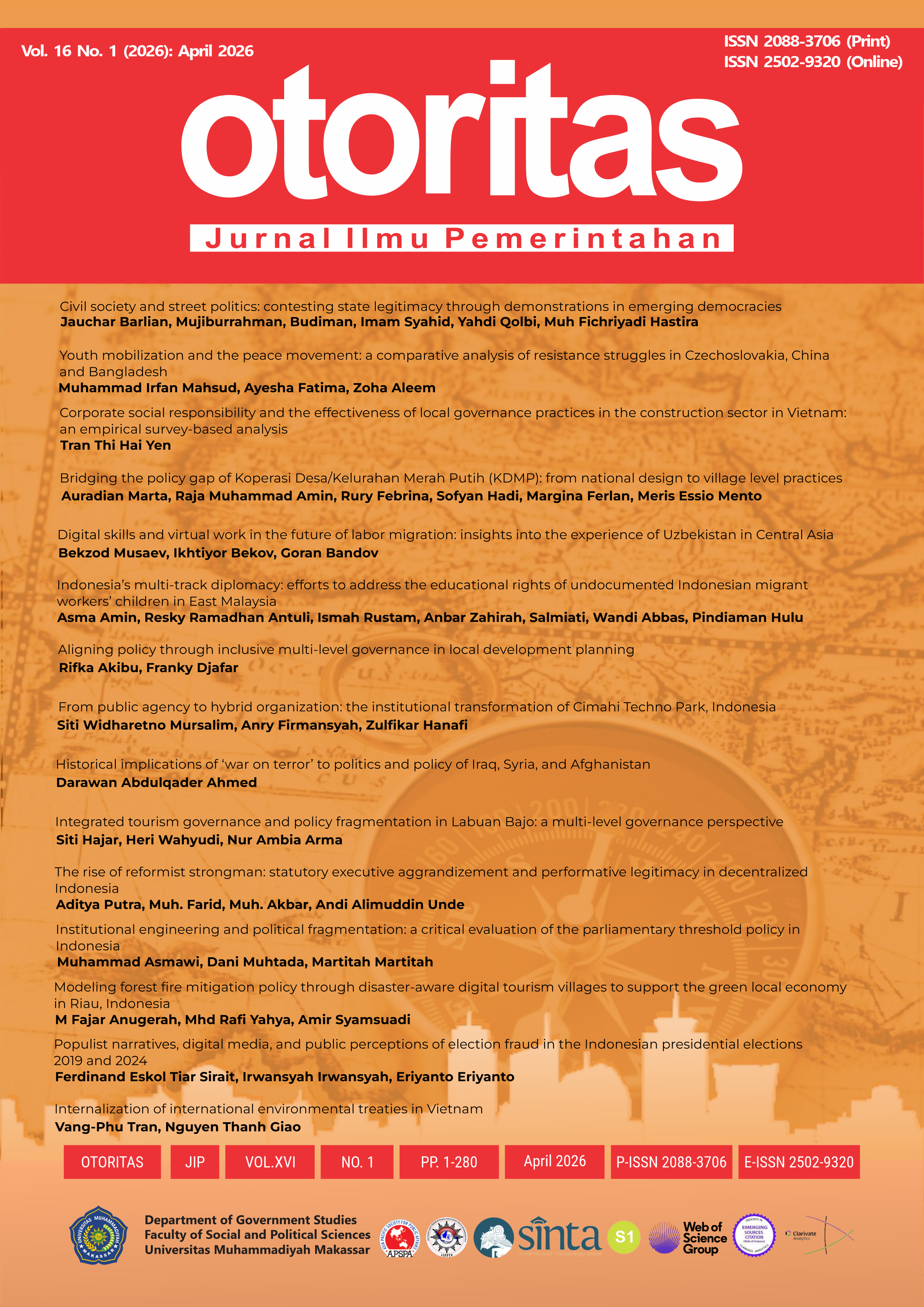
Corporate social responsibility and the effectiveness of local governance practices in the construction sector in Vietnam: an empirical survey-based analysis
DOI:
https://doi.org/10.26618/ojip.v16i1.20226Keywords:
CSR, local governance, sustainable development, governance effectiveness, construction enterprisesAbstract
Corporate Social Responsibility (CSR) is increasingly recognized as a strategic instrument for strengthening public governance and advancing sustainable development, particularly in emerging economies such as Vietnam. In the construction sector, which is characterized by high environmental and social risks, the integration of CSR remains largely voluntary, with limited regulatory enforcement and weak monitoring systems. This institutional gap creates urgency to investigate how CSR contributes to local governance effectiveness, especially within the context of ongoing digital transformation. This study examines the impact of CSR dimensions on local governance effectiveness in Vietnam’s construction sector using 110 survey based observations from firms, government officials, and experts collected between 2022 and 2024. A quantitative approach was applied, including Cronbach’s Alpha, Pearson correlation, and multiple linear regression using SPSS 26.0. The results indicate that all CSR components significantly enhance governance effectiveness, with legal and ethical responsibilities exerting a stronger influence than economic and philanthropic dimensions. The novelty of this research lies in positioning CSR as a complementary governance mechanism rather than merely a corporate obligation. The study contributes empirical evidence to the limited literature on CSR and public governance in developing contexts and offers policy relevant insights to strengthen legal frameworks, improve multi stakeholder coordination, and promote ethical business practices for sustainable governance outcomes.
References
Aben, T. A. E., van der Valk, W., Roehrich, J. K., & Selviaridis, K. (2021). Managing information asymmetry in public–private relationships undergoing a digital transformation: the role of contractual and relational governance. International Journal of Operations & Production Management, 41(7), 1145–1191. https://doi.org/10.1108/IJOPM-09-2020-0675
Armstrong, R., Waters, E., Dobbins, M., Anderson, L., Moore, L., Petticrew, M., Clark, R., Pettman, T. L., Burns, C., Moodie, M., Conning, R., & Swinburn, B. (2013). Knowledge translation strategies to improve the use of evidence in public health decision making in local government: Intervention design and implementation plan. Implementation Science, 8(1), 121. https://doi.org/10.1186/1748-5908-8-121
Braithwaite, J. (2001). Restorative Justice & Responsive Regulation. Oxford University PressNew York, NY. https://doi.org/10.1093/oso/9780195136395.001.0001
Collinge, W. (2020). Stakeholder Engagement in Construction: Exploring Corporate Social Responsibility, Ethical Behaviors, and Practices. Journal of Construction Engineering and Management, 146(3). https://doi.org/10.1061/(ASCE)CO.1943-7862.0001769
Ding, H., & Wang, Z. (2025). The Influence of Institutional Pressures on Environmental, Social, and Governance Responsibility Fulfillment: Insights from Chinese Listed Firms. Sustainability, 17(9), 3982. https://doi.org/10.3390/su17093982
Dmytriyev, S. D., Freeman, R. E., & Hörisch, J. (2021). The Relationship between Stakeholder Theory and Corporate Social Responsibility: Differences, Similarities, and Implications for Social Issues in Management. Journal of Management Studies, 58(6), 1441–1470. https://doi.org/10.1111/joms.12684
Dwivedi, O. P. (2002). Rethinking Democratic Accountability. In Political Science Quarterly (Vol. 117, Issue 3). Globe Pequot Publishing Group Incorporated/Bloomsbury. https://doi.org/10.2307/798293
Fan, P., Ouyang, Z., Nguyen, D. D., Nguyen, T. T. H., Park, H., & Chen, J. (2019). Urbanization, economic development, environmental and social changes in transitional economies: Vietnam after Doimoi. Landscape and Urban Planning, 187, 145–155. https://doi.org/https://doi.org/10.1016/j.landurbplan.2018.10.014
Freeman, R. E. (2010). Strategic Management. Cambridge University Press. https://doi.org/10.1017/CBO9781139192675
Grimmelikhuijsen, S. G. (2010). Transparency of Public Decision‐Making: Towards Trust in Local Government? Policy & Internet, 2(1), 5–35. https://doi.org/10.2202/1944-2866.1024
Harrison, J. S., Bosse, D. A., & Phillips, R. A. (2010). Managing for stakeholders, stakeholder utility functions, and competitive advantage. Strategic Management Journal, 31(1), 58–74. https://doi.org/10.1002/smj.801
Hudon, P.-A., & Floricel, S. (2023). The development of large public infrastructure projects: integrating policy and project studies models. Policy and Society, 42(2), 148–163. https://doi.org/10.1093/polsoc/puad004
Keping, Y. (2018). Governance and Good Governance: A New Framework for Political Analysis. Fudan Journal of the Humanities and Social Sciences, 11(1), 1–8. https://doi.org/10.1007/s40647-017-0197-4
Lane, J.-E. (2002). New Public Management: An Introduction (Google eBook). Routledge. https://www.taylorfrancis.com/books/mono/10.4324/9780203467329/new-public-management-jan-erik-lane%0Ahttp://books.google.com/books?hl=de&lr=&id=BZvjUL-8kWkC&pgis=1
Maddaloni, F. Di, & Sabini, L. (2022). Very important, yet very neglected: Where do local communities stand when examining social sustainability in major construction projects? International Journal of Project Management, 40(7), 778–797. https://doi.org/10.1016/j.ijproman.2022.08.007
McEvily, B., Zaheer, A., & Kamal, D. K. F. (2017). Mutual and exclusive: Dyadic sources of trust in interorganizational exchange. Organization Science, 28(1), 74–92. https://doi.org/10.1287/orsc.2016.1102
Menghwar, P. S., & Daood, A. (2021). Creating shared value: A systematic review, synthesis and integrative perspective. International Journal of Management Reviews, 23(4), 466–485. https://doi.org/10.1111/ijmr.12252
Ndreu, A. (2016). the Definition and Importance of Local Governance. Social and Natural Sciences Journal, 10(1). https://doi.org/10.12955/snsj.v10i1.730
Nguyen, C. V., Giang, L. T., Tran, A. N., & Do, H. T. (2021). Do Good Governance and Public Administration Improve Economic Growth and Poverty Reduction? The Case of Vietnam. International Public Management Journal, 24(1), 131–161. https://doi.org/10.1080/10967494.2019.1592793
Nguyen, M., Bensemann, J., & Kelly, S. (2018). Corporate social responsibility (CSR) in Vietnam: a conceptual framework. International Journal of Corporate Social Responsibility, 3(1), 9. https://doi.org/10.1186/s40991-018-0032-5
North, D. C. (2008). Institutions and the Performance of Economies over Time. In Handbook of New Institutional Economics (pp. 21–30). Springer. https://doi.org/10.1007/978-3-540-69305-5_2
Plewa, C., Carrillat, F. A., Mazodier, M., & Quester, P. G. (2016). Which sport sponsorships most impact sponsor CSR image? European Journal of Marketing, 50(5–6), 796–815. https://doi.org/https://doi.org/10.1108/EJM-02-2015-0078
Rotberg, R. I. (2014). Good Governance Means Performance and Results. Governance, 27(3), 511–518. https://doi.org/10.1111/gove.12084
Taamneh, M., Hummour, A. M. A., & Quroan, N. A. Al. (2020). Local decision-making within the concept of governance in Jordan. Middle East J. of Management, 7(2), 109. https://doi.org/10.1504/mejm.2020.105942
Thanh, V. Van, & Tri, N. M. (2025). Developing the State Economic Sector in Vietnam. Calitatea, 26(207), 38–44. https://doi.org/10.47750/QAS/26.207.05
Tolmie, C. R., Lehnert, K., & Zhao, H. (2020). Formal and informal institutional pressures on corporate social responsibility: A cross‐country analysis. Corporate Social Responsibility and Environmental Management, 27(2), 786–802. https://doi.org/10.1002/csr.1844
Tran, A. T., & Nguyen, P. A. (2025). The Effect of Provincial Governance and Public Administration Performance Index on Total Factor Productivity in Vietnam. Cogent Social Sciences, 11(1), 2504128. https://doi.org/10.1080/23311886.2025.2504128
Turner, S. (2025). James C. Scott, Seeing Like a State: How Certain Schemes to Improve the Human Condition Have Failed: Yale University Press, 2020 new edition [1998], 464 pp., ISBN: 978-0300246759. Springer.
Von Schnurbein, G., Seele, P., & Lock, I. (2016). Exclusive corporate philanthropy: Rethinking the nexus of CSR and corporate philanthropy. Social Responsibility Journal, 12(2), 280–294. https://doi.org/10.1108/SRJ-10-2014-0149
Yang, R. J., & Shen, G. Q. P. (2015). Framework for Stakeholder Management in Construction Projects. Journal of Management in Engineering, 31(4). https://doi.org/10.1061/(ASCE)ME.1943-5479.0000285
Downloads
Published
Issue
Section
License
Copyright (c) 2026 Otoritas : Jurnal Ilmu Pemerintahan

This work is licensed under a Creative Commons Attribution-ShareAlike 4.0 International License.
The Editorial Team of Otoritas: Jurnal Ilmu Pemerintahan reserves the right to transfer the copyright of the article once it has been accepted and a decision has been made to publish it.
Department of Government Studies, Faculty of Social and Political Sciences, Universitas Muhammadiyah Makassar in collaboration with Muhammadiyah’s College Association of Government Studies (AIPPTM) and Asia Pacific Society for Public Affairs (APSPA) as the publisher of Otoritas: Jurnal Ilmu Pemerintahan holds the copyright of all articles published in this journal.
The Publisher holds the right to reproduce and distribute the article and author is not allowed to publish the same article published in this journal.
Statement of Authenticity and Manuscript Copyright can be downloaded: here
After filling in the statement letter, please send via e-mail: otoritas@unismuh.ac.id