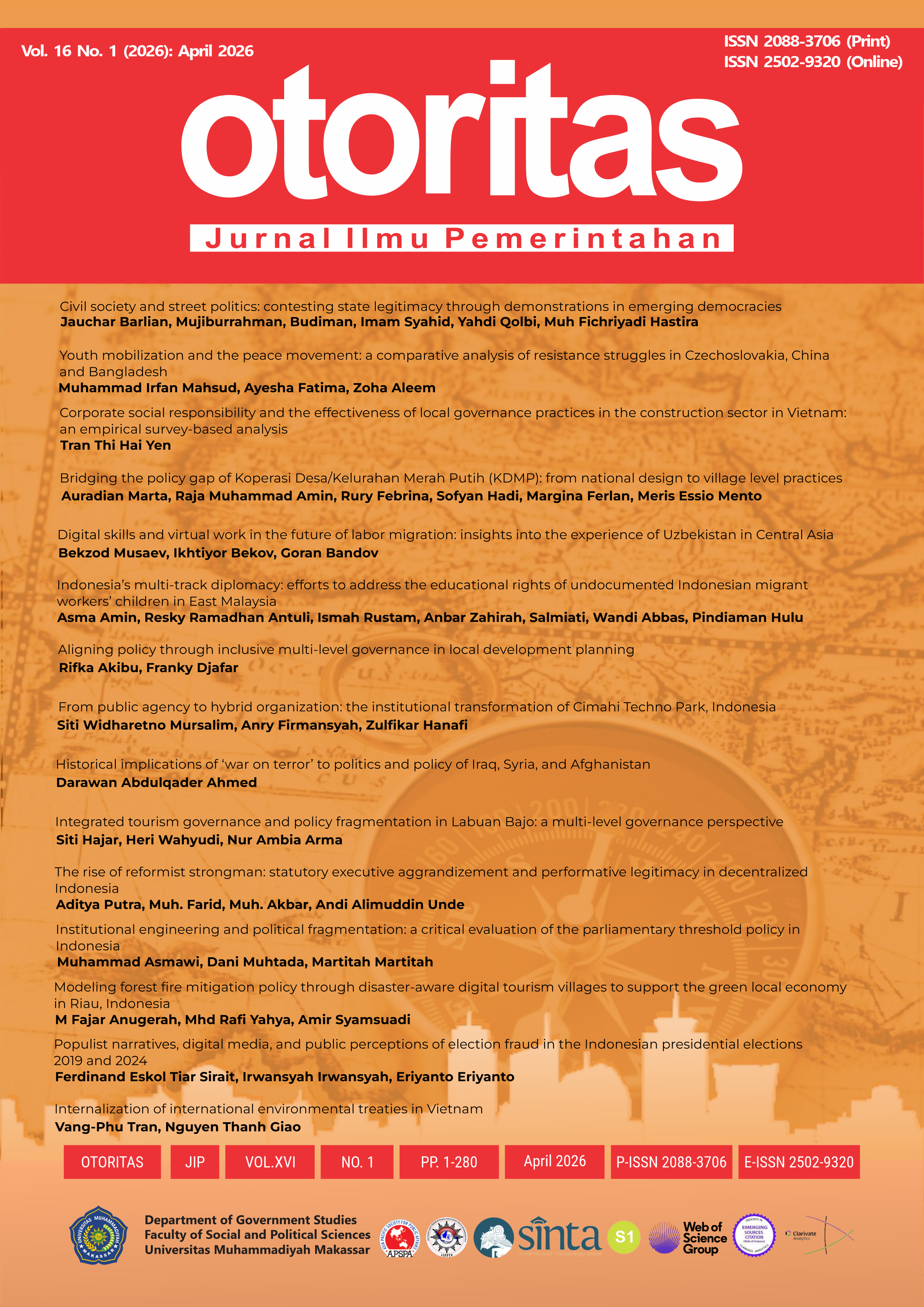
Civil society and street politics: contesting state legitimacy through demonstrations in emerging democracies
DOI:
https://doi.org/10.26618/ojip.v16i1.19963Keywords:
civil society, street politics, state legitimacy, public sphere, deliberative democracyAbstract
The wave of street demonstrations in Indonesia in recent years has highlighted tensions between the state and civil society, particularly when representative institutions are perceived as no longer capable of engaging in deliberative communication with citizens. This study aims to analyze street demonstrations as a political practice of civil society in response to the weakening of trust in formal democratic channels. This study focuses on a series of protests demanding the dissolution of the House of Representatives on August 25–31, 2025. This study used a phenomenological approach to analyze the symbolic and moral meanings emerging from the demonstrations. Data were collected through an analysis of media reports, civil society organization reports, official state documents, and social media content. The analytical process followed the Miles and Huberman model through data reduction, presentation, and conclusions. The findings indicate that when communication between the state and citizens is disrupted and public trust weakens, street politics emerges as a space to articulate criticism and ethical demands. The escalation of violence, differing narratives regarding the victims, and high public dissatisfaction with the handling of protests highlight the tension between electoral legitimacy and moral legitimacy. This study suggests that democratic legitimacy is dynamic and continuously negotiated through interactions between the state and civil society, as well as non-electoral participation in the public sphere.
References
Alnemr, N. (2025). Deliberative democracy in an algorithmic society: harms, contestations and deliberative capacity in the digital public sphere. Democratization, 1–20. https://doi.org/10.1080/13510347.2025.2522920
AROPI. (2025). Bedah Persepsi Publik Terhadap Unjuk Rasa Agustus–September & Isu Kontemporer. Asosiasi Riset & Opini Publik Indonesia.
Beliakova, N., & Timofeeva, Z. (2025). Religious Symbolism and Political Resistance: Navalny’s Martyr Narrative in the Russian Opposition. Religions, 16(1), 40. https://doi.org/10.3390/rel16010040
Bennett, W. L., & Segerberg, A. (2012). The logic of connective action: Digital media and the personalization of contentious politics. In The Logic of Connective Action: Digital Media and the Personalization of Contentious Politics. Cambridge University Press. https://doi.org/10.1017/CBO9781139198752
Boell, S. K., & Cecez-Kecmanovic, D. (2014). A hermeneutic approach for conducting literature reviews and literature searches. Communications of the Association for Information Systems, 34(1), 257–286. https://doi.org/10.17705/1cais.03412
Butler, J. (2016). Frames of War: When Is Life Grievable? Verso Books.
Carnegie Endowment for International Peace. (2025). Global Protest Tracker. Carnegieendowment.Org.
Chiwarawara, K. (2025). Character and social organisation of community protests in South Africa. African Identities, 23(1), 213–230. https://doi.org/10.1080/14725843.2023.2251695
Christmas, S. K., & Angelina, P. (2022). Efektivitas Kepolisian Sebagai Lembaga Rule of Law Dalam Mengemban Nilai-Nilai Demokrasi. Tanjungpura Law Journal, 6(1), 14. https://doi.org/10.26418/tlj.v6i1.46572
Cohen, J. L., & Arato, A. (1992). Civil Society and Political Theory. MIT Press. https://doi.org/10.7551/mitpress/1434.001.0001
Dalton, R. J. (2022). Political Action, Protest, and the Functioning of Democratic Governance. American Behavioral Scientist, 66(4), 533–550. https://doi.org/10.1177/00027642211021624
Davenport, C. (2007). State Repression and Political Order. Annual Review of Political Science, 10(1), 1–23. https://doi.org/10.1146/annurev.polisci.10.101405.143216
Denzin, N. K., & Lincoln, Y. S. (2011). The SAGE Handbook of Qualitative Research. SAGE Publications.
Diamond, L. (2006). Seymour Martin Lipset. 1959. “Some Social Requisites of Democracy: Economic Development and Political Legitimacy.” American Political Science Review 53 (March): 69–105 Cited 455 times. American Political Science Review, 100(4), 675–676. https://doi.org/10.1017/S000305540628256X
Diamond, L. (2008). The spirit of democracy: the struggle to build free societies throughout the world.
Diamond, L. (2024). The Spirit of Democracy: The Struggle to Build Free Societies Throughout the World (unabridged). Macmillan.
Earl, J. (2011). Political Repression: Iron Fists, Velvet Gloves, and Diffuse Control. Annual Review of Sociology, 37(1), 261–284. https://doi.org/10.1146/annurev.soc.012809.102609
Fabio Angiolillo, Ana Good God, Marina Nord, S. I. L. (2025). Democracy Report 2025: 25 Years of Autocratization – Democracy Trumped? University.
Fahmi, I. (2025). Sentimen Publik terhadap Insiden Brimob Melindas Driver Ojol. Drone Emprit. https://pers.droneemprit.id/sentimen-publik-terhadap-insiden-brimob-melindas-driver-ojol/
Fisher, D. R., Andrews, K. T., Caren, N., Chenoweth, E., Heaney, M. T., Leung, T., Perkins, L. N., & Pressman, J. (2019). The science of contemporary street protest: New efforts in the United States. Science Advances, 5(10). https://doi.org/10.1126/sciadv.aaw5461
Fishman, R. M. (2025). Deepening or Endangering Democracy: Demonstrations and Institutions under Representative Government. Perspectives on Politics, 23(1), 93–102. https://doi.org/10.1017/S1537592723002955
Flesher Fominaya, C. (2017). European anti-austerity and pro-democracy protests in the wake of the global financial crisis. Social Movement Studies, 16(1), 1–20. https://doi.org/10.1080/14742837.2016.1256193
Flick, U. (2018). An Introduction to Qualitative Research. SAGE Publications.
Given, L. M. (2015). 100 Questions (and Answers) About Qualitative Research. SAGE Publications.
Goodwin, J., Jasper, J. M., & Polletta, F. (2013). Passionate Politics. Emotions and social movements. In Passionate Politics.
Habermas, J., & Burger, T. (1991). The Structural Transformation of the Public Sphere: An Inquiry into a Category of Bourgeois Society. MIT Press.
Husserl, E. (1970). The Crisis of European Sciences and Transcendental Phenomenology: An Introduction to Phenomenological Philosophy. Northwestern University Press.
Imran, D., & Sardini, N. H. (2022). Bayang Otoritarianisme Digital: Analisis Rkuhp Kehormatan Penyelenggara Negara Dan Kebebasan Menyatakan Pendapat. Jurnal Education and Development, 11(1), 24–30. https://doi.org/10.37081/ed.v11i1.4223
Indriasari, D. T., & Karman, K. (2024). Freedom of Expression in Regulatory Pressure: Case Study on the Electronic Information and Transaction Law. Jurnal The Messenger, 15(1), 34–51. https://doi.org/10.26623/themessenger.v15i1.5787
Ishkanian, A. (2022). Social Movements and Social Policy: New Research Horizons. Journal of Social Policy, 51(3), 582–595. https://doi.org/10.1017/S0047279421001008
Jasper, J. M. (2011). Emotions and Social Movements: Twenty Years of Theory and Research. Annual Review of Sociology, 37(1), 285–303. https://doi.org/10.1146/annurev-soc-081309-150015
Juris, J. S. (2014). Embodying Protest: Culture and Performance within Social Movements. In Conceptualizing Culture in Social Movement Research (pp. 227–247). Springer. https://doi.org/10.1057/9781137385796_11
Kadivar, M. A. (2018). Mass Mobilization and the Durability of New Democracies. American Sociological Review, 83(2), 390–417. https://doi.org/10.1177/0003122418759546
Kang, S. (2023). Upping the ante without taking up arms: Why mass movements escalate demands. Journal of Peace Research, 60(1), 73–87. https://doi.org/10.1177/00223433221137614
Karn, S. (2023). Death – a concept of ‘martyrology’: references from Maoists people’s war in Nepal. Mortality, 28(3), 429–442. https://doi.org/10.1080/13576275.2021.1991902
Kilby, L. (2024). Protest, race and grievability: What does it mean for lives to matter? Social and Personality Psychology Compass, 18(1), e12805. https://doi.org/https://doi.org/10.1111/spc3.12805
Klandermans, B. (2012). Between Rituals and Riots: The Dynamics of Street Demonstrations. Mobilization: An International Quarterly, 17(3), 233–234. https://doi.org/10.17813/maiq.17.3.93g42727640w5102
Klein, G. R., & Regan, P. M. (2018). Dynamics of Political Protests. International Organization, 72(2), 485–521. https://doi.org/DOI: 10.1017/S0020818318000061
Leach, D. K. (2016). Clandestine Political Violence. In Contemporary Sociology: A Journal of Reviews (Vol. 45, Issue 1). https://doi.org/10.1177/0094306115621526m
Leitz, Lisa. (2025). The Politics of Grief and Mourning: Calls to Action and Processing Emotions. American Behavioral Scientist, 00027642251334072. https://doi.org/10.1177/00027642251334072
Lipsky, M. (1968). Protest as a political resource. American Political Science Review, 62(4), 1144–1158.
Marino, M., Donni, P. L., Bavetta, S., & Cellini, M. (2020). The democratization process: An empirical appraisal of the role of political protest. European Journal of Political Economy, 63, 101881. https://doi.org/https://doi.org/10.1016/j.ejpoleco.2020.101881
McAdam, D., Tarrow, S., & Tilly, C. (2001). Dynamics of Contention. Cambridge University Press.
Mendonça, R. F., & Ercan, S. A. (2015). Deliberation and protest: strange bedfellows? Revealing the deliberative potential of 2013 protests in Turkey and Brazil. Policy Studies, 36(3), 267–282. https://doi.org/10.1080/01442872.2015.1065970
Merkel, W. (2026). What is democratic resilience? Democratization, 33(3), 472–493. https://doi.org/10.1080/13510347.2025.2590677
Mietzner, M. (2021). Sources of resistance to democratic decline: Indonesian civil society and its trials. Democratization, 28(1), 161–178. https://doi.org/10.1080/13510347.2020.1796649
Nisnevich, Y. (2022). Public Mass Protest Promotions: Formation of an Inclusive Political Institute. World Economy and International Relations, 66(5), 120–134. https://doi.org/10.20542/0131-2227-2022-66-5-120-134
Nord, M., Angiolillo, F., Good God, A., Altman, D., Fernandes, T., & Lindberg, S. I. (2025). 25 Years of Autocratization - Democracy Trumped? Democracy Report 2025. In SSRN Electronic Journal. https://doi.org/10.2139/ssrn.5227625
Norris, P. (2011). Democratic Deficit: Critical Citizens Revisited. Cambridge University Press. https://doi.org/DOI: 10.1017/CBO9780511973383
O’Donnell, G. (1998). Horizontal accountability in new democracies. Journal of Democracy, 9(3), 125–126. https://doi.org/10.1353/jod.1998.0051
Papacharissi, Z. (2014). Affective Publics: Sentiment, Technology, and Politics. Oxford University Press. https://doi.org/10.1093/acprof:oso/9780199999736.001.0001
Papacharissi, Z. (2015). Affective Publics: Sentiment, Technology, and Politics. Oxford University Press.
Quaranta, M. (2016). Protesting in ‘hard times’: Evidence from a comparative analysis of Europe, 2000–2014. Current Sociology, 64(5), 736–756. https://doi.org/10.1177/0011392115602937
Sabucedo, J.-M., Gómez-Román, C., Alzate, M., van Stekelenburg, J., & Klandermans, B. (2017). Comparing protests and demonstrators in times of austerity: regular and occasional protesters in universalistic and particularistic mobilisations. Social Movement Studies, 16(6), 704–720. https://doi.org/10.1080/14742837.2017.1338940
Setiawan, K. M. P., & Tomsa, D. (2023). Defending a Vulnerable yet Resilient Democracy: Civil Society Activism in Jokowi’s Indonesia. Journal of Current Southeast Asian Affairs, 42(3), 350–371. https://doi.org/10.1177/18681034231209058
Tarrow, S. G. (2011). Power in Movement: Social Movements and Contentious Politics. In Cambridge Studies in Comparative Politics (3rd ed.). Cambridge University Press. https://doi.org/10.1017/CBO9780511973529
Theocharis, Y., Lowe, W., van Deth, J. W., & García-Albacete, G. (2015). Using Twitter to mobilize protest action: online mobilization patterns and action repertoires in the Occupy Wall Street, Indignados, and Aganaktismenoi movements. Information, Communication & Society, 18(2), 202–220. https://doi.org/10.1080/1369118X.2014.948035
Tilly, C. (2014). Social Movements, 1768–2004. Routledge. https://doi.org/10.4324/9781315632063
Tilly, C., & Tarrow, S. G. (2015). Contentious Politics. Oxford University Press.
Tracy, S. J. (2010). Qualitative quality: Eight a"big-tent" criteria for excellent qualitative research. Qualitative Inquiry, 16(10), 837–851. https://doi.org/10.1177/1077800410383121
Uwalaka, Temple, Joe, Sarah, Amadi, Fred A, & Amadi, Confidence Chinedu. (2025). Online Activism and Connective Mourning: An Examination of the #EndSARSMemorial Protests in Nigeria. Journal of Communication Inquiry, 49(1), 88–115. https://doi.org/10.1177/01968599231190112
Whittier, N., Giugni, M., McAdam, D., & Tilly, C. (2001). How Social Movements Matter. Contemporary Sociology, 30(5), 507. https://doi.org/10.2307/3089353
Yehene, E., & Ohayon, S. (2026). Political grief and ambiguous loss in a threatened democracy: psychological distress and civic responses during Israel’s judicial reform. Frontiers in Psychiatry, 16(1). https://doi.org/10.3389/fpsyt.2025.1687951
Downloads
Published
Issue
Section
License
Copyright (c) 2026 Otoritas : Jurnal Ilmu Pemerintahan

This work is licensed under a Creative Commons Attribution-ShareAlike 4.0 International License.
The Editorial Team of Otoritas: Jurnal Ilmu Pemerintahan reserves the right to transfer the copyright of the article once it has been accepted and a decision has been made to publish it.
Department of Government Studies, Faculty of Social and Political Sciences, Universitas Muhammadiyah Makassar in collaboration with Muhammadiyah’s College Association of Government Studies (AIPPTM) and Asia Pacific Society for Public Affairs (APSPA) as the publisher of Otoritas: Jurnal Ilmu Pemerintahan holds the copyright of all articles published in this journal.
The Publisher holds the right to reproduce and distribute the article and author is not allowed to publish the same article published in this journal.
Statement of Authenticity and Manuscript Copyright can be downloaded: here
After filling in the statement letter, please send via e-mail: otoritas@unismuh.ac.id