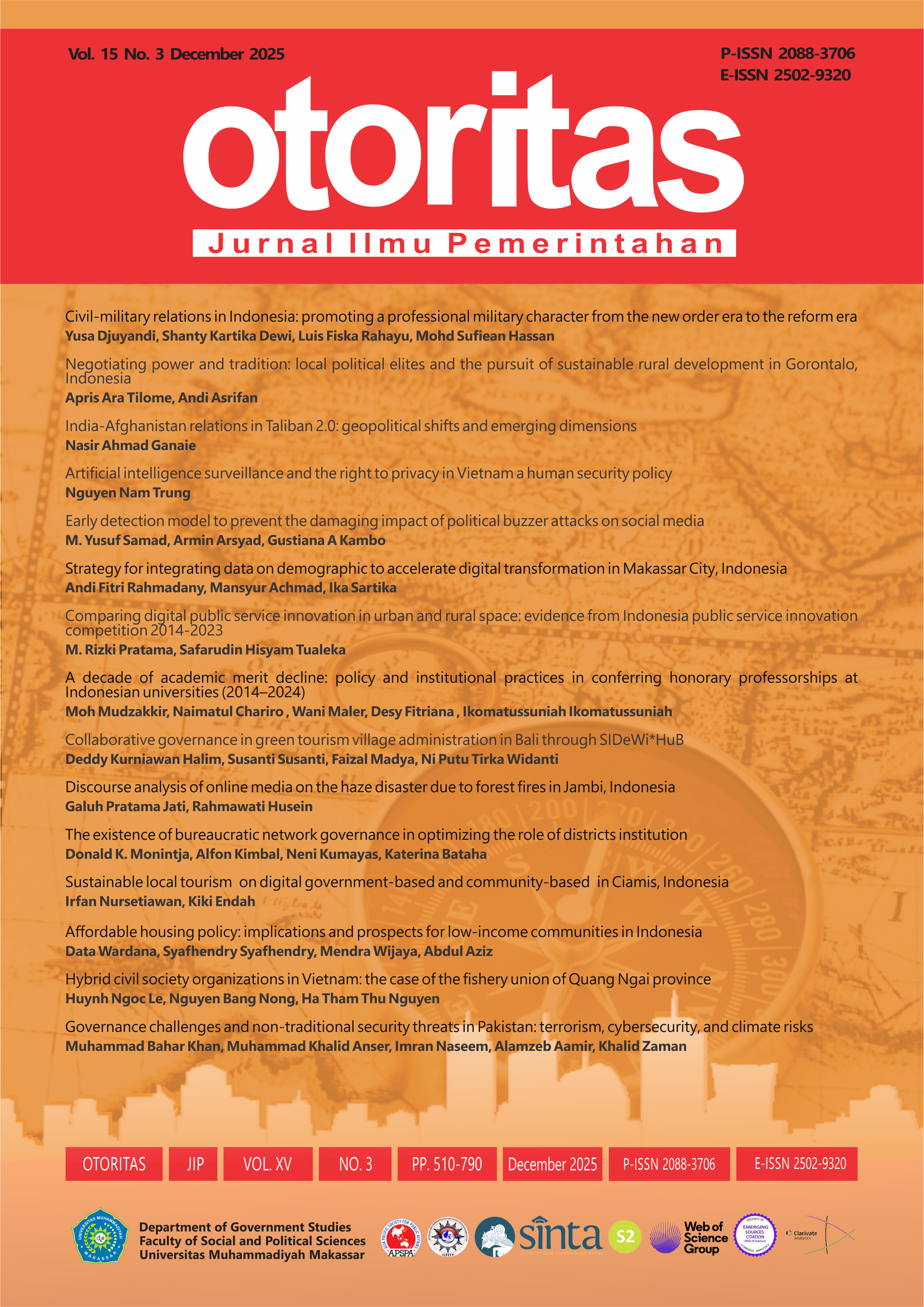
Hybrid civil society organizations in Vietnam: the case of the fishery union of Quang Ngai province
DOI:
https://doi.org/10.26618/ojip.v15i3.19732Keywords:
civil society, fishery union, hybrid actor, organizationsAbstract
The universal application of the traditional social work model has faced growing criticism in non-Western contexts, particularly in developing countries like Vietnam and China, where the relationship between the state and social organizations is complex and multifaceted. This study addresses this gap by examining the Fisheries Trade Union in Quang Ngai province as a representative example of a hybrid civil society actor in Vietnam. Using a qualitative ethnographic approach, which includes fieldwork and organizational analysis, we explore how the Union navigates its dual role as both a conduit for implementing state policies and an advocate for its members' negotiations to gain autonomy, despite significant institutional constraints. The study presents a novel model of organizational resilience and community empowerment that challenges the conventional state-society dichotomy prevalent in Western theories. This study uses ethnographic approach in over six months in 2024, with a combination of semi-structured interviews, focus group discussions, document analysis, and participant observation. This research contributes to a deeper understanding of hybrid organizational structures in non-Western settings, offering novel insights into their potential for fostering community-based social development and providing a more nuanced perspective for both researchers and policymakers. Qualitative analysis demonstrates that the Union sustains and advances itself by strategically balancing dual functions: executing state policy directives while representing and safeguarding the interests of the fishing community.
References
Anheier, H. K., Lang, M., & Toepler, S. (2020). Civil society in times of change: shrinking, changing and expanding spaces and the need for new regulatory approaches. Civil Szemle, 17(2), 5–35.
Anheier, H. K., & Toepler, S. (2019). International Encyclopedia of Civil Society. In International Encyclopedia of Civil Society. Springer Science & Business Media. https://doi.org/10.1007/978-3-319-99675-2
Bloom, J. D. (2014). Civil society in hybrid governance: Non-governmental organization (NGO) legitimacy in mediating wal-mart’s local produce supply chains in honduras. Sustainability (Switzerland), 6(10), 7388–7411. https://doi.org/10.3390/su6107388
Esposito, P., Brescia, V., Fantauzzi, C., & Frondizi, R. (2021). Understanding social impact and value creation in hybrid organizations: The case of Italian civil service. Sustainability (Switzerland), 13(7), 4058. https://doi.org/10.3390/su13074058
Hasenfeld, Y., & Gidron, B. (2005). Understanding multi-purpose hybrid voluntary organizations: The contributions of theories on civil society, social movements and non-profit organizations. Journal of Civil Society, 1(2), 97–112. https://doi.org/10.1080/17448680500337350
Hoffmann, S., & Putnam, R. D. (2003). Democracy in Flux: The Evolution of Social Capital in Contemporary Society. In Foreign Affairs (Vol. 82, Issue 1). Oxford University Press. https://doi.org/10.2307/20033465
Keane, J. (2003). Global civil society? In Global Civil Society? Cambridge University Press. https://doi.org/10.1017/CBO9780511615023
Kelly, C. R., & Kelly, C. R. (2011). Financial Crises and Civil Society Financial Crises and Civil Society. Chicago Journal of International Law, 11(2), 6.
Kerkvliet, B. J. T., & Marr, D. G. (2004). Beyond Hanoi: Local government in Vietnam. In Beyond Hanoi: Local Government in Vietnam. Institute of Southeast Asian Studies.
Ladner, A., Keuffer, N., & Bastianen, A. (2012). Local autonomy index in the EU, Council of Europe and OECD countries (1990-2020). Publications Office of the European Union Luxembourg.
Lam, W. M., & Lam, K. C. Y. (2013). China’s united front work in civil society: The case of Hong Kong. International Journal of China Studies, 4(3), 301–325.
Levitsky, S., & Way, L. A. (2010). Competitive authoritarianism: Hybrid regimes after the cold war. In Competitive Authoritarianism: Hybrid Regimes After the Cold War. Cambridge University Press. https://doi.org/10.1017/CBO9780511781353
Mati, J. M. (2020). Civil Society in ‘Politics’ and ‘Development’ in African Hybrid Regimes: The Kenyan Case. Voluntas, 31(4), 674–687. https://doi.org/10.1007/s11266-020-00211-y
Matveieva, O., Mamatova, T., Borodin, Y., Gustafsson, M., Wihlborg, E., & Kvitka, S. (2024). Digital Government in Conditions of War: Governance Challenges and Revitalized Collaboration between Local Authorities and Civil Society in Provision of Public Services in Ukraine. Proceedings of the Annual Hawaii International Conference on System Sciences, 2002–2011. https://doi.org/10.24251/hicss.2024.249
Mendez, C., & Bachtler, J. (2024). The quality of government and administrative performance: explaining Cohesion Policy compliance, absorption and achievements across EU regions. Regional Studies, 58(4), 690–703. https://doi.org/10.1080/00343404.2022.2083593
Min, B. H. (2022). Hybridization in government–civil society organization relationships: An institutional logic perspective. Nonprofit Management and Leadership, 32(3), 409–428. https://doi.org/10.1002/nml.21484
Norlund, I. (2007). Civil Society in Vietnam. Social organisations and approaches to new concepts. Asien, 105(Oktober), 68–90.
Nugmanovna, M. A. (2022). The place and significance of social and legal control in the legal socialization of the individual in civil society. Asian Journal of Research in Social Sciences and Humanities, 12(2), 21–33. https://doi.org/10.5958/2249-7315.2022.00070.3
Pinz, A., Englert, B., & Helmig, B. (2024). Organizing logic multiplicity in hybrid organizations: The role of organizational culture. Nonprofit Management and Leadership, 35(2), 353–378. https://doi.org/10.1002/nml.21617
Ríos, A. M., Guillamón, M. D., Cifuentes-Faura, J., & Benito, B. (2022). Efficiency and sustainability in municipal social policies. Social Policy and Administration, 56(7), 1103–1118. https://doi.org/10.1111/spol.12843
Saputra, T., Zuhdi, S., Affrian, R., Amri, K., & Putri, R. A. (2023). Civil Society Participation in Natural Resource Management in Conservation Areas: an Empirical Study of Tesso Nilo National Park, Riau Province, Indonesia. Public Administration Issues, 5, 48–68. https://doi.org/10.17323/1999-5431-2023-0-5-48-68
Teets, J. C. (2024). : Civil Society in China: How Society Speaks to the State . In The China Journal (Vol. 92). Taylor & Francis. https://doi.org/10.1086/730608
Toepler, S., Zimmer, A., Fröhlich, C., & Obuch, K. (2020). The Changing Space for NGOs: Civil Society in Authoritarian and Hybrid Regimes. Voluntas, 31(4), 649–662. https://doi.org/10.1007/s11266-020-00240-7
Downloads
Published
Issue
Section
License
Copyright (c) 2025 Otoritas : Jurnal Ilmu Pemerintahan

This work is licensed under a Creative Commons Attribution-ShareAlike 4.0 International License.
The Editorial Team of Otoritas: Jurnal Ilmu Pemerintahan reserves the right to transfer the copyright of the article once it has been accepted and a decision has been made to publish it.
Department of Government Studies, Faculty of Social and Political Sciences, Universitas Muhammadiyah Makassar in collaboration with Muhammadiyah’s College Association of Government Studies (AIPPTM) and Asia Pacific Society for Public Affairs (APSPA) as the publisher of Otoritas: Jurnal Ilmu Pemerintahan holds the copyright of all articles published in this journal.
The Publisher holds the right to reproduce and distribute the article and author is not allowed to publish the same article published in this journal.
Statement of Authenticity and Manuscript Copyright can be downloaded: here
After filling in the statement letter, please send via e-mail: otoritas@unismuh.ac.id