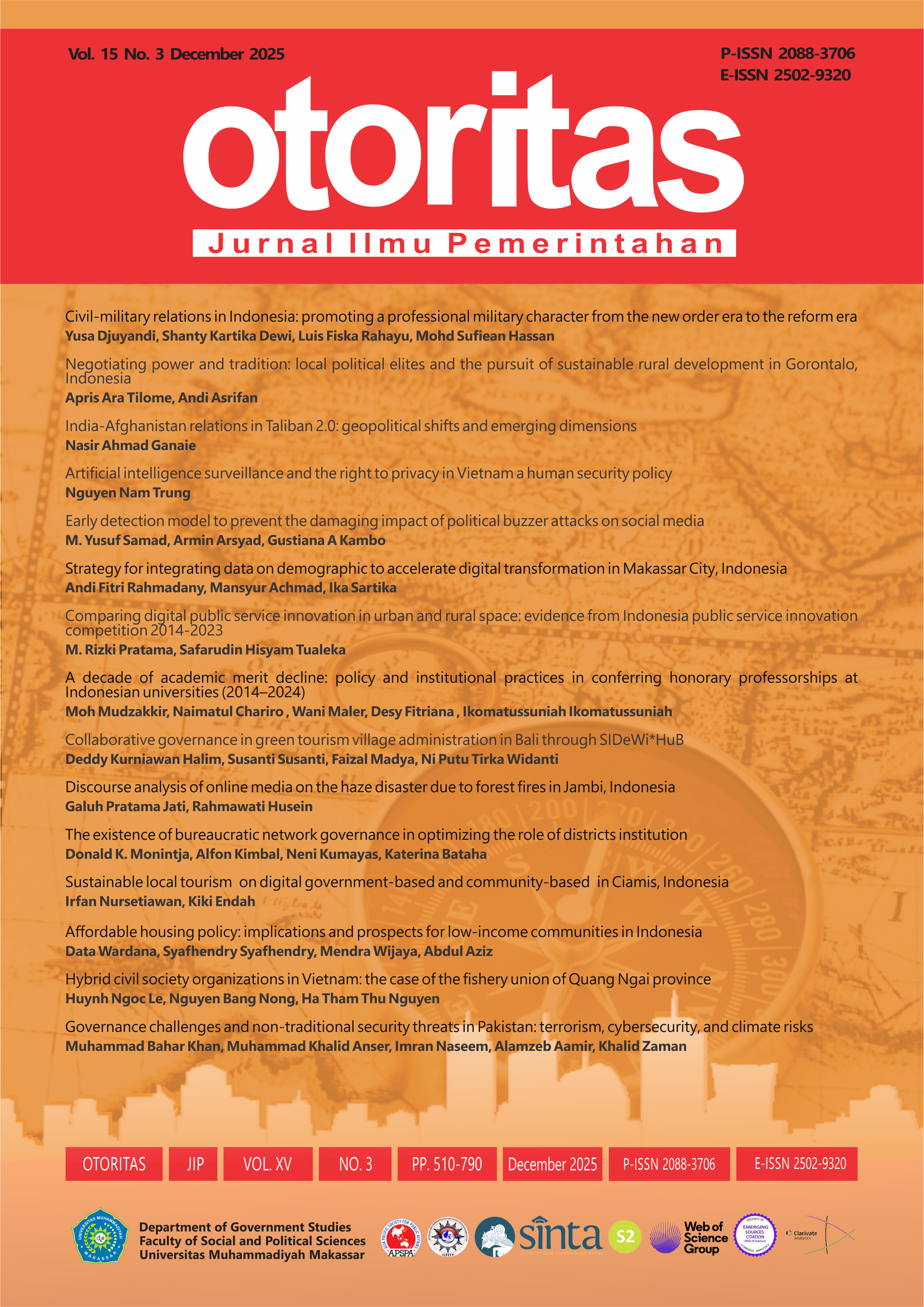
Civil-military relations in Indonesia: promoting a professional military character from the new order era to the reform era
DOI:
https://doi.org/10.26618/ojip.v15i3.18714Keywords:
civil and military relations, military character, new order, reform eraAbstract
Civil-military relations in Indonesia have experienced ups and downs during several periods of government, namely since the old order, new order, and reform order eras. Military involvement in the political sphere during the new order government has sparked criticism of the professionalism of the Indonesian National Army, as it is considered to have been used as a tool to maintain power through repressive actions. This study uses qualitative methods with literature review techniques to analyze the state of civil-military relations in Indonesia from the new order era to the reform era in an effort to shape a reformist military character. Military control over civilians during the new order era was driven by the need to create political stability and security for the sake of development. However, after the new order era, Indonesia continued to make major changes in realizing a professional national army. In the reform era, the military was under civilian control, which did not allow active military personnel to enter the political and public bureaucratic areas.
References
Abdullah, H. (2024). Dominasi Militer (Angkatan Darat) Dalam Pemerintahan Orde Baru. TAWARIKH : Jurnal Sejarah Dan Pembelajaran Sejarah, 1(1), 31–40. https://jurnal.naskahaceh.co.id/index.php/tawarikh/article/view/184
Adebowale, I. B., Ehiane, S. O., & Adi, I. (2024). Civil–Military Relations: A Panacea to Conflicts. In S. O. Ehiane, L. S. Shulika, & C. H. Vhumbunu (Eds.), Engagement of Africa in Conflict Dynamics and Peace Architectures (pp. 105–120). Palgrave Macmillan. https://doi.org/10.1007/978-981-99-8235-6_6
Affan, H. (2025a, May 19). Orde Baru: Sejarah Dwifungsi ABRI – Panggilan sejarah, kelemahan pemimpin sipil, atau hasrat berkuasa? BBC News Indonesia. https://www.bbc.com/indonesia/articles/c5yedz5ne47o
Affan, H. (2025b, May 19). Orde Baru: Sejarah Dwifungsi ABRI – Panggilan sejarah, kelemahan pemimpin sipil, atau hasrat berkuasa? BBC News Indonesia. https://www.bbc.com/indonesia/articles/c5yedz5ne47o
Agus, M. A., & Dzaki, A. I. (2023). Insubordination to Unlawful Order: Praktek di Antara Bangsa-Bangsa dan Tantangan Penerapannya di Indonesia. Jurnal Hukum Lex Generalis, 4(1), 59–85. https://doi.org/10.56370/JHLG.V4I1.353
Alamsyah, A., Agustang, A., & Jumadi, J. (2022). Configuration of Civil-Millitarian Relations (Study of Military Sociology In The Morosi Smelter Industry Area). SHS Web of Conferences, 149, 1–6. https://doi.org/10.1051/SHSCONF/202214902012
Anwar. (2020). Dwi Fungsi ABRI : Melacak Sejarah Keterlibatan ABRI dalam Kehidupan Sosial Politik dan Perekonomian Indonesia. Jurnal Adabiya, 20(1), 23–46. https://doi.org/10.22373/ADABIYA.V20I1.6776
Apandi, A., Cahyani, A. R., Sari, F. R., & S, R. L. (2025). Dinamika Politik dan Militer di Indonesia dalam Konteks Pemberontakan dan Peralihan Kekuasaan (1946-1965). Journal of Indonesian Social Studies Education, 3(1), 73–85. https://journal.unnes.ac.id/journals/JISSE/article/view/18400
Basuki, Y. (2014). Reformasi TNI: Pola, Profesionalitas, dan Refungsionalisasi Militer dalam Masyarakat. Masyarakat: Jurnal Sosiologi, 19(2), 10–41. https://doi.org/10.7454/MJS.v19i2.1243
Campbell, K. S. (2009). Civil-Military Relations and Political Liberalization: A Comparative Study of the Military’s Corporateness and Political Values in Egypt, Syria, Turkey, and Pakistan [The George Washington University]. https://scholarspace.library.gwu.edu/concern/gw_etds/zs25x859f
Chakravorty, P. K. (2018). Civil-Military Relations in the Present Context. CLAWS Journal, 11(2), 34–45. https://ojs.indrastra.com/index.php/clawsjournal/article/view/109
Croissant, A., & Kuehn, D. (2017). Introduction. In Reforming Civil-Military Relations in New Democracies: Democratic Control and Military Effectiveness in Comparative Perspectives. Springer. https://doi.org/10.1007/978-3-319-53189-2_1
Croissant, A., Kuehn, D., Chambers, P., & Wolf, S. O. (2010). Beyond the fallacy of coup-ism: Conceptualizing civilian control of the military in emerging democracies. Democratization, 17(5), 950–975. https://doi.org/10.1080/13510347.2010.501180
Croissant, A., Kuehn, D., Lorenz, P., & Chambers, P. W. (2013). Indonesia: The Democratization of Personal Control. In A. Croissant, D. Kuehn, P. Lorenz, & P. W. Chambers (Eds.), Democratization and Civilian Control in Asia (pp. 97–117). Palgrave Macmillan. https://doi.org/10.1057/9781137319272_6
Crouch, H. A. (2007). The Army and Politics in Indonesia (1st ed.). Equinox Publishing. https://books.google.co.id/books?id=TJptHWc4i1EC&printsec=frontcover&hl=id#v=onepage&q&f=false
Damayanti, W. (2022). Eksistensi Gerakan Mahasiswa Tahun 1966 Sebagai Upaya Tumbangkan Kepemimpinan Soekarno. JEJAK : Jurnal Pendidikan Sejarah & Sejarah, 2(2), 24–35. https://doi.org/10.22437/jejak.v2i2.21063
Darmawijaya. (2015). Islam dan Kekuasaan Orde Baru: Membaca Kembali Politik De-Islamisasi Soeharto. Sosiologi Reflektif, 10(1), 63–84.
detiknews. (2004, October 3). Panglima: Fokus Hankam, TNI Tak Lagi di Wilayah Politik. Detik.Com. https://news.detik.com/berita/d-218070/panglima-fokus-hankam-tni-tak-lagi-di-wilayah-politik
Dewi, M. F. (2024, October 9). Di Era Jokowi, Ada 2.569 Perwira TNI Duduki Jabatan Sipil - Nasional. Bloomberg Technoz. https://www.bloombergtechnoz.com/detail-news/51195/di-era-jokowi-ada-2-569-perwira-tni-duduki-jabatan-sipil
Djafar, M. TB. (2015). Krisis politik dan proposisi demokratisasi: perubahan politik orde baru ke reformasi. Bumi Aksara.
Djuyandi, Y. (2012). Membangun Demokrasi melalui Profesionalisme Tentara Nasional Indonesia. Humaniora, 3(2), 512–522. https://doi.org/10.21512/humaniora.v3i2.3356
Djuyandi, Y. (2015). The professionalism of Indonesian national army in civil-military relations. A case study in general election 2014. Journal of Social Research and Policy, 6(1).
Djuyandi, Y., Sudirman, A., Suryana, N., Kunci, K., & Koresponden, P. (2025). Analisis Hubungan Sipil-Militer di Indonesia Pasca Reformasi 1998. Journal of Political Issues, 7(1), 46–56. https://doi.org/10.33019/JPI.V7I1.337
Elga, A. Y. (2013). Misteri Supersemar. Palapa.
Endrayani, T. D., Suharman, S., & Wagiyah, E. (2021). Peranan Jendral Suharto dalam Melahirkan Orde Baru Tahun 1965-1968. Rinontje: Jurnal Pendidikan Dan Penelitian Sejarah, 2(1), 41–50. https://jurnal.ipw.ac.id/index.php/rinontje/article/view/101
Fatgehipon, A. H. (2024). Hubungan Sipil Dan Militer Era Presiden Joko Widodo. Uwais Inspirasi Indonesia.
Feaver, P. D. (1999). Civil-military relations. Annual Review of Political Science, 2(Volume 2, 1999), 211–241. https://doi.org/10.1146/Annurev.Polisci.2.1.211/Cite/Refworks
Felice, W. F. (1998). Militarism and human rights. Internationa Affairs, 74(1), 25–40.
Fissell, B. M. (2025). The Military’s Constitutional Role. North Carolina Law Review, 103(2), 331–384. https://digitalcommons.law.villanova.edu/facpubs
Floresa. (2025, February 22). Tendensi Militeristik Pemerintahan Prabowo-Gibran; Apa Saja Indikasinya? Mengapa Dinilai Bisa Membuat Indonesia Kembali ke Orde Baru? Floresa. https://floresa.co/reportase/mendalam/71844/2025/02/22/tendensi-militeristik-pemerintahan-prabowo-gibran-apa-saja-indikasinya-mengapa-dinilai-bisa-membuat-indonesia-kembali-ke-orde-baru
Frantz, E. (2019). The legacy of military dictatorship: Explaining violent crime in democracies. International Political Science Review, 40(3), 404–418. https://doi.org/10.1177/0192512118769079/SUPPL_FILE/IPS769079_FRENCH_AND_SPANISH_ABSTRACTS.PDF
Gunawan, A. B. (2021). Under the Shadow of Army Domination: Defense Transformation in Indonesia Dissertation. Heidelberg University.
Hanson, K., & Knuppe, A. J. (2025). Polarization versus professionalism: military and civilian views on the domestic use of the military. Political Science Research and Methods, 13(3), 645–662. https://doi.org/10.1017/PSRM.2024.41
Haris, S. (2019). Menimbang Demokrasi Dua Dekade Reformasi. Yayasan Pustaka Obor Indonesia.
hukumonline. (2022, August 15). Ini Respons Presiden Jokowi Soal Jabatan Sipil untuk Prajurit TNI Aktif. Hukumonline.Com. https://www.hukumonline.com/berita/a/ini-respons-presiden-jokowi-soal-jabatan-sipil-untuk-prajurit-tni-aktif-lt62f9be72824ee/?page=2
Huntington, S. P. (2000). The Soldier and the State: The Theory and Politics of Civil–Military Relations (15th ed.). Harvard University Press.
Ibrahim, J., & Welch, C. E. (2012). Militer Dan Kapitalisme Ersatz: Bisnis ABRI Pada Masa Orde Baru. Humaniora, 14(3), 286–294. https://journal.ugm.ac.id/jurnal-humaniora/article/view/765
Inpantri, A. G., Siddiq, M. I. H., Jayanti, M. P., & Alhabsy, M. I. (2022). The Role and Development of the Function of ABRI (Angkatan Bersenjata Republik Indonesia) in the New Order Period. Social Impact Journal, 1(2), 191–200. https://doi.org/10.61391/SIJ.V1I2.21
Janowitz, M. (1964). Organizing Multiple Goals: War Making and Arms Control. In The New Military: Changing Patterns of Organization (pp. 11–38). Russell Sage Foundation.
Jenkins, D. (1983). The Evolution of Indonesian Army Doctrinal Thinking: The Concept of Dwifungsi. Asian Journal of Social Science, 11(1), 15–30. https://doi.org/10.1163/080382483X00103
Kardi, K. (2014). Demokratisasi Relasi Sipil–Militer pada Era Reformasi di Indonesia. Masyarakat: Jurnal Sosiologi, 19(2), 106–131. https://doi.org/10.7454/MJS.v19i2.1246
Kompas.com. (2012, January 14). Pembelian Tank Leopard Ditolak oleh DPR. Kompas.Com. https://nasional.kompas.com/read/2012/01/14/03230138/pembelian.tank.leopard.ditolak.oleh.dpr
Kyed, H. M., & Lynn, A. (2024). Soldier Defection as a Revolutionary Strategy in Myanmar. Journal of Contemporary Asia, 54(5), 824–845. https://doi.org/10.1080/00472336.2024.2321521
Liputan6. (2001, July 24). Panglima: TNI Konsisten Menolak Dekrit - News Liputan6.com. Liputan6.Com. https://www.liputan6.com/news/read/17018/panglima-tni-konsisten-menolak-dekrit
Noor, U. M. (2020). Persepsi Penerapan Wajib Militer Guna Meningkatkan Pendidikan Bela Negara. Widya Yuridika: Jurnal Hukum, 3(1), 61–70. http://publishing-widyagama.ac.id/ejournal-v2/index.php/yuridika/
Otterbein, K. F. (2008). Clan and Tribal Conflict. Encyclopedia of Violence, Peace, & Conflict: Volume 1-4, Third Edition, 2, 660–666. https://doi.org/10.1016/B978-0-12-820195-4.00005-4
Pantev, P., Ratchev, V., Tagarev, T., & Zaprianova, V. (2005). Civil-Military Relations and Democratic Control of the Security Sector (P. Pantev, Ed.). G.S. Rakovsky Defense and Staff College.
Pickering, J., & Kiyani, G. (2024). Civilian Control, Civil–Military Friction, and Foreign Military Intervention. Armed Forces and Society. https://doi.org/10.1177/0095327X241279162/SUPPL_FILE/SJ-DOCX-1-AFS-10.1177_0095327X241279162.DOCX
Pion-Berlin, D., & Dudley, D. (2020). Civil-Military Relations: What Is the State of the Field. In A. M. Sookermany (Ed.), Handbook of Military Sciences (pp. 1–22). Springer. https://doi.org/10.1007/978-3-030-02866-4_37-1
Prasetiadi, D. Z., Marjono, M., & Sumardi, S. (2021). Keterlibatan Militer dalam Politik Pemerintahan di Indonesia Tahun 1958-1998. HISTORIA: Jurnal Program Studi Pendidikan Sejarah, 9(1), 23–34. https://doi.org/10.24127/HJ.V9I1.3000
Puspitasari, S. H. (2005). Pengalaman Indonesia Menuju Demokrasi Beberapa Catalan Atas Pemilihan Umum Pada Masa Orde Lama, Orde Baru Dan Pasca Orde Baru. Jurnal Hukum IUS QUIA IUSTUM, 12(28), 46–61. https://doi.org/10.20885/IUSTUM.VOL12.ISS28.ART4
Ramadantica, I. (2024). Implementasi Kebijakan Netralitas TNI Dalam Berpolitik Sebagai Unsur Lembaga Pertahanan Di Pusdiklatkopassus. Community Empowerment : Jurnal Pengabdian Dan Pemberdayaan Masyarakat, 2(1), 44–53. https://doi.org/10.15575/COMMEN.V2I2.745
Ramadhan, A. (2025, March 17). Arti Dwifungsi ABRI yang Dikhawatirkan Hidup Lagi lewat Revisi UU TNI. Kompas.Com. https://nasional.kompas.com/read/2025/03/17/08322381/arti-dwifungsi-abri-yang-dikhawatirkan-hidup-lagi-lewat-revisi-uu-tni?page=all
Rohman, A. (2023). G30S/PKI: Soekarno-Soeharto Berenang di Antara Dua Karang. Visi Literasi Nusantara. https://anyflip.com/pagc/aujn/basic
Rosidah, N. (2019). Hukum Peradilan Militer. Anugrah Utama Raharja.
Rubba, R. M., & Liana, C. (2020). Kedaulatan Rakyat Tahun 1974-1994. AVATARA, e-Journal Pendidikan Sejarah, 9(1). https://ejournal.unesa.ac.id/index.php/avatara/article/view/34729
Samosir, H. (2025, February 13). Presiden Prabowo perluas peran TNI di ranah sipil, tanda kembalinya ‘dwifungsi ABRI’ ala Orde Baru? BBC News Indonesia. https://www.bbc.com/indonesia/articles/c203lez30qxo
Sapii, R. B. S., Susanto, A. H., & Aponno, A. D. (2022). Kekosongan Hukum Peraturan Penyelesaian Sengketa Proses Pemilu: Hambatan Pemilu Demokratis dan Berintegritas Rezim Orde Baru. JAPHTN-HAN, 1(1), 1–17. https://doi.org/10.55292/JAPHTNHAN.V1I1.3
Setiawan, D., Octavianus, C., Janis, D., Winadi, G., Abdullah, Y., Umasugi, T., & Suyuti, H. (2013). Perkembangan Hubungan Militer dengan Sipil di Indonesia. Global and Policy Journal of International Relations, 1(01), 74–83. https://doi.org/10.33005/JGP.V1I01.2012
Siddiq, M. (2019). Profesionalisme Militer pada Pemerintahan Soeharto dan Abdurrahman Wahid. Madani Jurnal Politik Dan Sosial Kemasyarakatan, 11(1), 21–33. https://doi.org/10.52166/MADANI.V11I1.1267
SKOMSOS TNI. (2002, August). Sikap TNI-POLRI Terhadap Perubahan Keempat UUD 1945 Pada ST MPR 2002. TNI. https://tni.mil.id/view-19-sikap-tni-polri-terhadap-perubahan-keempat-uud-1945-pada-st-mpr-2002.html
Soebijono, Tambunan, A. S. S., Mukmi, H., & Astoeti, R. K. (1997). Dwifungsi ABRI: Perkembangan dan Peranannya dalam Kehidupan Politik di Indonesia. Gadjah Mada University Press. https://ugmpress.ugm.ac.id/id/product/sosial-humaniora/dwifungsi-abri-perkembangan-dan-peranannya-dalam-kehidupan-politik-di-indonesia
Sugeng, A. R. Z. (2021). Hak Memilih Bagi Anggota Tentara Nasional Indonesia: Studi Komparasi Hak Memilih Anggota Angkatan Bersenjata di Beberapa Negara. Jurnal Konstitusi & Demokrasi, 1(2), 103–119. https://doi.org/10.7454/JKD.v1i2.1106
Sukmawan, D. I., & Pedrason, R. (2022). Kontrol Sipil Pragmatis: Implementasi Hubungan Sipil-Militer di Masa Pemerintahan Joko Widodo. Politika: Jurnal Ilmu Politik, 13(2), 274–289. https://doi.org/10.14710/POLITIKA.13.2.2022.274-289
Sundari, S. (2021). Kerjasama Sipil Militer dalam Mendukung Sistem Pemerintahan Negara. Yogyakarta. https://www.scribd.com/document/471643986/eb14a-kerjasama-sipil-militer
Suparno, B. A. (2012). Reformasi dan Jatuhnya Soeharto. Kompas.
Suryowati, E. (2018, June 19). Di Era SBY Ada Juga Penjabat Gubernur dari TNI Aktif. Jawa Pos. https://www.jawapos.com/politik/0171816/di-era-sby-ada-juga-penjabat-gubernur-dari-tni-aktif#goog_rewarded
Wibisono, A. (2023). Batas Moral Kepatuhan: Sebuah Kajian Etika Militer Berdasarkan Pemikiran Clausewitz dalam Buku Vom Krieg. Sekolah Tinggi Filsafat Driyarkara.
Wijaya, C. (2019, February 11). Dukungan purnawirawan TNI ke kubu Jokowi dan Prabowo: Apakah efektif untuk mendulang suara? - BBC News Indonesia. Bbc.Com. https://www.bbc.com/indonesia/indonesia-47195716
Wirasaputri, N. M. (2017). Perkembangan Politik Hukum Kalangan Militer dalam Transisi Demokrasi Indonesia. Kanun Jurnal Ilmu Hukum, 19(3), 515–532. https://jurnal.usk.ac.id/kanun/article/view/8983
Downloads
Published
Issue
Section
License
Copyright (c) 2025 Otoritas : Jurnal Ilmu Pemerintahan

This work is licensed under a Creative Commons Attribution-ShareAlike 4.0 International License.
The Editorial Team of Otoritas: Jurnal Ilmu Pemerintahan reserves the right to transfer the copyright of the article once it has been accepted and a decision has been made to publish it.
Department of Government Studies, Faculty of Social and Political Sciences, Universitas Muhammadiyah Makassar in collaboration with Muhammadiyah’s College Association of Government Studies (AIPPTM) and Asia Pacific Society for Public Affairs (APSPA) as the publisher of Otoritas: Jurnal Ilmu Pemerintahan holds the copyright of all articles published in this journal.
The Publisher holds the right to reproduce and distribute the article and author is not allowed to publish the same article published in this journal.
Statement of Authenticity and Manuscript Copyright can be downloaded: here
After filling in the statement letter, please send via e-mail: otoritas@unismuh.ac.id