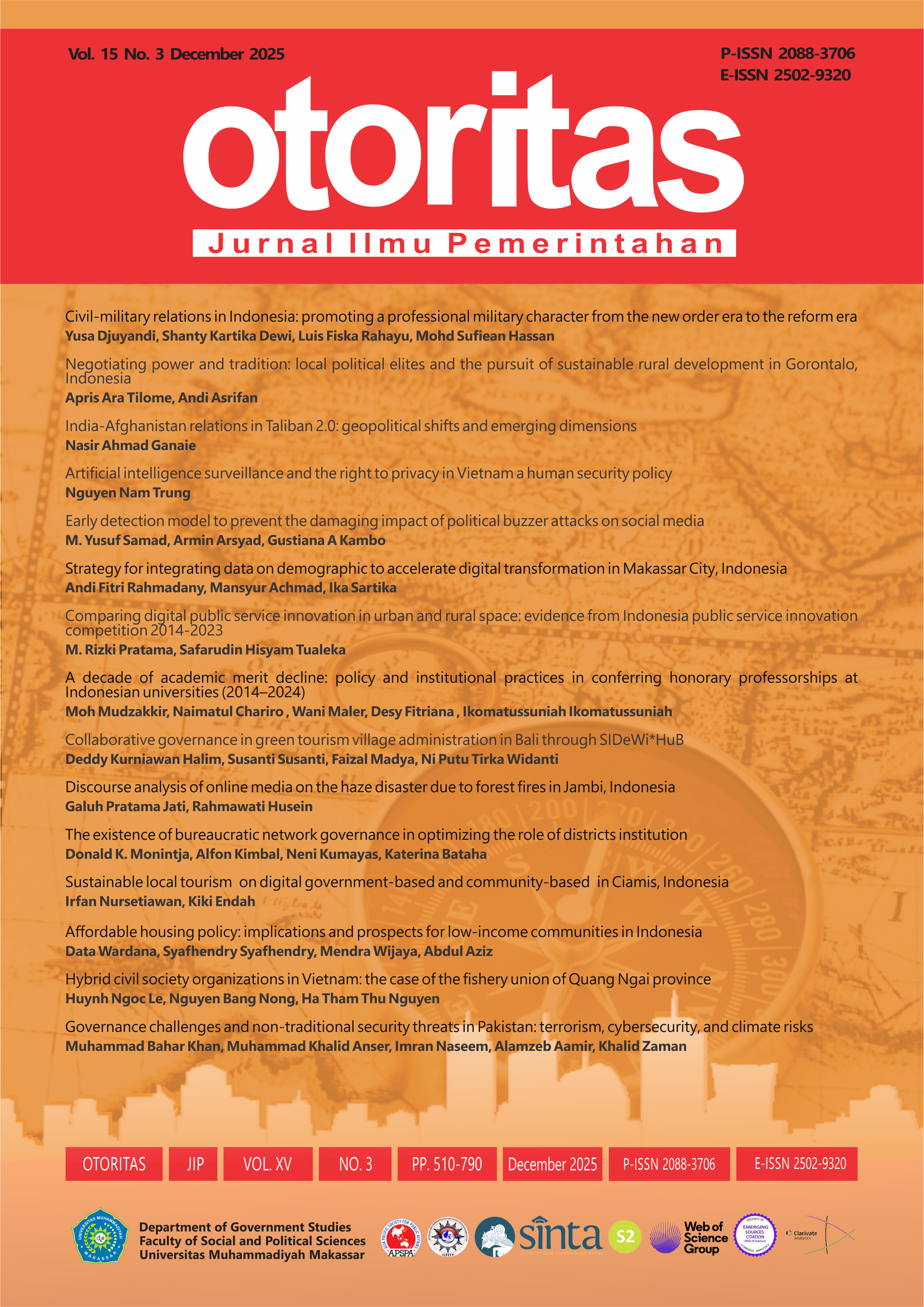
India-Afghanistan relations in Taliban 2.0: geopolitical shifts and emerging dimensions
DOI:
https://doi.org/10.26618/ojip.v15i3.17996Keywords:
Counter-terrorism, Foreign Policy, India-Afghanistan Relations, Regional Security, Taliban, TerrorismAbstract
This paper conducts a comprehensive analysis of India’s Afghan foreign policy changes during 2021 after the Taliban takeover. For two decades India has been actively engaged with Afghanistan by investing heavily in infrastructure improvements as well as security developments and governance schemes. Prime Minister Narendra Modi asserts that India switched from supporting the Afghan government to adopting a more realistic stance towards the Taliban administration. This research seeks to advance these shifts while investigating elements that focus on security worries and diplomatic methods together with regional military forces. This study examines how regional stability, together with geopolitical strategies in India, has been altered because of these recent developments. The research follows a qualitative design method which performs systematic analysis of new political developments in India through case studies. This paper analyses the geopolitical transformation factors impacting India through the application of realism, securities theory, and strategic autonomy. India’s diplomatic reactions, security measures, and economic responses to the Taliban takeover between 2021 and the present period make up the paper’s study scope. The paper thoroughly investigates security implications by studying regional architecture security roles between Pakistan and China. India’s complicated foreign policies under Modi become clearer through this paper, which reveals how Indian national security interests, together with regional factors, determine the government’s response to the Taliban’s Taliban’s return to power. The study generates a better comprehension of the current geopolitical frameworks in South Asia.
References
Achakzai, N. K. (2022). Afghanistan during the Taliban 2.0 Heading towards Devestation. Siazga Research Journal, 1(2), 66–72. https://doi.org/10.58341/srj.v1i2.12
Adlam, E. (2022). Operational theories as structural realism. Studies in History and Philosophy of Science, 94, 99–111. https://doi.org/10.1016/j.shpsa.2022.05.007
Ahlawat, D., & Izarali, M. R. (2022). Security Implications for India and Pakistan from the Taliban Regime since the U.S. Withdrawal from Afghanistan. Perspectives on Terrorism, 16(5), 20–33.
Ahmad, P., & Singh, B. (2017). Sino-Pakistan Friendship, Changing South Asian Geopolitics and India’s Post-Obama Options. South Asia Research, 37(2), 133–146. https://doi.org/10.1177/0262728017700184
Ahmad, P. T. (2022). An Analysis of India’s Soft Power Policy in Afghanistan. India Quarterly, 78(4), 634–653. https://doi.org/10.1177/09749284221127787
Akbari, F., & True, J. (2022). One year on from the Taliban takeover of Afghanistan: re-instituting gender apartheid. Australian Journal of International Affairs, 76(6), 624–633. https://doi.org/10.1080/10357718.2022.2107172
Akbarzadeh, S. (2003). India and Pakistan’s geostrategic rivalry in Central Asia. Contemporary South Asia, 12(2), 219–228. https://doi.org/10.1080/095849302000147672
Akram, M., Mohamad, D., & Arshad-Ayaz, A. (2024). How was the Taliban 2.0 in Afghanistan seen in Pakistan? Asian Journal of Comparative Politics, 9(2), 274–290. https://doi.org/10.1177/20578911231172197
Al-Sharif, R. (2021). Critical realism and attribution theory in qualitative research. Qualitative Research in Organizations and Management: An International Journal, 16(1), 127–144. https://doi.org/10.1108/QROM-04-2020-1919
Anas, O. (2021). India–West Asia Relations Under the ‘Nationalist’ Modi Government. International Studies, 58(1), 59–79. https://doi.org/10.1177/0020881720984324
Ansari, A., & Tiwari, P. (2015). Comparison of Cost of Treatment of Selected Cancers with Patented Drugs: India Versus its Neighbors. Value in Health, 18(7), A819. https://doi.org/10.1016/j.jval.2015.09.249
Aria, A., Tayeb, M. B., & Zazai, A. K. (2023). China’s New Approach to Neighborhood Diplomacy: Analyzing the Economic and Political Relations with Afghanistan in the Post-2014 Period. Journal of Humanities and Social Sciences Studies, 5(8), 94–101. https://doi.org/10.32996/jhsss.2023.5.8.11
Aryal, S. K., & Bharti, S. S. (2021). Focus 74-Post-Taliban Takeover: What is at Stake for India in Afghanistan? SADF Focus, FOCUS No.(74), 1–12.
Azam, M. (2022). Afghanistan–Pakistan Relations. In Pakistan’s Foreign Policy (pp. 99–110). Routledge. https://doi.org/10.4324/9781003250920-8
Batabyal, A. (2011). India, Pakistan and Dialogue under the Shadow of Terror. South Asian Survey, 18(2), 207–224. https://doi.org/10.1177/0971523113513366
Benitez, F. (2023). Structural realism and theory classification. Theoria (Sweden), 89(5), 734–747. https://doi.org/10.1111/theo.12491
Bharti, S. S. (2022). Taliban Urges for Joint Mechanism: The Assessment of Vulnerability in Afghanistan. Academia Letters. https://doi.org/10.20935/al5133
Boedeker, J. (2013). Baloch Identities: A Matter of Descent or Mentality? The Journal of the Middle East and Africa, 4(2), 225–243. https://doi.org/10.1080/21520844.2013.831715
Boni, F. (2021). Afghanistan 2021: US withdrawal, the Taliban return and regional geopolitics. Asia Maior, XXXII. https://doi.org/10.52056/9791254690994/17
Boni, F. (2023). Afghanistan 2022: Life under the Taliban. Asia Maior, 18, 411–415.
Calvillo Cisneros, J. M. (2023). Los Talibán 2.0. Del terrorismo al contraterrorismo. Studia Historica. Historia Contemporánea, 41, 15–37. https://doi.org/10.14201/shhc2023411537
CHACKO, P. (2021). A New Quest for Self-Reliance: East Asia and Indian Economic Nationalism. The Journal of Indian and Asian Studies, 02(02). https://doi.org/10.1142/S2717541321400052
Chatterjee, N., Mahmood, Z., & Marcussen, E. (2021). Politics of Vaccine Nationalism in India: Global and Domestic Implications. Forum for Development Studies, 48(2), 357–369. https://doi.org/10.1080/08039410.2021.1918238
Chattopadhyay, P. (2013). Theorising Indias South Asian Policy: From Geopolitics to Global Politics. South Asian Survey, 20(1), 59–73. https://doi.org/10.1177/0971523114559813
Chrisman, J. J. (2019). Stewardship Theory: Realism, Relevance, and Family Firm Governance. Entrepreneurship: Theory and Practice, 43(6), 1051–1066. https://doi.org/10.1177/1042258719838472
Dar, A. I. (2021). Beyond Eurocentrism: Kautilya’s realism and India’s regional diplomacy. Humanities and Social Sciences Communications, 8(1), 205. https://doi.org/10.1057/s41599-021-00888-6
Datta, S. (2022). South Asian regionalism: the limits of cooperation. Commonwealth & Comparative Politics, 60(1), 121–123. https://doi.org/10.1080/14662043.2021.2018965
Daulet Singh, Z. (2021). Changing Geopolitics and Negotiating Postures in the India-China Border Dispute. Outlines of Global Transformations: Politics, Economics, Law, 14(2), 66–81. https://doi.org/10.23932/2542-0240-2021-14-2-4
Destradi, S. (2014). India: A Reluctant Partner for Afghanistan. Washington Quarterly, 37(2), 103–117. https://doi.org/10.1080/0163660X.2014.926212
Elik, S., & Uslu, S. (2021). India’s relations with central asia in framework of kautilya’s foreign policy theories, 1991-2019. Bilig, 98, 99–122. https://doi.org/10.12995/BILIG.9805
Encarnation, L., & Fair, C. C. (2024). China and the Taliban: Past as prologue? Journal of Strategic Studies, 47(5), 588–611. https://doi.org/10.1080/01402390.2023.2177988
Galston, W. A. (2010). Realism in political theory. European Journal of Political Theory, 9(4), 385–411. https://doi.org/10.1177/1474885110374001
Ganaie, N. A. (2018). Modernizing Extremism: A Case of New Age Militancy in Kashmir. Advances in Politics and Economics, 1(1), 61. https://doi.org/10.22158/ape.v1n1p61
Ganaie, N. A., Yousuf, M., & Wani, Z. A. (2025). Continuing Problems in Kashmir during the 21st Century. In Kashmir after 2019 (pp. 175–203). Routledge India. https://doi.org/10.4324/9781003588849-11
Ganguly, S. (2014). Shifting tides in South Asia: India and its neighbors. Journal of Democracy, 25(2), 93–104. https://doi.org/10.1353/jod.2014.0028
Guite, J. T. (2024). What Makes Their Relations Tick? International Studies, 61(1), 109–116. https://doi.org/10.1177/00208817241228368
Gupta, S. (2013). India’ s Policy Towards Afghanistan. In Chatham House (Vol. 949). Chatham House London.
Haboudinejad, G., & Ali, T. (2022). Geopolitics of Ports: Balancing in India’s Geopolitical Strategy (Emphasizing the Role of Chabahar Port). Geopolitics Quarterly, 18(65), 150–187.
Hall, I. (2017). Narendra Modi and India’s normative power. International Affairs, 93(1), 113–131. https://doi.org/10.1093/ia/iiw004
Hanauer, L., & Chalk, P. (2023). India’s and Pakistan’s Strategies in Afghanistan: Implications for the United States and the Region. In India’s and Pakistan’s Strategies in Afghanistan: Implications for the United States and the Region. Santa Monica, CA: RAND, 2012. https://doi.org/10.7249/op387
Hassan. (2023). Afghanistan: Lessons learnt from 20 years of supporting democracy development and security. Bruxelas, Bélgica: Directorate General for External …, January.
Hussain, E. (2022). Taliban 2.0 and Afghanistan–Pakistan Relations. Journal of Asian Security and International Affairs, 9(3), 462–474. https://doi.org/10.1177/23477970221130546
Imranullah, A., & Hakimuddin, M. (2024). Strategic Interests and Geopolitical Considerations: Assessing the Importance of Afghanistan for the US Post-Withdrawal. Journal of Arts, Humanities and Social Science, 1(2), 1–9. https://doi.org/10.69739/jahss.v1i2.18
India and its neighbours. (1991). Strategic Survey, 92(1), 160–171. https://doi.org/10.1080/04597239108460886
Ito, T. (2014). India’s pragmatic diplomacy with major powers: A comparative study of the strategic partnership with the US, China, and Russia. In Eurasia’s Regional Powers Compared - China, India, Russia (pp. 137–151). Routledge. https://doi.org/10.4324/9781315768915-11
Jash, A. (2022). China in India’s Post-Cold War Engagement with Southeast Asia. Strategic Analysis, 46(6), 641–643. https://doi.org/10.1080/09700161.2022.2149985
Kaura, V. (2017). US-Pakistan Relations in the Trump Era: Resetting the Terms of Engagement in Afghanistan. ORF Occasional Paper, 128, 1–30.
Khan, R. (2022). Between Independence and Autonomy: The Changing Landscape of Ethno-nationalist Movements in Pakistan. Nationalities Papers, 50(4), 643–660. https://doi.org/10.1017/nps.2021.65
Kronstadt, K. A. (2010). Terrorist attacks in Mumbai, India, and implications for U.S. interests. In Focus on Terrorism (Vol. 10).
Kumar Sharma, R. (2023). «Taliban Factor» in India-Central Asia Relations. International Relations and International Law Journal, 103(3). https://doi.org/10.26577/irilj.2023.v103.i3.07
Lal, R. (2015). China’s relations with South Asia. In China and the Developing World: Beijing’s Strategy for the Twenty-first Century (pp. 133–149). Routledge. https://doi.org/10.4324/9781315642413-6
Manish, & Mani, A. (2023). Taliban 2.0 and the BRI: A Text* Analysis of China’s Balancing Act. Strategic Analysis, 47(6), 503–519. https://doi.org/10.1080/09700161.2024.2315707
Manzoor, A. (2022). Taliban Rule in Afghanistan—Impact on India-Afghanistan Relations. Advances in Politics and Economics, 5(2), p1. https://doi.org/10.22158/ape.v5n2p1
Mazloum Yar, F. G., Ihsan, I. U., & Hafiz, M. S. (2022). Analyzing the Role of Great Powers in Creating the Durand Line and Its impact on Afghanistan-Pakistan Relations. Randwick International of Social Science Journal, 3(4), 673–686. https://doi.org/10.47175/rissj.v3i4.551
Mazumdar, A. (2014). Indian foreign policy in transition: Relations with South Asia. In Indian Foreign Policy in Transition: Relations with South Asia. Routledge. https://doi.org/10.4324/9781315779140
Mullen, R. D., & William, C. (2017). India in Afghanistan : Understanding Development Assistance by Emerging Donors to Conflict-Affected Countries. JSTOR.
Murthy, P. (2000). India and its neighbours: The 1990s and beyond. Strategic Analysis, 24(8), 1411–1429. https://doi.org/10.1080/09700160008455295
Nath, J. (2019). Significance of Afghanistan in India’s foreign policy. Humanities and Social Sciences Reviews, 7(4), 472–476. https://doi.org/10.18510/hssr.2019.7463
Nunez, I. (2023). On integral theory: an exercise in dialectical critical realism. Journal of Critical Realism, 22(3), 431–444. https://doi.org/10.1080/14767430.2023.2217053
Paliwal, A. (2017). India’s Taliban Dilemma: To Contain or to Engage? Journal of Strategic Studies, 40(1–2), 35–67. https://doi.org/10.1080/01402390.2015.1040153
Pant, H. V. (2010). India in Afghanistan: A test case for a rising power. Contemporary South Asia, 18(2), 133–153. https://doi.org/10.1080/09584931003674984
Pati, S. S. (2023). Four Decades of India’s Afghan Policy: Still Looking for a Direction. International Journal for Multidisciplinary Research, 5(4), 1–6. https://doi.org/doi.org/10.36948/ijfmr.2023.v05i04.5089
Pattanaik, S. S. (2008). War on Terror and its Impact on Pakistan’s Kashmir Policy. Strategic Analysis, 32(3), 389–412. https://doi.org/10.1080/09700160802063293
Ram, R., & Humayun, S. I. (2022). The Afghan Debacle and the Taliban Triumph: What India Expects. Kardan Journal of Social Sciences and Humanities. https://doi.org/10.31841/kjssh.2022.46
Ranjan, P. (2022). India-Afghanistan Trade and International Law. Global Trade and Customs Journal, 17(1), 2–9. https://doi.org/10.54648/gtcj2022001
Rehman, H. D., & Khan, F. U. (2014). Indo-Pakistan Zero-Sum Rivalry and Afghanistan. Journal of Contemporary Studies, 3(2), 15–28. http://www.theatlantic.com/magazine/archive/2008/08/behind-the-indian-
Riedel, B. (2008). Pakistan and Terror: The Eye of the Storm. The ANNALS of the American Academy of Political and Social Science, 618(1), 31–45. https://doi.org/10.1177/0002716208316746
Rizvi, M. M. A. (2011). Interpreting India’s vision in West Asia: A study of India-Iran relations. South Asian Survey, 18(1), 81–92. https://doi.org/10.1177/0971523112469525
Rossi, E. (2023). Fact-Centric Political Theory, Three Ways: Normative Behaviourism, Grounded Normative Theory, and Radical Realism. Political Studies Review, 21(3), 483–489. https://doi.org/10.1177/14789299231157625
Sahora, A. (2019). Understanding The Instability In Afghanistan. World Affairs: The Journal of International Issues, 23(4), 118–129. https://www.jstor.org/stable/48566201
Schetter, C. (2013). The Durand Line. The Afghan-Pakistani Border Region between Pashtunistan, Tribalistan and Talibanistan. Internationales Asienforum, 44(1–2), 47–70.
Schleich, D. A.-M. (2020). Geopolitics in the Himalayas: A Kingdom Sandwiched between China and India. Institut Für Strategie- Politik- Sicherheits- Und Wirtschaftsberatung ISPSW, 49(10629), 8.
Schofield, J. (2011). Diversionary wars: Pashtun unrest and the sources of the Pakistan-Afghan confrontation. Canadian Foreign Policy Journal, 17(1), 38–49. https://doi.org/10.1080/11926422.2011.557283
Shah, K. M. (2023). Trends in Terrorism in India’s Neighbourhood. In India’s Neighbourhood (pp. 249–264). Routledge. https://doi.org/doi.org/10.4324/9781032617374-13
Shahab, A. Z. (2022). The taliban’s takeover of Afghanistan and Pakistan’s non‐traditional security challenges. Global Policy, 13(1), 125–131. https://doi.org/doi.org/10.1111/1758-5899.13045doi.org/10.1111/1758-5899.13045
Sharma, C. K., & Banerjee, R. (2022). Coronasphere: Narratives on COVID-19 From India and Its Neighbours. In Coronasphere: Narratives on COVID-19 from India and its Neighbours. Routledge India. https://doi.org/10.4324/9781003282815
Singh, B., Khan, A., Thoker, P. A., & Lone, M. A. (2022). New Great Game in the Indo-Pacific. Routledge India. https://doi.org/10.4324/9781003030119
Singh, P. P., & Philip, D. (2023). Modelling & Analysis of High Impact Terrorist Attacks in India & Its Neighbors. ISPRS International Journal of Geo-Information, 12(4), 162. https://doi.org/10.3390/ijgi12040162
Snider, J. (2022). Taliban 2.0 and US National Security Policy in Afghanistan. Journal of Asian Security and International Affairs, 9(3), 402–423. https://doi.org/10.1177/23477970221129905
Sultani, N., & Srivatsa, S. (2025). Regional Cooperation and Healthcare Improvement: India’s Role in Supporting Afghanistan’s Healthcare System. Asian Research Journal of Arts & Social Sciences, 23(7), 256–270. https://doi.org/10.9734/arjass/2025/v23i7743
Tabish, M., Munir, K., & Asghar, M. F. (2022). Taliban 2.0: An Analysis of Taliban’s use of Political Communication During the Kabul ‘Triumph’ and Ensuing Quest for Global Recognition. Global Foreign Policies Review, V(II), 29–38. https://doi.org/10.31703/gfpr.2022(V-II).04
Tellis, A. J. (2017). Are India-Pakistan Peace Talks Worth a Damn? Carnegie Endowment for International Peace - Reports, I,II,III,IV,V,VII,1-69,71-91. https://search.proquest.com/docview/1947368398?accountid=17215%0Ahttps://limo.libis.be/services/KULeuven?url_ver=Z39.88-2004&rft_val_fmt=info:ofi/fmt:kev:mtx:book&genre=unknown&sid=ProQ:Political+Science+Database&atitle=&title=ARE+INDIA-PAKISTAN+PEACE+TAL
Tsygankov, A. P., & Tsygankov, P. A. (2022). Might Makes No Right: Realism and International Relations Theory. Russia in Global Affairs, 20(1), 68–76. https://doi.org/10.31278/1810-6374-2022-20-1-68-76
Ullah, Z. (2022). Contextualising the Taliban redux (2021): is the Taliban takeover of Afghanistan a Pyrrhic Victory for Pakistan ? Small Wars & Insurgencies, 33(7), 1177–1202. https://doi.org/10.1080/09592318.2022.2118417
Van Der Veer, P. (2007). Contesting traditions: Religion and violence in South Asia. In Women and the contested state. Religion, violence, and agency in South and Southeast Asia (pp. 7–25). University of Notre Dame Press.
Verma, R. (2023). Taliban 2.0 and China’s Counterterrorism Diplomacy in Afghanistan. Middle East Policy, 30(1), 83–97. https://doi.org/10.1111/mepo.12677
Wagner, C. (2010). Pakistan’s Foreign Policy between India and Afghanistan. Sicherheit & Frieden, 28(4), 246–251. https://doi.org/10.5771/0175-274x-2010-4-246
Westcott, S. P. (2022). The Pragmatic Neighbour: China’s Afghanistan Policy 2001–2021. Journal of Asian Security and International Affairs, 9(3), 446–461. https://doi.org/10.1177/23477970221129909
Wink, A. (2019). Afghan caravan trade and imperialism in India. Chungara, 51(1), 111–120. https://doi.org/10.4067/S0717-73562018005001603
Yar, F. G. M., & Niazmal, B. A. (2025). Comparative Analysis of Rural Development Strategies in Select Successful Nations: Contextual Lessons for Afghanistan. Interdiciplinary Journal and Hummanity (INJURITY), 4(3), 147–157. https://doi.org/10.58631/injurity.v4i3.1423
Zahab, M. (2002). The regional dimension of sectarian conflicts in Pakistan. Pakistan: Nationalism without a Nation, 115–128.
Zaheer, M. A., & Asim, M. (2021). The Ethnic Dilemma in Balochistan with More Focusing Upon Intra-Provincial Conflicts under CPEC Scenario. Journal of South Asian Studies, 9(1), 57–66. https://doi.org/10.33687/jsas.009.01.3619
Downloads
Published
Issue
Section
License
Copyright (c) 2025 Otoritas : Jurnal Ilmu Pemerintahan

This work is licensed under a Creative Commons Attribution-ShareAlike 4.0 International License.
The Editorial Team of Otoritas: Jurnal Ilmu Pemerintahan reserves the right to transfer the copyright of the article once it has been accepted and a decision has been made to publish it.
Department of Government Studies, Faculty of Social and Political Sciences, Universitas Muhammadiyah Makassar in collaboration with Muhammadiyah’s College Association of Government Studies (AIPPTM) and Asia Pacific Society for Public Affairs (APSPA) as the publisher of Otoritas: Jurnal Ilmu Pemerintahan holds the copyright of all articles published in this journal.
The Publisher holds the right to reproduce and distribute the article and author is not allowed to publish the same article published in this journal.
Statement of Authenticity and Manuscript Copyright can be downloaded: here
After filling in the statement letter, please send via e-mail: otoritas@unismuh.ac.id