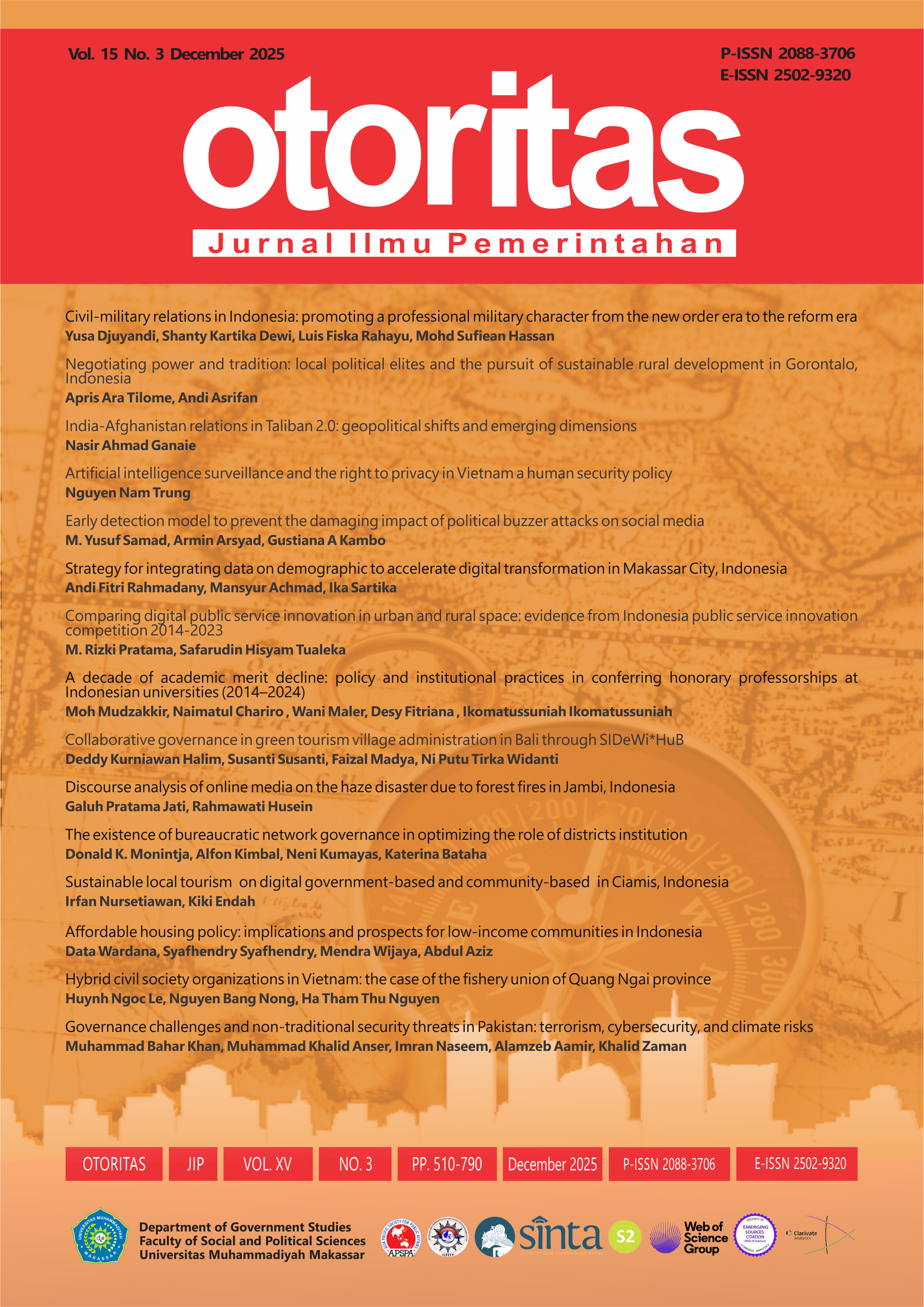
Comparing digital public service innovation in urban and rural space: evidence from Indonesia public service innovation competition 2014-2023
DOI:
https://doi.org/10.26618/ojip.v15i3.17703Keywords:
digital public service, innovation, urban, ruralAbstract
This study examines the landscape of digital public service innovation in Indonesia, focusing on a comparison of developments in urban and rural local governments from 2014 to 2023. Using a comparative approach integrated with a systematic search strategy guided by the PRISMA flowchart, this study analyzed 990 documents from the Ministry of Administrative and Bureaucratic Reform's innovation competition, with 170 documents meeting the inclusion criteria based on the title and description of digital public service innovations and the level of government for in-depth content analysis. Findings reveal distinct patterns in digital public service innovation. Local governments show a stronger emphasis on interactive rather than static services, enhancing user engagement, while district governments demonstrate a gradual but growing shift toward interactive solutions. External innovations outnumber internal ones, indicating a priority on citizen-oriented services, yet raising concerns about institutional digital capacity. Furthermore, independent innovation dominates over collaborative efforts, reflecting a lack of cross-sector collaboration in digital governance. This finding highlights the need for a balanced approach that integrates interactivity with accessibility, strengthens internal digital capacity, and encourages collaborative innovation. The study is limited by its reliance on secondary competition data, which may overlook informal initiatives, as well as interpretive bias in document-based categorization. It also does not analyze causal mechanisms such as leadership or bureaucratic culture, and its focus on Indonesia limits its generalizability. Future research should employ qualitative and cross-country comparative methods to deepen and broaden the findings.
References
Al-Sobhi, F., Weerakkody, V., & El-Haddadeh, R. (2012). Building Trust in E-Government Adoption through an Intermediary Channel: International Journal of Electronic Government Research, 8(2), 91–106. https://doi.org/10.4018/jegr.2012040105
Anshari, M., & Hamdan, M. (2023). Enhancing e-government with a digital twin for innovation management. Journal of Science and Technology Policy Management, 14(6), 1055–1065. https://doi.org/10.1108/JSTPM-11-2021-0176
Attour, A., & Chaupain-Guillot, S. (2020). Digital Innovations in Public Administrations: Technological or Policy Innovation Diffusion?: Journal of Innovation Economics & Management, n° 31(1), 195–219. https://doi.org/10.3917/jie.pr1.0061
Bharosa, N., Meijer, K., & Van Der Voort, H. (2020). Innovation in Public Service Design: Developing a co-creation tool for public service innovation journeys. The 21st Annual International Conference on Digital Government Research, 275–284. https://doi.org/10.1145/3396956.3396981
Bretschneider, S. (2004). “Best Practices” Research: A Methodological Guide for the Perplexed. Journal of Public Administration Research and Theory, 15(2), 307–323. https://doi.org/10.1093/jopart/mui017
Callens, C. (2023). User Involvement as a Catalyst for Collaborative Public Service Innovation. Journal of Public Administration Research and Theory, 33(2), 329–341. https://doi.org/10.1093/jopart/muac030
Callens, C., & Verhoest, K. (2024). Unlocking the process of collaborative innovation—Combining mechanisms of divergence and convergence. Public Management Review, 26(7), 1849–1870. https://doi.org/10.1080/14719037.2023.2171096
Carlsson, F., Matteby, M., Magnusson, J., & Berbyuk Lindstrom, N. (2023). Collective digital transformation: Institutional work in municipal collaboration. Proceedings of the 24th Annual International Conference on Digital Government Research, 583–592. https://doi.org/10.1145/3598469.3598536
Cinar, E., Demircioglu, M. A., Acik, A. C., & Simms, C. (2024). Public sector innovation in a city state: Exploring innovation types and national context in Singapore. Research Policy, 53(2), 104915. https://doi.org/10.1016/j.respol.2023.104915
Cinar, E., Simms, C., Trott, P., & Demircioglu, M. A. (2024). Public sector innovation in context: A comparative study of innovation types. Public Management Review, 26(1), 265–292. https://doi.org/10.1080/14719037.2022.2080860
Cunningham, P., Cunningham, M., Europäische Kommission, & Institute of Electrical and Electronics Engineers (Eds.). (2011). IST-Africa Conference proceedings, 2011: 11 - 13 May 2011, Gaborone, Botswana. IEEE.
Daßler, L., Hein, A., & Krcmar, H. (2024). Innovating Public Services: Drivers and Challenges of Innovation Labs in the Co-Production of E-Government Services. Proceedings of the 25th Annual International Conference on Digital Government Research, 711–720. https://doi.org/10.1145/3657054.3657138
Datta, P., Walker, L., & Amarilli, F. (2020). Digital transformation: Learning from Italy’s public administration. Journal of Information Technology Teaching Cases, 10(2), 54–71. https://doi.org/10.1177/2043886920910437
European Court of Auditors. (2022). LEADER and community-led local development facilitates local engagement but additional benefits still not sufficiently demonstrated. European Court of Auditors. https://www.eca.europa.eu/Lists/ECADocuments/SR22_10/SR_Leader_EN.pdf#page=3.10
European Parliamentary Research Service. (2021). Smart villages: Concept, issues and prospects for EU rural areas. European Parliamentary Research Service. https://www.europarl.europa.eu/RegData/etudes/BRIE/2021/689349/EPRS_BRI%282021%29689349_EN.pdf?
Eynon, R., & Dutton, W. H. (2007). Barriers to Networked Governments: Evidence from Europe 1. Prometheus, 25(3). https://doi.org/10.1080/08109020701531361
Gebrihet, H. G., & Pillay, P. (2021). Emerging Challenges and Prospects of Digital Transformation and Stakeholders Integration in Urban Land Administration in Ethiopia. Global Journal of Emerging Market Economies, 13(3), 341–356. https://doi.org/10.1177/09749101211034097
Hadi, A. (2018). Bridging Indonesia’s Digital Divide: Rural-Urban Linkages? Jurnal Ilmu Sosial Dan Ilmu Politik, 22(1), 17. https://doi.org/10.22146/jsp.31835
Hamidi, S., & Zandiatashbar, A. (2019). Does urban form matter for innovation productivity? A national multi-level study of the association between neighbourhood innovation capacity and urban sprawl. Urban Studies, 56(8), 1576–1594. https://doi.org/10.1177/0042098018767002
Hartley, J. (2005). Innovation in governance and public services: Past and present. Public Money and Management, 25(1), 27–34. https://doi.org/10.1111/j.1467-9302.2005.00447.x
Hening, P., & Kumara, G. H. (2019). Public Sector Transformation in the Digital Age: Obstacles and Challenges for the Government of Indonesia. Iapa Proceedings Conference, 75. https://doi.org/10.30589/proceedings.2019.223
Hien, B. N., Tuyen, N. T. K., Lan, N. T., Ngan, N. T. K., & Thanh, N. N. (2024). The Impact of Digital Government Initiatives on Public Value Creation: Evidence from Ho Chi Minh City –Vietnam. Revista de Gestão Social e Ambiental, 18(2), e04892. https://doi.org/10.24857/rgsa.v18n2-092
Ji, X., Wang, K., Xu, H., & Li, M. (2021). Has Digital Financial Inclusion Narrowed the Urban-Rural Income Gap: The Role of Entrepreneurship in China. Sustainability, 13(15), 8292. https://doi.org/10.3390/su13158292
Kusumasari, B., Pramusinto, A., Santoso, A. D., & Fathin, C. A. (2019). What Shapes Public Sector Innovation? Public Policy and Administration, 18(4), 430–446. https://doi.org/10.13165/VPA-19-18-4-05
Mas-Verdú, F., Ortiz-Miranda, D., & García-Álvarez-Coque, J. M. (2016). Examining organizational innovations in different regional settings. Journal of Business Research, 69(11), 5324–5329. https://doi.org/10.1016/j.jbusres.2016.04.132
Menon, S. (2024). Technology-Enabled Self-Governing Models for the Digital World. In P. Shroff-Mehta, Jagdish. N. Sheth, J. Garrison, & S. R. Mehta, The Routledge Handbook of Global and Digital Governance Crossroads (1st ed., pp. 348–360). Routledge India. https://doi.org/10.4324/9781003316077-27
Mihai, P. D., Liviu, T., & Maria, N. (2022). E-Government and the General Population’s Digital Skills in the European Union and OECD Member States. In A. M. Dima & M. Kelemen (Eds.), Digitalization and Big Data for Resilience and Economic Intelligence (pp. 41–53). Springer International Publishing. https://doi.org/10.1007/978-3-030-93286-2_3
Milakovich, M. E. (2021). Digital Governance: Applying Advanced Technologies to Improve Public Service (2nd ed.). Routledge. https://doi.org/10.4324/9781003215875
Misra, A., Misra, D. P., Mahapatra, S. S., & Biswas, S. (2018). Digital transformation model: Analytic approach on participatory governance & community engagement in India. Proceedings of the 19th Annual International Conference on Digital Government Research: Governance in the Data Age, 1–7. https://doi.org/10.1145/3209281.3209359
Muluk, M. R. K., Pratama, M. R., & Muzaqi, A. H. (2021). The Landscape of Inclusive Public Service Innovation in Indonesian Local Government: 3rd Annual International Conference on Public and Business Administration (AICoBPA 2020), Bogor, Indonesia. https://doi.org/10.2991/aebmr.k.210928.090
Munandar, Tb., Harsiti, H., Malik, A., Satriawan, K., & Afandi, A. (2018). A Literature Study: The Concept of Smart City between Municipal vs. Regency (Between Efficiency, Habitability, and Local Wisdom). Proceedings of the The 1st International Conference on Computer Science and Engineering Technology Universitas Muria Kudus. The 1st International Conference on Computer Science and Engineering Technology Universitas Muria Kudus, Kudus, Indonesia. https://doi.org/10.4108/eai.24-10-2018.2280608
OECD. (2003). The e-Government Imperative. OECD. https://doi.org/10.1787/9789264101197-en
OECD. (2022). Unlocking Rural Innovation. OECD. https://doi.org/10.1787/9044a961-en
Pradana, I. P. Y. B., Kumorotomo, W., & Susanto, E. (2023). The Institutionalization of Public Innovation: Evidence from Indonesia. Administration & Society, 55(4), 726–751. https://doi.org/10.1177/00953997231151438
Prasetyanti, Retnayu & Susilatun, Hamidah Rosidanti. (2020). Innovating Rural: A Comparative Analysis of Community-Driven Rural Innovation in North Sumatera and Yogyakarta, Indonesia. IJICC, 11(2). https://ijicc.net/index.php/ijicc-editions/2020/153-vol-11-iss-2
Prasojo, Eko & Holidin, Defny. (2013). Rethinking Problematic Governance of Local Government in New Proliferated Regions and Their Impacts. Bisnis & Birokrasi: Jurnal Ilmu Administrasi Dan Organisasi, 19(2), 149–152. https://doi.org/10.20476/jbb.v19i2.1889
Pratama, A. B. (2019). The landscape of public service innovation in Indonesia. Innovation & Management Review. https://doi.org/10.1108/INMR-11-2018-0080
Pratama, M. R., Rosidah, A. M., & Kusumaningtyas, S. (2023). Comparing Best Practice Public Service Innovation in East Java: Type, Distribution, and Consequences. Journal of Governance, 8(1). https://doi.org/10.31506/jog.v8i1.17765
Pratama, M. R., Tualeka, S. H., & Prasetya, A. (2024). Symphony of Digital Public Service Innovation in Indonesia: Evidence from Indonesia Public Service Innovation Competition 2014-2022. Jurnal Studi Pemerintahan, 21–42. https://doi.org/10.18196/jsp.v15i1.342
Rath, B. N. (2016). Does the digital divide across countries lead to convergence? New international evidence. Economic Modelling, 58, 75–82. https://doi.org/10.1016/j.econmod.2016.05.020
Ravšelj, D., Umek, L., Todorovski, L., & Aristovnik, A. (2022). A Review of Digital Era Governance Research in the First Two Decades: A Bibliometric Study. Future Internet, 14(5), 126. https://doi.org/10.3390/fi14050126
Rekunenko, I., Koldovskyi, A., Hordiienko, V., Yurynets, O., Abu Khalaf, B., & Ktit, M. (2025). Technology adoption in government management: Public sector transformation analysis. Journal of Governance and Regulation, 14(1), 150–160. https://doi.org/10.22495/jgrv14i1art14
Roziqin, A., Kamil, M., Romadhan, Ach. A., & Zakaria, I. (2024). The dark side of local public sector innovation: Insights from SAMPADE innovation. Journal of Science and Technology Policy Management. https://doi.org/10.1108/JSTPM-01-2024-0001
Seyfang, G., & Smith, A. (2007). Grassroots innovations for sustainable development: Towards a new research and policy agenda. Environmental Politics, 16(4), 584–603. https://doi.org/10.1080/09644010701419121
Sigurjonsson, T. O., Jónsson, E., & Gudmundsdottir, S. (2024). Sustainability of Digital Initiatives in Public Services in Digital Transformation of Local Government: Insights and Implications. Sustainability, 16(24), 10827. https://doi.org/10.3390/su162410827
Sørensen, E., & Torfing, J. (2016). Collaborative Innovation in the Public Sector. In J. Torfing & P. Triantafillou (Eds.), Enhancing Public Innovation by Transforming Public Governance (1st ed., pp. 117–138). Cambridge University Press. https://doi.org/10.1017/CBO9781316105337.006
Suchitwarasan, C., Cinar, E., Simms, C., & Kim, J. (2023). Public sector innovation for sustainable development goals: A comparative study of innovation types in Thailand and Korea. Australian Journal of Public Administration, 1467-8500.12619. https://doi.org/10.1111/1467-8500.12619
Sujarwoto, S., Augia, T., Dahlan, H., Sahputri, R. A. M., Holipah, H., & Maharani, A. (2022). COVID-19 Mobile Health Apps: An Overview of Mobile Applications in Indonesia. Frontiers in Public Health, 10, 879695. https://doi.org/10.3389/fpubh.2022.879695
Sutriadi, R., Fahmi, F. Z., Arifianto, A., & Muttaqin, F. I. (2022). Role of government and society in urban innovation system: A case study from Indonesia. IOP Conference Series: Earth and Environmental Science, 1015(1), 012020. https://doi.org/10.1088/1755-1315/1015/1/012020
Van Ostaijen, M., & Jhagroe, S. (2022). Making Public Administration great again. Policy Design and Practice, 5(3), 261–275. https://doi.org/10.1080/25741292.2022.2101258
Wohlers, T. E., & Bernier, L. L. (2016). Conclusion. In T. E. Wohlers & L. L. Bernier, Setting Sail into the Age of Digital Local Government (Vol. 21, pp. 105–111). Springer US. https://doi.org/10.1007/978-1-4899-7665-9_8
Yin, X., Chen, J., & Li, J. (2022). Rural innovation system: Revitalize the countryside for a sustainable development. Journal of Rural Studies, 93, 471–478. https://doi.org/10.1016/j.jrurstud.2019.10.014
Yuan, Q. (2024). Promoting Multi-actor Collaboration for New Online Service during Public Health Emergency: Roles of an Innovation Lab at Local Government. Proceedings of the 17th International Conference on Theory and Practice of Electronic Governance, 81–87. https://doi.org/10.1145/3680127.3680145
Zhang, M., & Kaur, M. (2024). Toward a theory of e-government: Challenges and opportunities, a literature review. Journal of Infrastructure, Policy and Development, 8(10), 7707. https://doi.org/10.24294/jipd.v8i10.7707
Downloads
Published
Issue
Section
License
Copyright (c) 2025 Otoritas : Jurnal Ilmu Pemerintahan

This work is licensed under a Creative Commons Attribution-ShareAlike 4.0 International License.
The Editorial Team of Otoritas: Jurnal Ilmu Pemerintahan reserves the right to transfer the copyright of the article once it has been accepted and a decision has been made to publish it.
Department of Government Studies, Faculty of Social and Political Sciences, Universitas Muhammadiyah Makassar in collaboration with Muhammadiyah’s College Association of Government Studies (AIPPTM) and Asia Pacific Society for Public Affairs (APSPA) as the publisher of Otoritas: Jurnal Ilmu Pemerintahan holds the copyright of all articles published in this journal.
The Publisher holds the right to reproduce and distribute the article and author is not allowed to publish the same article published in this journal.
Statement of Authenticity and Manuscript Copyright can be downloaded: here
After filling in the statement letter, please send via e-mail: otoritas@unismuh.ac.id